<?xml version="1.0" encoding="utf-8"?><feed xmlns="http://www.w3.org/2005/Atom" ><generator uri="https://jekyllrb.com/" version="3.10.0">Jekyll</generator><link href="https://zijianchen.ca/feed.xml" rel="self" type="application/atom+xml" /><link href="https://zijianchen.ca/" rel="alternate" type="text/html" /><updated>2026-03-10T02:15:46+00:00</updated><id>https://zijianchen.ca/feed.xml</id><title type="html">Zijian Chen</title><subtitle>Student researcher, University of Waterloo</subtitle><author><name>Zijian Chen</name><email>s42chen@uwaterloo.ca</email></author><entry><title type="html">Why Should You Watch Movies With Sound?</title><link href="https://zijianchen.ca/posts/movies-and-soundtracks/" rel="alternate" type="text/html" title="Why Should You Watch Movies With Sound?" /><published>2025-04-27T00:00:00+00:00</published><updated>2025-04-27T00:00:00+00:00</updated><id>https://zijianchen.ca/posts/movies-and-soundtracks</id><content type="html" xml:base="https://zijianchen.ca/posts/movies-and-soundtracks/"><![CDATA[<style>
/* Custom header sizing for this page only */
h1 {
  font-size: 2.2em !important;
  margin-top: 1.5em !important;
  margin-bottom: 0.8em !important;
}

h2 {
  font-size: 1.8em !important;
  margin-top: 1.3em !important;
  margin-bottom: 0.7em !important;
}

h3 {
  font-size: 1.5em !important;
  margin-top: 1.2em !important;
  margin-bottom: 0.6em !important;
}

h4 {
  font-size: 1.3em !important;
  margin-top: 1.1em !important;
  margin-bottom: 0.5em !important;
}

h5 {
  font-size: 1.1em !important;
  margin-top: 1em !important;
  margin-bottom: 0.4em !important;
}

h6 {
  font-size: 1em !important;
  margin-top: 0.9em !important;
  margin-bottom: 0.3em !important;
}

/* Dark mode compatibility */
@media (prefers-color-scheme: dark) {
  h1, h2, h3, h4, h5, h6 {
    color: inherit;
  }
}

.dark h1, .dark h2, .dark h3, .dark h4, .dark h5, .dark h6,
[data-theme="dark"] h1, [data-theme="dark"] h2, [data-theme="dark"] h3, 
[data-theme="dark"] h4, [data-theme="dark"] h5, [data-theme="dark"] h6,
body.dark-mode h1, body.dark-mode h2, body.dark-mode h3, 
body.dark-mode h4, body.dark-mode h5, body.dark-mode h6 {
  color: inherit;
}
</style>

<p>Being born as an “older” Generation Z, I was fortunate to grow up without iPads and smartphones for the first decade of my life. However, kids are naturally drawn to screens; for young me, it was the movie theater.</p>

<p>I’m not sure if you’ve ever been trapped in a highly restrained, dark, noisy, and crowded space for 14 hours straight, but I’m sure you have if you’ve ever flown from Canada to Asia. What made it worse was when the flight attendant cheerfully informed passengers that they no longer provided earphones; apparently, budget cuts had reached new heights at 30,000 feet. That’s how I gained my first thorough understanding of how utterly lifeless a movie can be without sound. Watching Tom Cruise’s lips move silently while he presumably saved the world was, in some sense, more confusing than inspiring.</p>

<p>This experience motivated my exploration into film music. The University of Waterloo offers <a href="https://uwaterloo.ca/music/sites/default/files/uploads/files/music_246_-_s._wood_-_w22_-_accessible.pdf">a fascinating course on soundtracks</a>, taught by professional film score composer Simon Wood. As an avid music history enthusiast, this course not only satisfied my curiosity about film score history, but also revealed the various connections between modern pop music and motion pictures. If you’re interested, I have a separate <a href="https://wu-ming233.github.io/posts/pop-music-history/">post on modern pop music history</a>.</p>

<p>This document, adapted from my course notes, presents a journey through the evolution of film music, from the silent era’s live accompaniments to today’s hybrid orchestral scores. We’ll explore how composers like Max Steiner, Bernard Herrmann, and Hans Zimmer shaped the language of cinema, and discover how music doesn’t just accompany films, but fundamentally transforms how we experience stories on screen.</p>

<hr />

<p>Though often referred to as “soundtracks,” this exploration focuses primarily on “scores”—instrumental music crafted specifically for films. It’s worth noting that a great score isn’t always great music in isolation; its true power lies in how it enhances a scene, not in standing alone as a masterpiece to win a Grammy. Interestingly, modern music and film emerged around the same time, and they complement each other ever since. To set the stage, we’ll begin with a broad preview of key concepts and examples, revisiting each in greater depth later.</p>

<hr />

<h2 id="assorted-ideas">Assorted Ideas</h2>

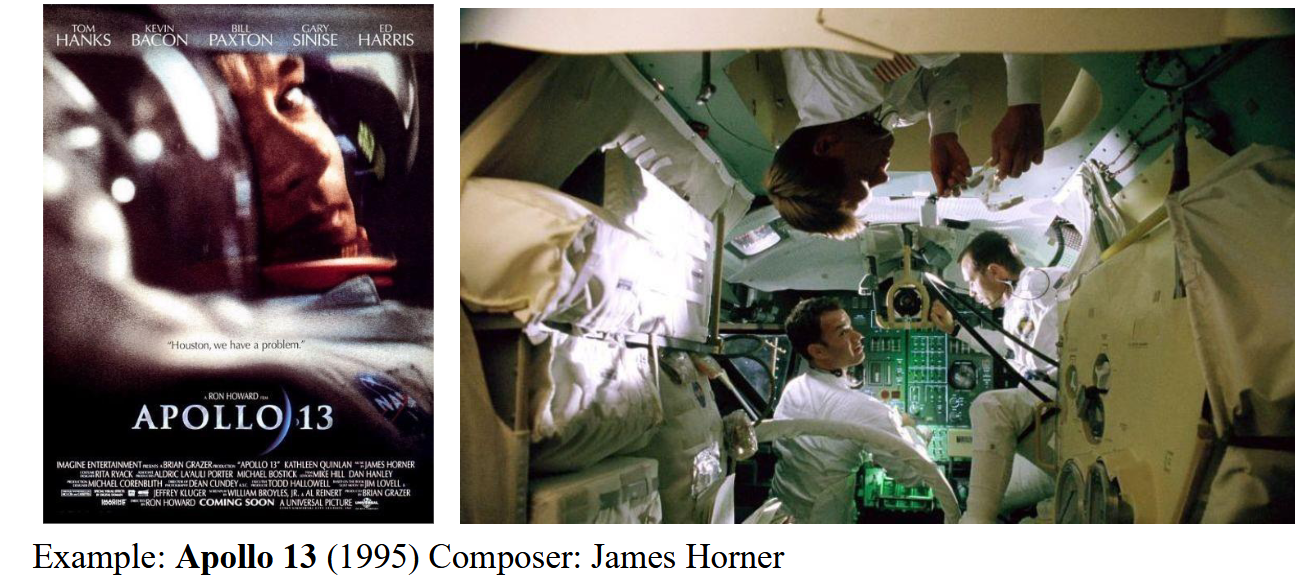
<h3 id="our-first-scene-apollo-13-1995">Our First Scene: <em>Apollo 13</em> (1995)</h3>
<p><img src="/images/music246/Pasted image 20250109201208.png" alt="" /></p>

<p><mark style="background: #FFB8EBA6;">James Horner</mark>, a brilliant composer we’ll encounter frequently, tragically died a few years ago when he crashed his personal jet into a mountain. <em>Apollo 13</em> focuses on the third lunar mission. Since it was the third attempt, the public had largely lost interest in moon landings, making it an interesting choice for Hollywood drama. The film follows three astronauts who used mathematical ingenuity to survive when everything went wrong.</p>

<h4 id="scene-1-wife-showering">Scene 1: Wife Showering</h4>
<p>An astronaut’s wife grapples with anxiety about her husband’s upcoming moon trip. She’s convinced that Apollo “13” is cursed, and when her wedding ring slips off and goes missing, she takes it as an ominous sign that she might lose her husband.</p>

<h4 id="scene-2-astronauts-getting-ready">Scene 2: Astronauts Getting Ready</h4>
<p>Cut to the three astronauts suiting up while technicians meticulously check every piece of equipment. The tension builds as we transition to the launch site, where history is about to unfold.</p>

<hr />

<h4 id="cues-not-songs">Cues, Not Songs</h4>
<p>The music here is called a <mark style="background: #FFB8EBA6;">cue</mark>, not a song. Let’s reserve “song” for when someone’s actually singing. A cue is music crafted specifically for a film scene, designed to <strong>synchronize</strong> perfectly with what’s happening on screen.</p>

<h4 id="effects-of-music">Effects of Music</h4>
<p>We watched these <em>Apollo 13</em> scenes twice: first in silence, then with sound. Since there’s minimal dialogue, the music’s impact became crystal clear:</p>

<ol>
  <li><strong>Scene Transitions</strong>: Without music, jumping from one scene to another feels jarring. The music creeps in at the end of the first scene, gradually building volume and creating anticipation that makes the transition smooth. This can happen three ways:
    <ul>
      <li>Music starts <em>before</em> the transition, building expectations so the shift feels natural</li>
      <li>Music hits <em>right at</em> the transition; perfect for shocking the audience or delivering jump scares</li>
      <li>Music enters <em>after</em> the transition, often following something dramatic like a death, giving audiences a moment to process before the emotional guidance resumes</li>
    </ul>
  </li>
  <li>
    <p><strong>Intimacy in Silence</strong>: The shower scene is mostly music-free, and for good reason. Add music here and it becomes overly dramatic. Without it, you focus on the wife’s actual emotions rather than what the composer wants you to feel. This silence also creates breathing room before eight minutes of intense musical drama. <strong>Where music isn’t can be just as important as where it is</strong>. Think horror movies: the real terror isn’t during the musical buildup, it’s when everything goes dead quiet right before the scare.</p>
  </li>
  <li>
    <p><strong>Emotional Ambiguity</strong>: Without music, you can’t tell what the astronauts are feeling. Nervous? Excited? The visuals alone leave you guessing.</p>
  </li>
  <li>
    <p><strong>Instrumentation and Symbolism</strong>: The astronaut preparation music features <em>brass</em> and <em>synthesizer bass</em>. Brass evokes military strength; historically chosen because it doesn’t shatter like violins during combat. Most early astronauts were military, so it also signals heroism and sacrifice. The synthesizer bass provides a steady beat that represents technology and precision: when you’re heading to the moon, you want reliable consistency.</p>
  </li>
  <li>
    <p><strong>Musical Style</strong>: The score uses a <mark style="background: #FFB8EBA6;">chorale</mark> style (赞美诗): church hymns from the 1600s-1700s. It follows a pattern of rhythmic notes, pause, repeat, designed so regular people could sing along without running out of breath. The astronauts even extend their arms like a crucifix at one point, reinforcing the faith and sacrifice theme. This particular style is classified as “Protestant Hymn.”</p>
  </li>
  <li>
    <p><strong>Tempo</strong>: Slow and steady reinforces professionalism. A constantly changing tempo would feel too emotional for a mission requiring mathematical precision. The controlled pace signals that this is serious business.</p>
  </li>
  <li><strong>Texture Evolution</strong>: As Scene 2 wraps up, strings and woodwinds take over the same melody. This smooths the transition while adding hope and grandeur, building anticipation for the rocket launch.</li>
</ol>

<hr />

<h3 id="the-four-functions-of-film-music">The Four Functions of Film Music</h3>
<p><strong>Why include music in films?</strong></p>

<p><img src="/images/music246/Pasted image 20250109210554.png" alt="" /></p>

<p>Picture this image with happy music: instant wholesome family vibes. Now imagine it with ominous music: suddenly it’s a completely different story. Music hijacks your emotions faster than you can think.</p>

<p>Movies exist to tell stories and make you believe in them, even temporarily. They want you to achieve “<em>suspension of disbelief</em>”: that state where you forget you’re watching actors pretend in front of cameras. Even <em>Harry Potter</em> needs you to buy into the wizarding world, which is why anachronisms break the spell instantly.</p>

<p>But here’s the paradox: music completely violates this suspension of disbelief. Real life doesn’t come with a soundtrack. So why does every movie have one? Because music is simply too powerful to ignore.</p>

<p>Film music operates somewhere between “emotion” and “action”: it either makes you feel something or enhances what’s happening on screen. More specifically, it serves four main purposes, often simultaneously:</p>

<ol>
  <li>
    <p><strong>Creating Atmosphere of Time and Place</strong>: Music instantly transports you. Hear Chuck Berry, and you’re in the 1950s. Pentatonic scales evoke China (or at least Hollywood’s version of it). When characters get in a car and the music gets muffled, you know they’re hearing the radio. But this relies on audience assumptions, often centered on American perspectives, which can lead to stereotypical musical choices, especially in films before the 1950s.</p>
  </li>
  <li>
    <p><strong>Underlining or Creating Emotional/Psychological Depth</strong>: Music can support what’s obviously happening or reveal hidden subtext. Picture a cheerful party where two people smile and chat, but the music turns dark: suddenly you know these two have unresolved conflict, even if they’re acting friendly.</p>
  </li>
  <li>
    <p><strong>Providing Continuity</strong>: As <em>Apollo 13</em> showed us, without music, scene cuts feel abrupt. Movies need frequent cuts to compress time, and music acts as the glue, especially in <mark style="background: #ADCCFFA6;">montages</mark> (蒙太奇手法): those rapid sequences that compress hours into minutes. Picture a shopping montage: friend says no, friend says no, friend nods, cut to them carrying shopping bags. Without music, it’s just confusing jump cuts.</p>
  </li>
  <li>
    <p><strong>Supporting Theatrical Buildup and Finality</strong>: Music controls the emotional pacing of films. It builds tension, releases it, and provides that satisfying sense of closure when everything wraps up.</p>
  </li>
</ol>

<hr />

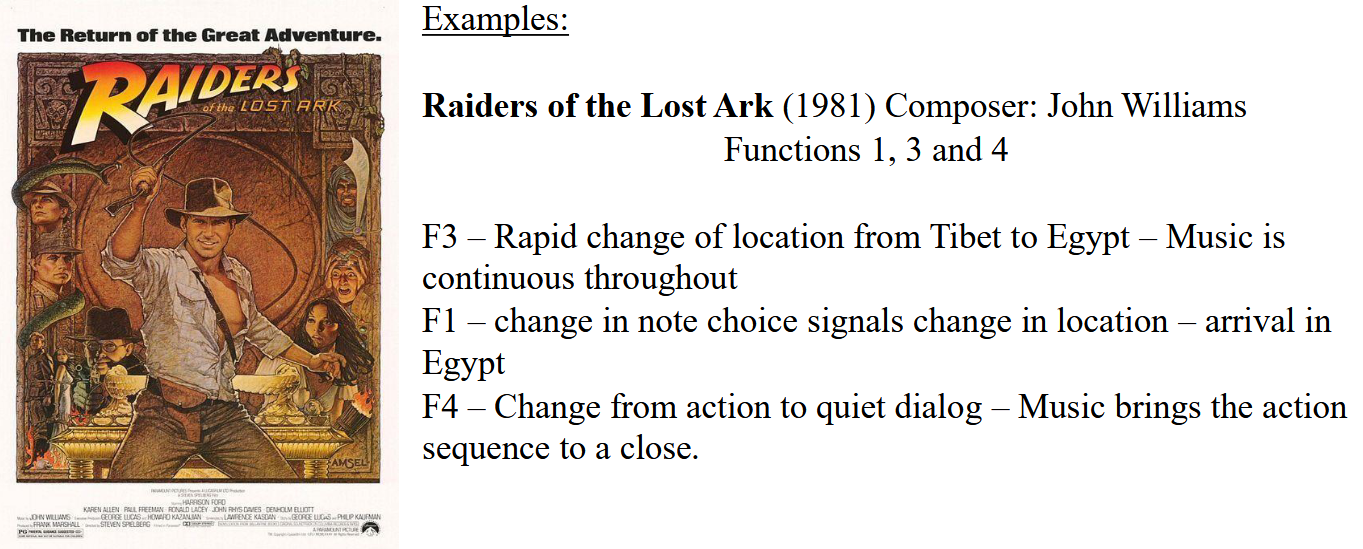
<h4 id="raiders-of-the-lost-ark-1981"><em>Raiders of the Lost Ark</em> (1981)</h4>
<p><img src="/images/music246/Pasted image 20250109215918.png" alt="" /></p>

<p>Composer: <mark style="background: #FFB8EBA6;">John Williams</mark>, a master of the craft.</p>

<p><strong>F3: Continuity</strong><br />
The film rockets from the Himalayas to Egypt in rapid succession. Music becomes the thread that keeps this geographic transition smooth.</p>

<p><strong>F1: Where and When</strong><br />
The score flows from the iconic Indiana Jones theme (major scale, appropriately heroic) to a love theme (also major, but with strings for romantic warmth) to “Egyptian” music (harmonic minor starting on the 5th degree: the “snake charmer” sound familiar to American audiences, though culturally stereotypical). The love theme hints at romance before it actually develops, demonstrating how film composers use musical foreshadowing.</p>

<p><strong>F4: Pacing</strong><br />
After an intense action sequence, the film needs to slow down for dialogue and plot development. The music mirrors this shift, cooling down from high energy to conversational.</p>

<hr />

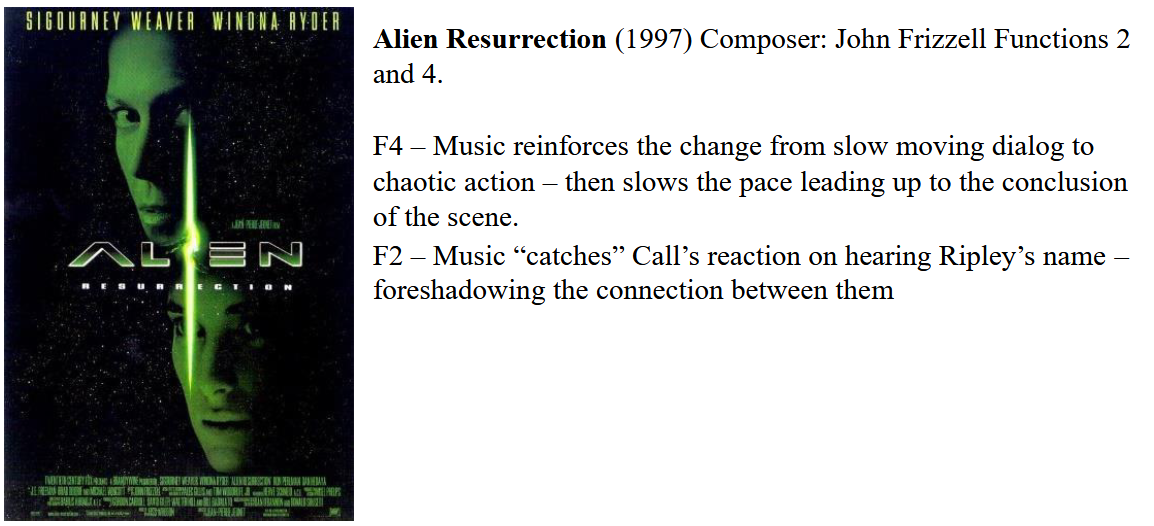
<h4 id="alien-resurrection-1997"><em>Alien Resurrection</em> (1997)</h4>
<p><img src="/images/music246/Pasted image 20250110005620.png" alt="" /></p>

<p>Composer: John Frizzell. The fourth <em>Alien</em> movie: the first two were acclaimed, the third faltered, and this one puzzles audiences but features an excellent score. It follows a woman resurrected because she carried alien queen DNA, which pirates want to weaponize.</p>

<p><strong>Scene Breakdown</strong>: The resurrected woman (now part alien) plays basketball when pirates attempt to flirt with her. She ignores them until she’s had enough, then thoroughly defeats them. The pirate boss appears, she walks away, and casually sinks a backwards shot.</p>

<p><strong>F4: Pacing</strong></p>
<ul>
  <li>Dead silence during the harassment: no music means you feel the full discomfort without emotional buffer.</li>
  <li>When she starts fighting, dark musical “clouds” roll in, but without much rhythm since everyone’s too shocked to process what’s happening.</li>
  <li>She catches the ball one-handed, and the music begins its rhythmic buildup.</li>
  <li>After she defeats the second pirate, the music cuts out to punctuate the end of the fight.</li>
  <li>It builds again when the boss arrives and questions start flying, then stops before her impossible shot so you hear nothing but the swish.</li>
</ul>

<p><strong>F2: Revealing Hidden Information</strong><br />
Call is a spy among the pirates, sent to kill Ripley (the resurrected woman), but she only knows the name, not the face. When the boss reveals she’s Ripley, Call’s reaction gets a heavy musical emphasis, foreshadowing her secret mission though the audience doesn’t know she’s a spy yet.<br />
<a href="https://www.dailymotion.com/video/x2p6o86">Watch the scene here</a></p>

<hr />

<p>This above was our “greatest hits” album. Now let’s get more systematic with proper definitions and frameworks.</p>

<h3 id="diegesis">Diegesis</h3>
<p>The <strong>diegesis</strong> (叙事) is the <em>world</em> described by the narrative. This encompasses all characters, events, and elements depicted by the film, whether <em>explicitly shown or implicitly understood</em>.</p>

<p>For example, Star Wars explicitly shows us starships, but we assume bathrooms exist on Earth within that universe even though they’re never depicted. Both are part of the diegesis.</p>

<h3 id="diegetic-music--source-music">Diegetic Music / Source Music</h3>
<p>Music whose source exists within the diegesis. The characters in the film can hear it just as the audience can. Picture a character putting on headphones while a muffled pop song plays: that’s diegetic music.</p>

<p>This is also called “<mark style="background: #FFB8EBA6;">source music</mark>,” “direct music,” or “foreground music.”</p>

<p><strong>Functions:</strong></p>
<ul>
  <li><strong>Establish time and place (F1)</strong>: A character listening to Elvis immediately signals the 1960s</li>
  <li><strong>Create realism and immediacy</strong>: Makes the world feel lived-in and authentic</li>
  <li><strong>Offer ironic commentary</strong>: Characters fighting while a child’s music box accidentally starts playing creates ironic contrast, suggesting their behavior is childish</li>
</ul>

<h3 id="nondiegetic-music--score">Nondiegetic Music / Score</h3>
<p>Music heard only by the film audience, invisible to the characters themselves. Also called “<mark style="background: #FFB8EBA6;">score</mark>,” “underscore,” or “background music.” This is where we’ll spend most of our time.</p>

<p><strong>Original Score</strong>: Music composed specifically for the film. Individual pieces are called <em>cues</em> rather than songs.</p>

<p><strong>Pre-existing Music</strong>: Selected music that wasn’t originally written for the film but works perfectly for specific scenes. Many films combine both approaches: mostly original score with strategic use of pre-existing pieces.</p>

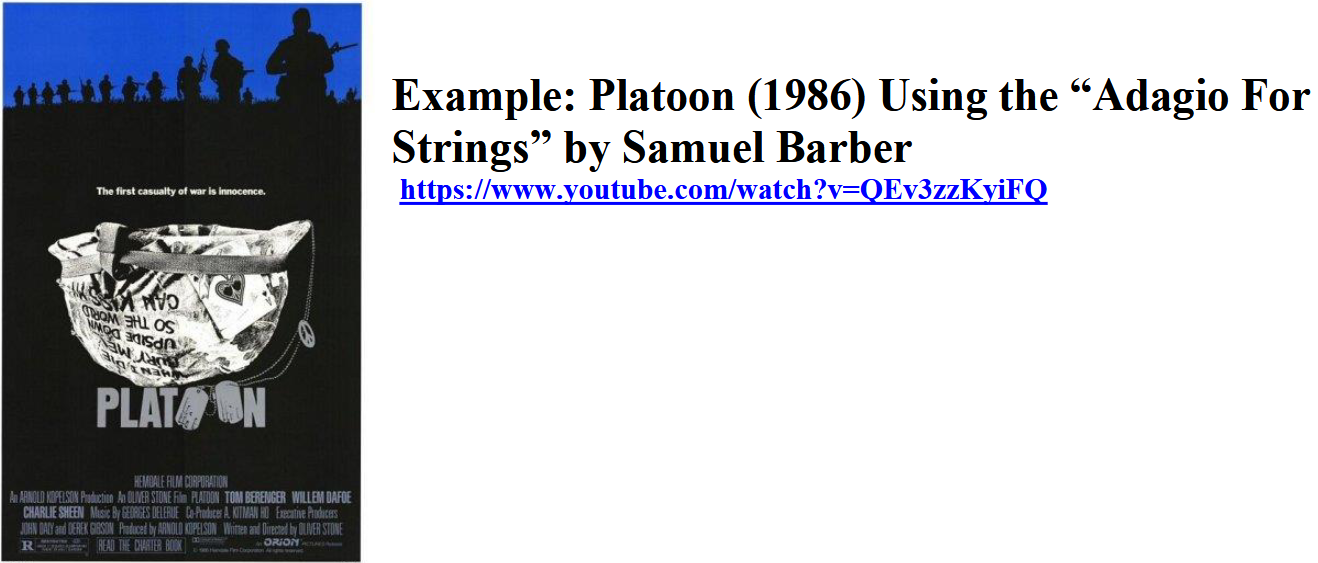
<h4 id="example-pre-existing-music-as-score-platoon-1986">Example: Pre-existing Music As Score, <em>Platoon</em> (1986)</h4>
<p><img src="/images/music246/Pasted image 20250116193108.png" alt="" /></p>

<p>Samuel Barber’s “Adagio for Strings” (1938), a classical piece, has appeared in numerous films including <em>The Elephant Man</em> (1980) and <em>Sicko</em> (2007). In <em>Platoon</em>, composer George Deleure created original scores but also incorporated Barber’s piece. Instead of intense war music, this classical selection underscores the profound sadness of loss.
<a href="https://www.youtube.com/watch?v=QEv3zzKyiFQ">Watch the scene</a></p>

<h4 id="score-vs-soundtrack">Score vs. Soundtrack</h4>
<p>Generally, scores are original compositions while soundtracks feature pre-existing pop songs. The distinction isn’t precise: everything else blurs together. Soundtrack songs might be decades old, say from the 1940s. A <em>music supervisor</em>, not a composer, selects which pop music fits each scene.</p>

<h3 id="adapted-score">Adapted Score</h3>
<p>Pre-existing music <em>reworked</em> to fit the film. Since this music wasn’t originally designed for cinema, it needs adjustment for timing, pacing, and dramatic effect. The original artist or another composer can handle the adaptation.</p>

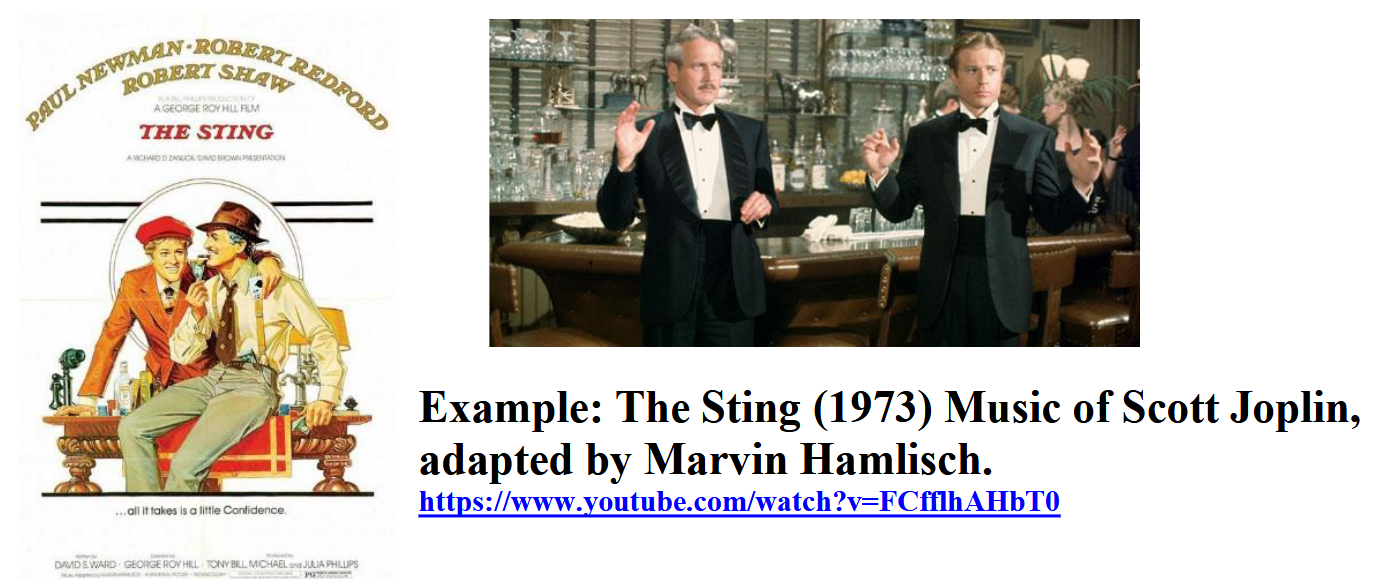
<h4 id="example-the-sting-1973-adapted-score">Example: <em>The Sting</em> (1973), Adapted Score</h4>
<p><img src="/images/music246/Pasted image 20250116194244.png" alt="" /></p>

<p><a href="https://www.youtube.com/watch?v=FCfflhAHbT0">Watch the scene</a></p>

<p>Originally composed by Scott Joplin as a ragtime classic, the music works beautifully after adaptation, though it’s historically curious: the film is set in the 1930s while ragtime peaked around 1900-1910.</p>

<h3 id="compiled-score">Compiled Score</h3>
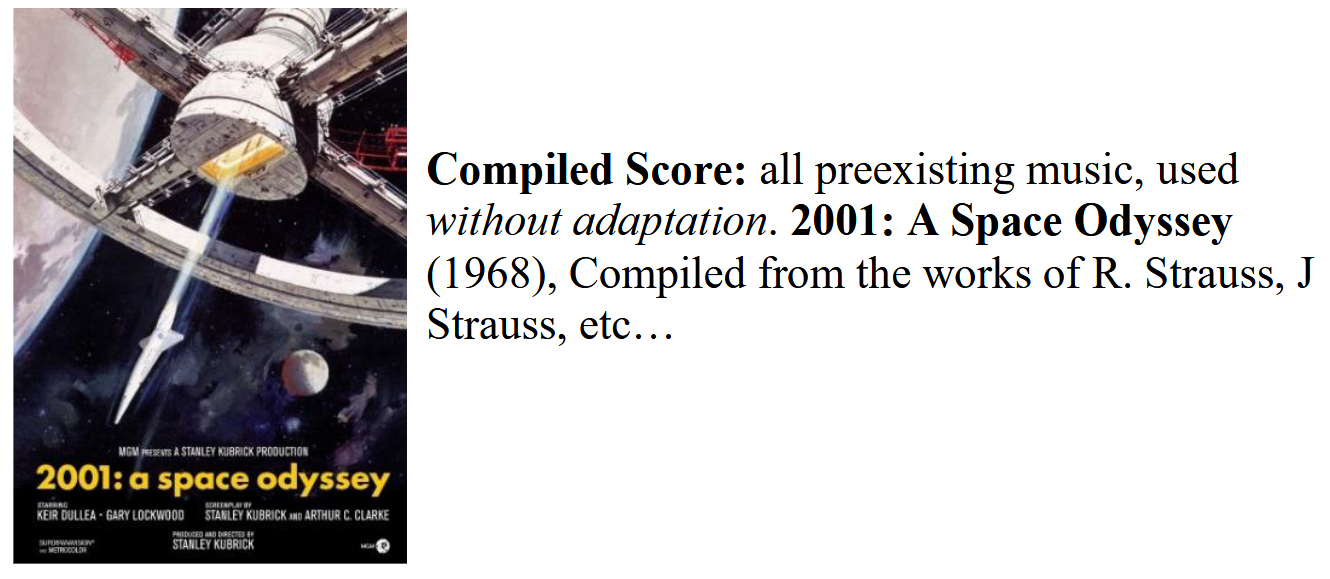
<p>Pre-existing music used <em>without adaptation</em>, straight out of the box.</p>

<h4 id="example-2001-a-space-odyssey-1968-compiled-score">Example: <em>2001: A Space Odyssey</em> (1968), Compiled Score</h4>
<p><img src="/images/music246/Pasted image 20250116194934.png" alt="" /></p>

<p>Kubrick used classical pieces as-is, creating one of cinema’s most memorable musical experiences without a single note of original composition.</p>

<hr />

<h2 id="describing-the-music">Describing the Music</h2>

<p>What <em>style</em> characterizes the music? What instruments are used (including voice as an instrument)? How do these choices relate to the film’s needs?</p>

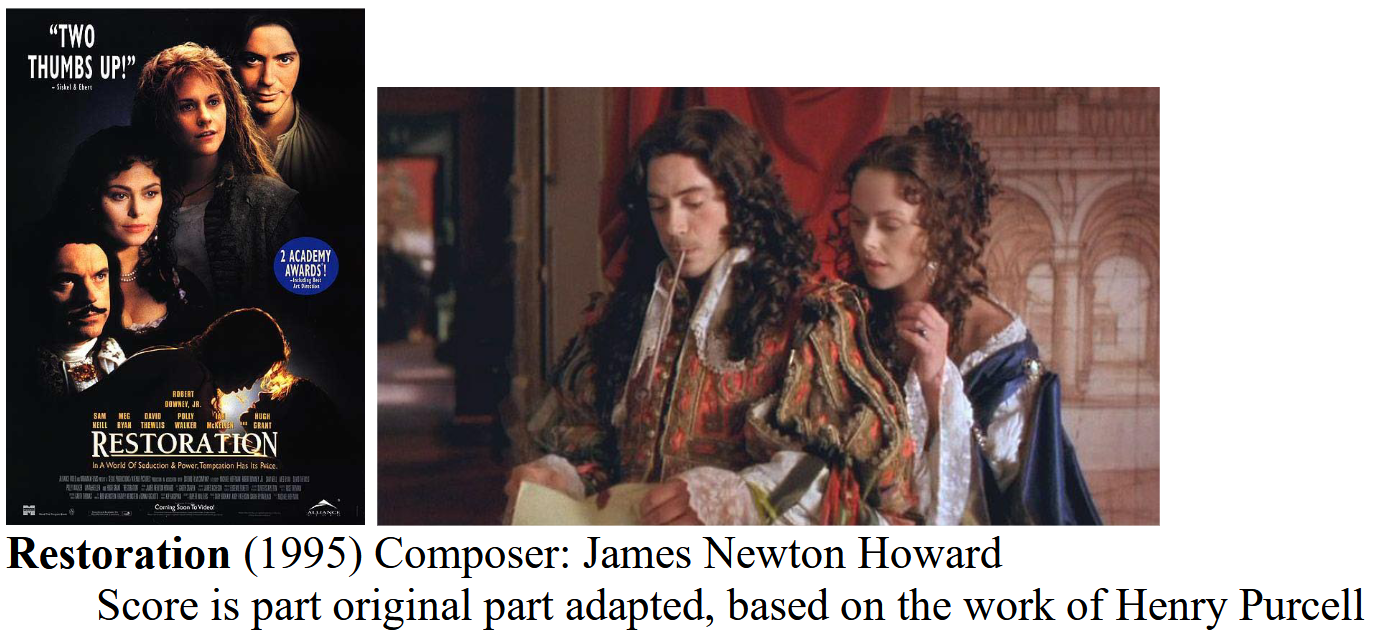
<h3 id="example-restoration-1995">Example: <em>Restoration</em> (1995)</h3>
<p><img src="/images/music246/Pasted image 20250116195321.png" alt="" /></p>

<p>Set in the 1600s, the film uses period-appropriate music, both adapted and unaltered, mostly as diegetic music. We’ll focus on Henry Purcell’s work from the late 1600s.</p>

<p>Purcell’s music exemplifies the <strong>baroque era</strong> (巴洛克风格), characterized by <em>constant dynamics and tempo throughout</em>. This reflects the 1600s emphasis on control and elegance. However, this consistency makes it problematic as film score because cinema needs F4: pacing variation and dynamic change.</p>

<p><em>James Newton Howard</em> adapted Purcell’s music, using the same repeated melody as a character climbs stairs, but with cinematic modifications.
<a href="https://www.youtube.com/watch?v=psna8iUfYWQ">Watch the adaptation</a></p>

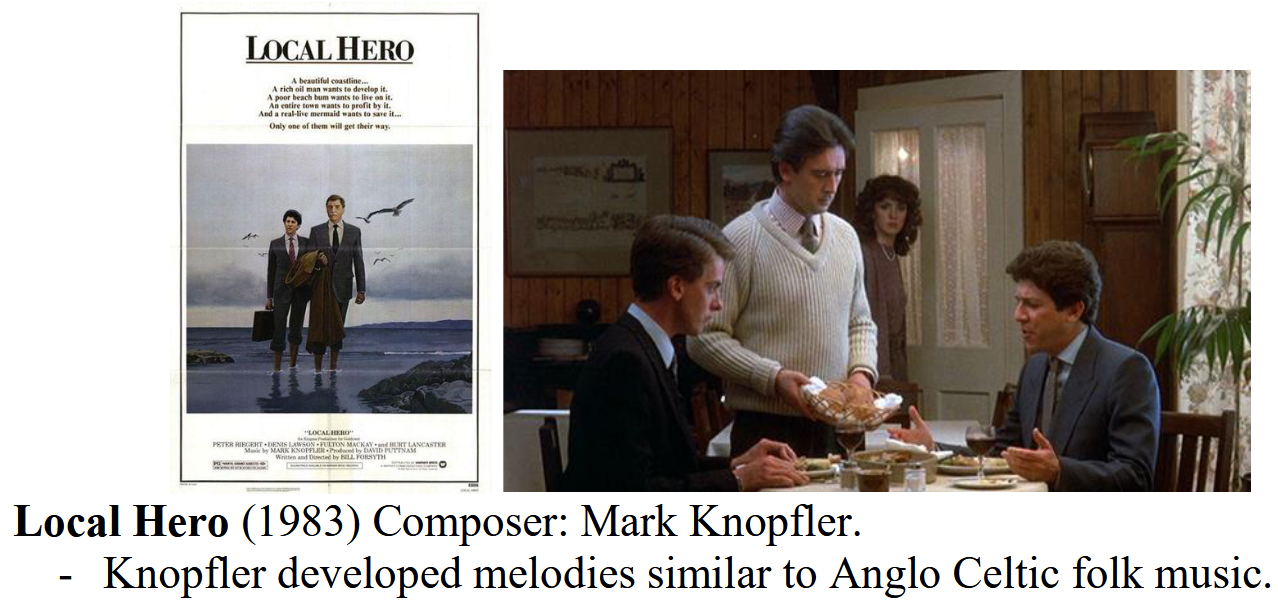
<h3 id="example-local-hero-1983">Example: <em>Local Hero</em> (1983)</h3>
<p><img src="/images/music246/Pasted image 20250116200707.png" alt="" /></p>

<p>The story follows an oil company employee sent to Scotland to convince a village to sell their land for an oil plant.</p>

<p><strong>F1</strong>: Mark Knopfler composed an original score in <em>Anglo-Celtic</em> folk style. Anglo-Celtic refers to the British Isles (England, Scotland, Ireland), and the music employs traditional Scottish elements like bagpipe melodies (风笛). This creates authentic geographical atmosphere.</p>

<p><a href="https://www.youtube.com/watch?v=hm-ZHUfCTwk">Watch the scene</a></p>

<p>This plays during the film’s peaceful resolution, a happy ending that contrasts dramatically with <em>Restoration</em>’s intensity.</p>

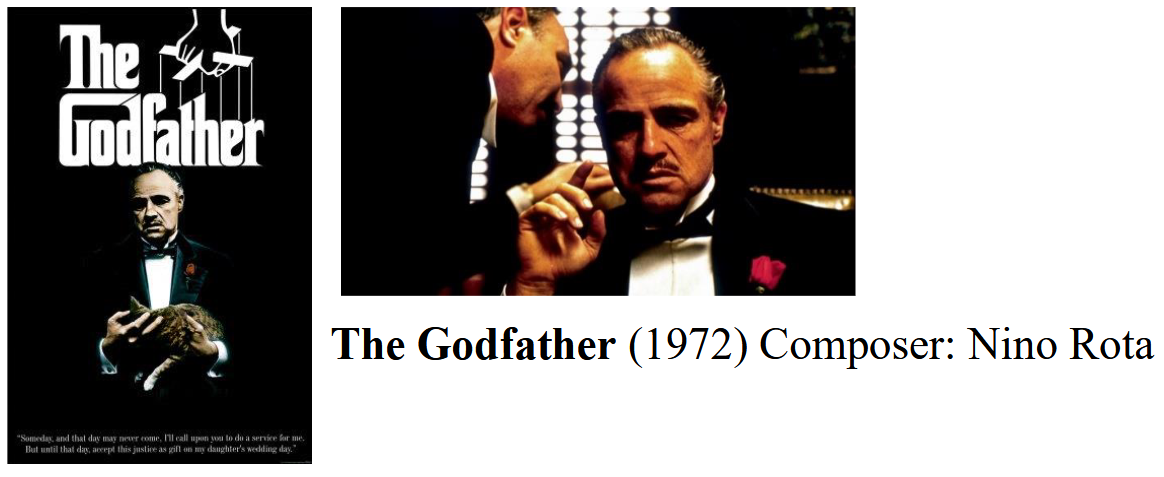
<h3 id="example-the-godfather-1972">Example: <em>The Godfather</em> (1972)</h3>
<p><img src="/images/music246/Pasted image 20250116201447.png" alt="" /></p>

<p>The story centers on an aging Sicilian gang leader, the “Godfather”, facing disrespectful young criminals from other gang families and an assassination attempt. He must choose a successor from among his sons, but his most capable son wants nothing to do with the family business.</p>

<p><strong>The Godfather Theme</strong>:</p>
<ul>
  <li><strong>Brass (trumpet) solo with echo</strong>: The solo represents the godfather’s isolation; all responsibility rests on his shoulders. The echo suggests a single voice in a vast, empty space, emphasizing loneliness.</li>
  <li><strong>Transition to trumpet with woodwinds playing waltz</strong>: The happier waltz reflects the opening scene: the godfather’s daughter’s wedding. Brass appears in traditional Sicilian wedding music, while the waltz style evokes old-fashioned traditions, mirroring the traditional gang leader himself.</li>
</ul>

<hr />

<h2 id="emotional-vs-action-music">Emotional vs. Action Music</h2>

<p>Film music generally falls between two approaches:</p>

<h3 id="1-playing-the-drama">1. Playing the Drama</h3>
<p>Music reinforces or foreshadows emotional elements within the narrative. Even if a scene appears normal, the music might be ominous, revealing hidden tension. This approach ignores momentary visual changes, camera angles, or quick cuts, focusing instead on deeper emotional currents.</p>

<h3 id="2-hitting-the-action">2. Hitting the Action</h3>
<p>Music directly underscores visual events. Car chase scenes get fierce, intense music that matches the on-screen action. This doesn’t include music that smooths editing cuts; that’s about continuity, not action.</p>

<p>Most film music combines both functions strategically.</p>

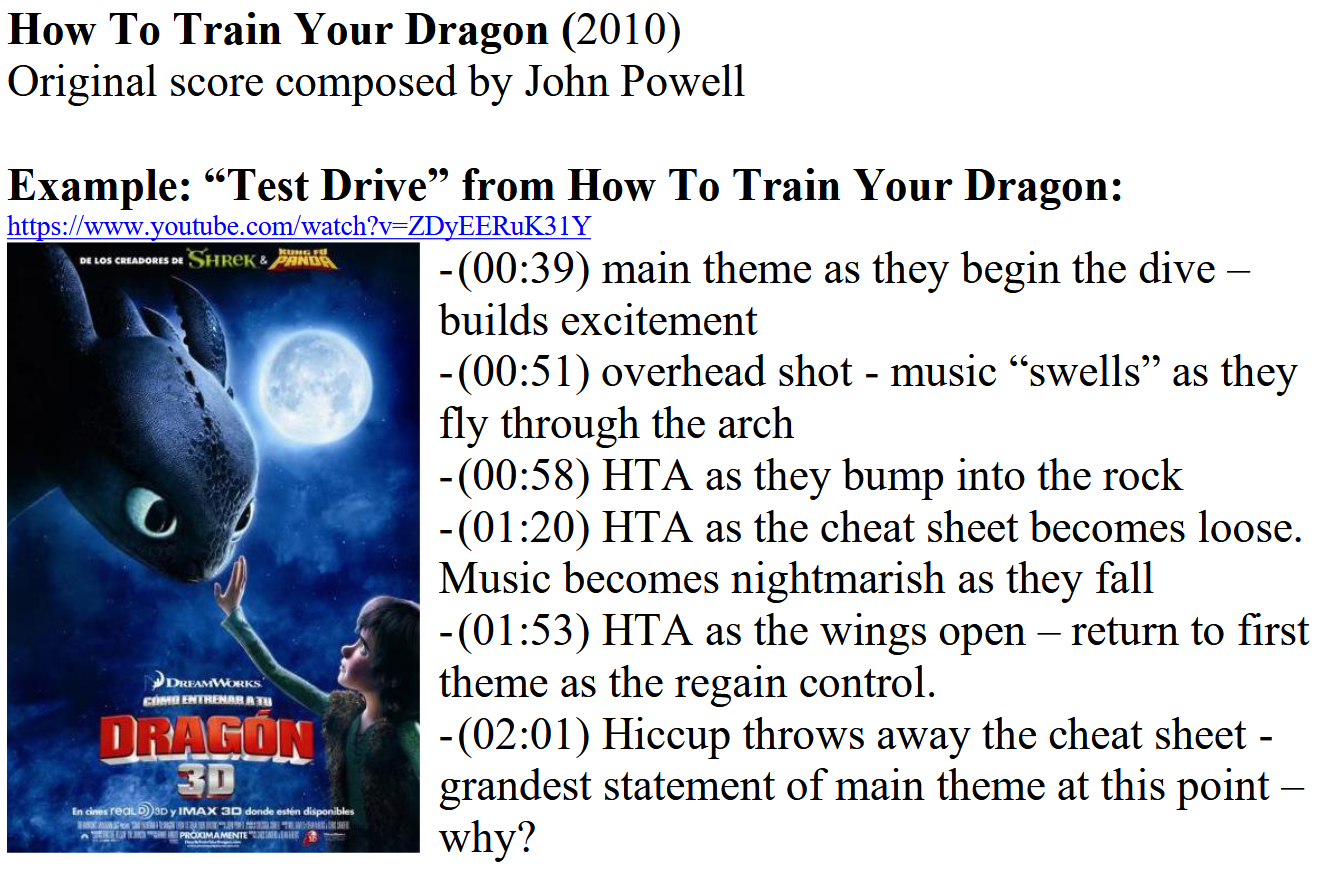
<h3 id="example-how-to-train-your-dragon-2010">Example: <em>How to Train Your Dragon</em> (2010)</h3>
<p><img src="/images/music246/Pasted image 20250116204126.png" alt="" /></p>

<p><a href="https://www.youtube.com/watch?v=ZDyEERuK31Y">Watch the scene</a></p>

<p>Scene: Hiccup takes his first ride with Toothless, using a cheat sheet to control the dragon.</p>

<ul>
  <li><strong>(00:39)</strong> Theme begins by playing the drama, capturing Hiccup’s excitement</li>
  <li><strong>(00:51)</strong> Music “swells” (激昂) during the overhead shot</li>
  <li><strong>(00:58)</strong> Hits the action when Toothless crashes into a rock (notably, this doesn’t repeat for subsequent crashes; that would become silly)</li>
  <li><strong>(01:20)</strong> HTA as the cheat sheet comes loose and Hiccup falls, the theme turning nightmarish</li>
  <li><strong>(01:53)</strong> HTA as Hiccup regains control, returning to the main theme</li>
  <li><strong>(02:01)</strong> Playing the drama: the main theme returns when Hiccup throws away the cheat sheet, trusting his instincts, symbolizing complete trust between boy and dragon</li>
</ul>

<hr />

<h2 id="musical-characteristics">Musical Characteristics</h2>

<h3 id="1-melody--theme">1. Melody / Theme</h3>
<p>Melody and theme are interchangeable here. Considered the most “recognizable” musical element, it’s common to assign specific characters, objects, or situations their own themes.</p>

<p>This isn’t new: opera has long assigned themes to characters. However, traditional opera simply repeated the same music whenever a character appeared, regardless of dramatic context.</p>

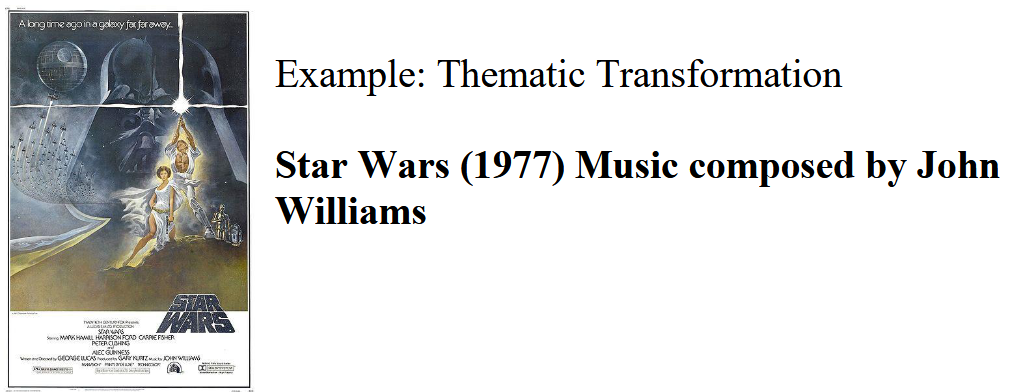
<p>German opera composer <em>Richard Wagner</em> revolutionized this with “<strong>Thematic Transformation</strong>”: themes <em>should constantly vary in response to narrative development</em>. Happy Birthday in major when joyful, Happy Birthday in minor and slower when the story turns gloomy. Wagner called this the “<em>leitmotif</em>“—we use this interchangeably with melody and theme.</p>

<h4 id="example-star-wars-1977-thematic-transformation">Example: <em>Star Wars</em> (1977), Thematic Transformation</h4>
<p><img src="/images/music246/Pasted image 20250116210725.png" alt="" /></p>

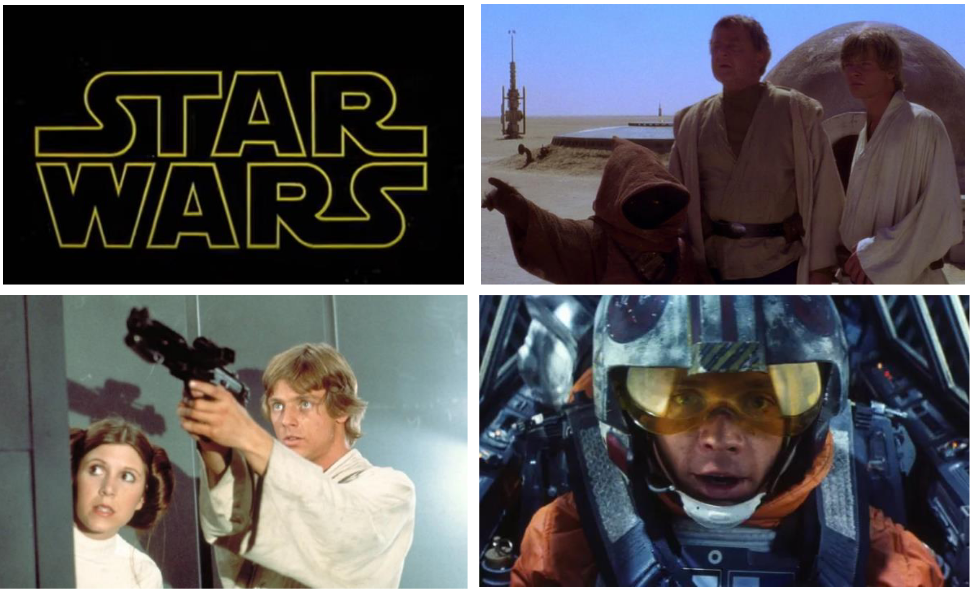
<p><mark style="background: #FFB8EBA6;">John Williams</mark> demonstrates Luke Skywalker’s theme undergoing transformation across four scenes:</p>

<p><img src="/images/music246/Pasted image 20250116210831.png" alt="" /></p>

<ul>
  <li><strong>Film opening</strong>: Grand, iconic version establishing Luke’s heroic destiny</li>
  <li><strong>Luke’s introduction on the farm</strong>: Gentle version with French Horn, reflecting his humble origins</li>
  <li><strong>Death Star escape scene</strong>: Playful, energetic version suggesting safety and adventure</li>
  <li><strong>Climactic torpedo shot</strong>: Serious, dangerous version emphasizing the high stakes</li>
</ul>

<h3 id="2-tempo--pulse">2. Tempo / Pulse</h3>
<p>Musical speed influences narrative tempo. Romantic scenes typically use slower tempos; battle scenes demand faster ones. Sound design also affects time perception: the sharp sound of a sword being drawn makes the action feel quicker.</p>

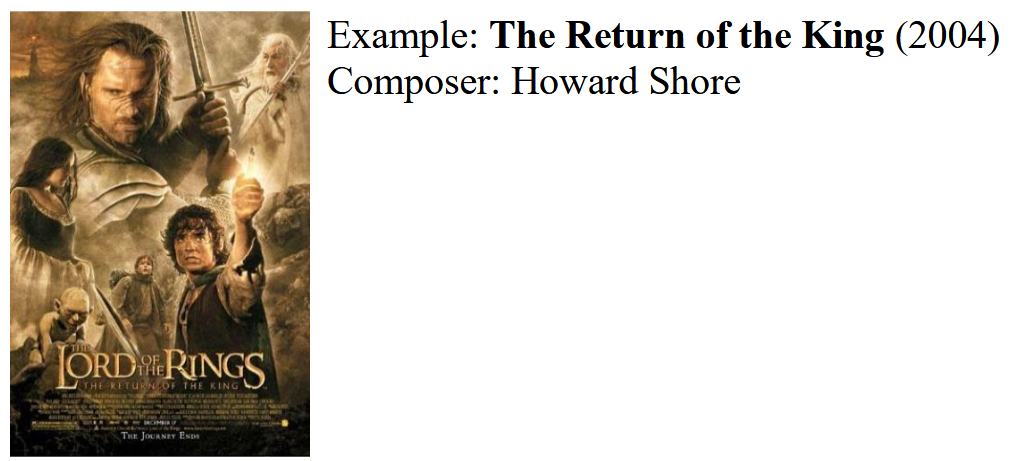
<h4 id="example-the-return-of-the-king-2004">Example: <em>The Return of the King</em> (2004)</h4>
<p><img src="/images/music246/Pasted image 20250116212147.png" alt="" /></p>

<p>This <em>Lord of the Rings</em> installment features extensive battle scenes that should feel intense and fast-paced. However, the music for this apocalyptic battle is unexpectedly slow, creating sorrowful rather than triumphant feelings.</p>

<p>This scene also blurs the line between source music and score: The king orders a hobbit to sing during dinner (source music), but as the scene shifts to the battleground, the singing continues with added echo (becoming score). As battle progresses, orchestra joins not to enhance the singing, but to create dark, chaotic atmosphere. The music cuts precisely after the enemy’s arrow volley, returning to the king finishing his meal.</p>

<h3 id="3-harmony">3. Harmony</h3>
<p>The combination of notes creates different emotional atmospheres:</p>
<ul>
  <li>Consonant or dissonant?</li>
  <li>Orderly or chaotic?</li>
  <li>Tonal or atonal?</li>
</ul>

<p>Major scales are always consonant, orderly, and tonal. These harmonic choices fundamentally shape how we perceive the diegesis.</p>

<h4 id="example-the-cider-house-rules-highly-consonant">Example: <em>The Cider House Rules</em> (Highly Consonant)</h4>
<p><img src="/images/music246/Pasted image 20250116213125.png" alt="" />
Major scale, highly consonant harmony creates lovely, safe, calm feelings.</p>

<h4 id="example-meet-joe-black-between-consonant-and-dissonant">Example: <em>Meet Joe Black</em> (Between Consonant and Dissonant)</h4>
<p><img src="/images/music246/Pasted image 20250116213500.png" alt="" />
The story follows Death asking a dying man why humans fear death, then falling in love with the man’s daughter. Some sections feel resolved and consonant while others feel dangerous and dissonant, reflecting the music’s movement between major and minor territories.</p>

<h4 id="example-aliens-dissonant">Example: <em>Aliens</em> (Dissonant)</h4>
<p><img src="/images/music246/Pasted image 20250116213744.png" alt="" />
Ripley battles aliens while trying to save a girl and reach their ship. The predominantly dissonant harmony creates uncertainty about the characters’ survival, with one brief consonant moment when the girl safely boards the ship.</p>

<hr />

<h1 id="technical-details-how-its-done">Technical Details: How It’s Done</h1>

<p>How are films actually produced?</p>

<blockquote>
  <p>Note: We don’t cover computer-animated films, which follow very different processes. Voice work happens before rendering, and the production timeline differs significantly from traditional filmmaking.</p>
</blockquote>

<h3 id="basic-timetable-of-film-production">Basic Timetable of Film Production</h3>

<h4 id="preproduction">Preproduction</h4>
<p>Gathering everything needed: script, financing, casting, costumes, location scouting, and countless other preparations.</p>

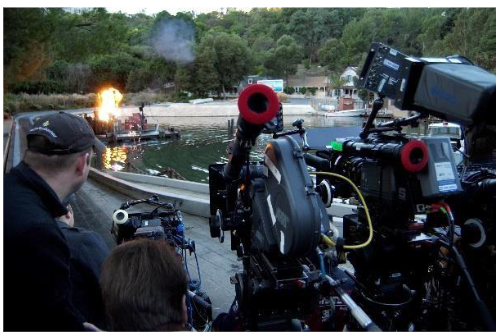
<h4 id="production">Production</h4>
<p><img src="/images/music246/Pasted image 20250123193557.png" alt="" /></p>

<p>Also called “principal photography.” This involves finalizing the script and production design, then actually shooting the film.</p>

<p><strong>Director vs. Producer</strong>: The producer handles business aspects (raising money, logistics, transportation), while the director focuses on the film’s creative vision and appearance.</p>

<h4 id="postproduction">Postproduction</h4>
<p>After “wrap” (completion of shooting), extensive work remains. Films aren’t shot in final order; all <em>editing</em> happens in postproduction. Scenes at the same location are filmed together for efficiency. The same scene gets multiple takes from different camera angles: 1-shots (single character), 2-shots (two characters), etc. Editors piece these together for optimal presentation, along with visual effects.</p>

<p><em>Audio</em> gets added here too. When actors shout in a “loud bar,” they’re actually performing in silence; bar noise gets added in postproduction.</p>

<p><em>Music</em> is typically added after scenes are assembled, so composers work with nearly finished footage. This creates a <em>hard deadline</em> tied to the release date. Music becomes one of the final elements, with composers averaging 5-8 weeks to complete their work.</p>

<hr />

<h2 id="how-composers-make-scores">How Composers Make Scores</h2>

<p>Composer involvement varies based on working style and project specifics.</p>

<h3 id="scripts">Scripts</h3>
<p>Composers can get a head start by reading scripts before shooting finishes. If set in 1980s Japan, they can research Japanese musical styles immediately. Scripts also reveal whether music should be original or pre-existing, diegetic or score.</p>

<p>However, scripts have limitations: they can change significantly, and they lack timing and pacing information crucial for musical composition.</p>

<h3 id="screenings">Screenings</h3>
<p>Composers see the film at various stages:</p>

<ul>
  <li><strong>Rushes</strong>: Daily footage from each shooting session. Limited value beyond getting a sense of the film.</li>
  <li><strong>Assembly cut</strong>: All scenes the director might use, including multiple takes. Can run extremely long (9 hours for <em>Titanic</em>). Composers get ideas but can’t work seriously yet.</li>
  <li><strong>Rough cut</strong>: Closer to the final version, better for beginning composition work.</li>
  <li><strong>Fine cut/Locked cut</strong>: Nearly all editing completed, with finalized pacing and timing. <strong>Most composers begin serious work at this stage.</strong></li>
</ul>

<h3 id="spotting-session-and-cue-sheets">Spotting Session and Cue Sheets</h3>
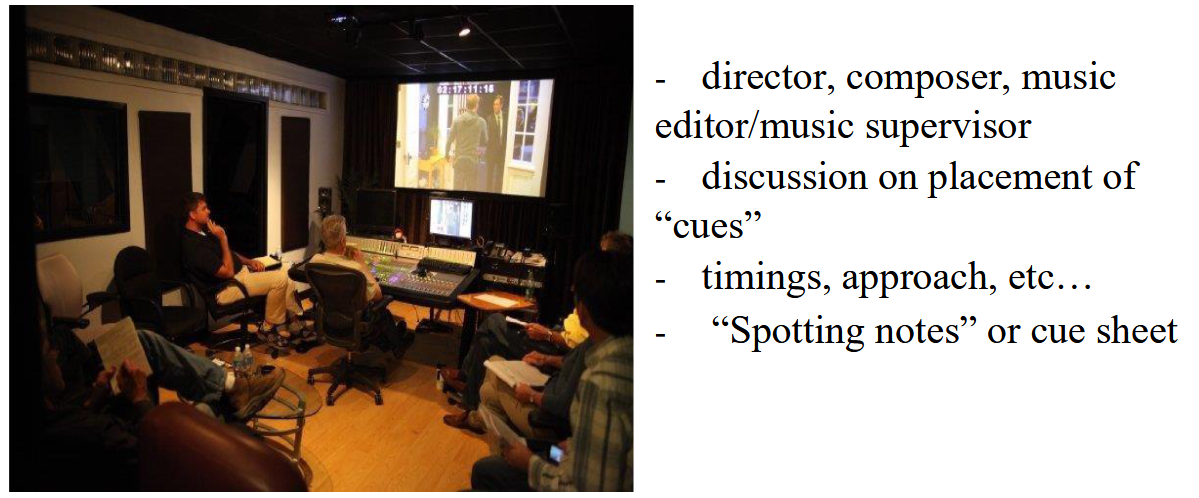
<p><img src="/images/music246/Pasted image 20250123194549.png" alt="" /></p>

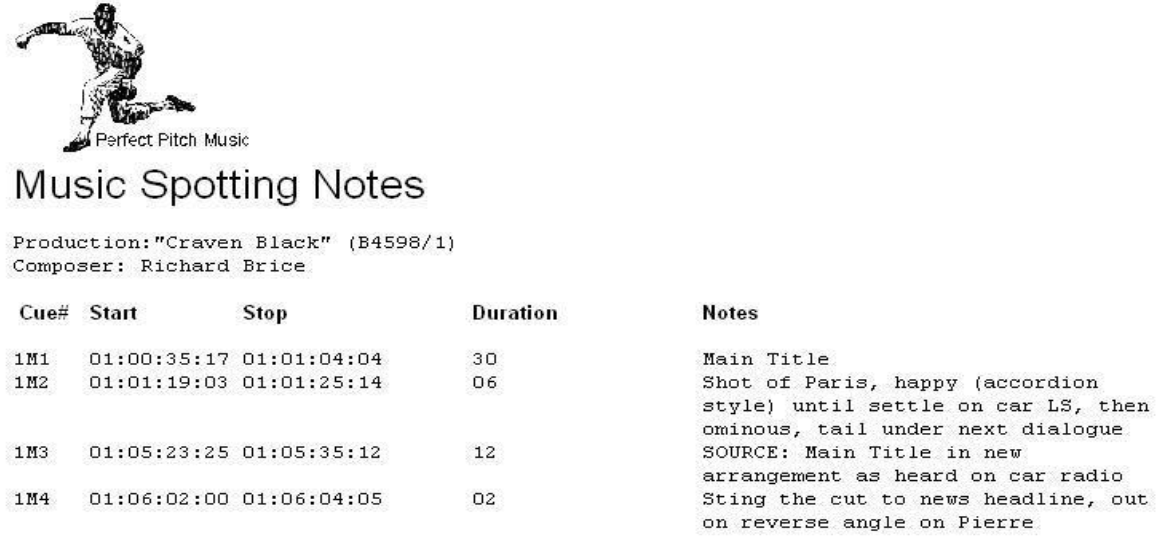
<p>After editing completion, the director, composer, and music editor review the film together, discussing music placement, timing, emotional approaches, and musical style. The music editor compiles these discussions into “spotting notes” or a “<em>cue sheet</em>.”</p>

<p><img src="/images/music246/Pasted image 20250123194944.png" alt="" /></p>

<h3 id="temp-music">Temp Music</h3>
<p>“Temp” (temporary) tracks present a controversial challenge. During early production, directors often want to hear scenes with music, so music editors add “temporary placeholder music” from existing films or classical pieces.</p>

<p><strong>Pros</strong>: Helps directors (who may struggle to articulate musical desires) communicate their vision through reference tracks.</p>

<p><strong>Cons</strong>:</p>
<ul>
  <li>Composers hearing temp tracks first may find it hard to generate original ideas</li>
  <li>Directors become attached to temp music after repeated viewings, wanting to keep as much as possible without copyright issues</li>
</ul>

<p>The tension: “Directors want to keep as much temp music as possible without legal problems; composers want to keep as little as possible without being fired.”</p>

<h3 id="composing">Composing</h3>
<p>Usually 5-8 weeks until delivery of the finished score. The fixed release date creates short, hard deadlines. If production runs overtime, music time shrinks further.</p>

<p><strong>Who’s involved?</strong></p>

<ul>
  <li>
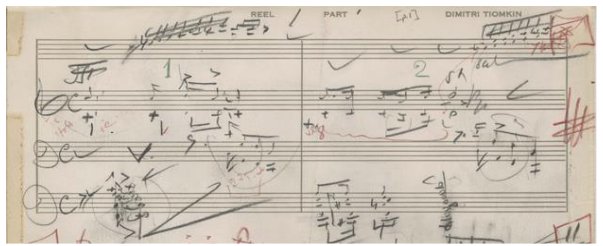
    <p><strong>Composers</strong>: Create musical sketches (sometimes pencil and paper) containing core musical ideas
<img src="/images/music246/Pasted image 20250123201429.png" alt="" /></p>
  </li>
  <li>
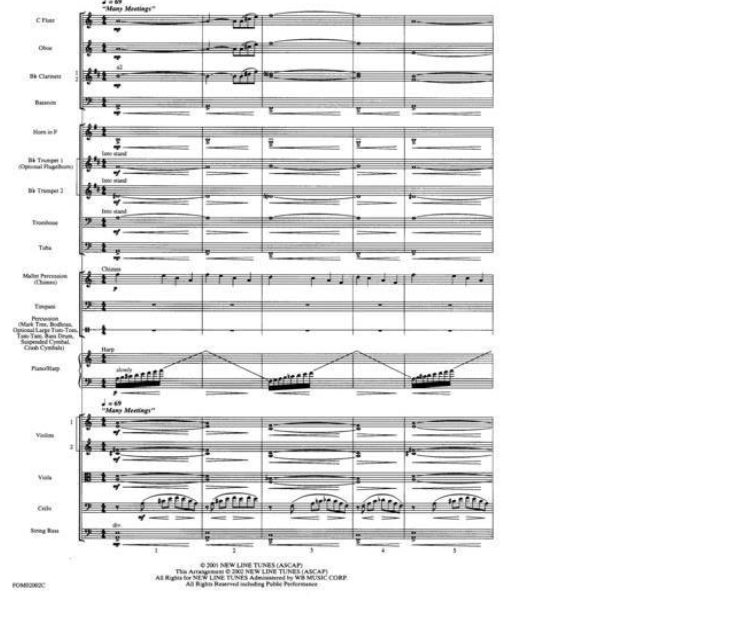
    <p><strong>Orchestrators</strong>: Formalize sketches, distributing melodies among instruments. Skilled in composition, music theory, and orchestral knowledge.
<img src="/images/music246/Pasted image 20250123201559.png" alt="" /></p>
  </li>
  <li>
    <p><strong>Synth Demonstrations</strong>: Instead of piano demos, composers now use synthesized instruments to preview music for directors before expensive recording sessions.
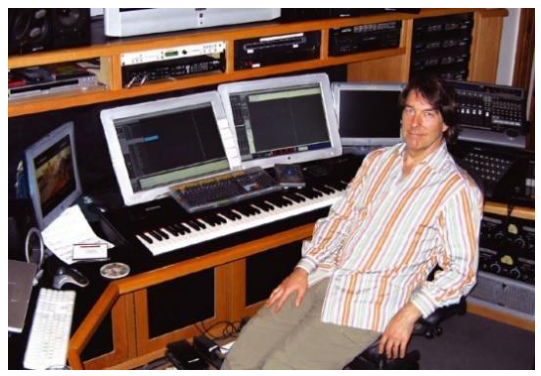
<img src="/images/music246/Pasted image 20250123202126.png" alt="" /></p>
  </li>
  <li>
    <p><strong>Copyists</strong>: Produce final sheet music for each instrument, adding performance details like bow marks for strings and breath marks for woodwinds.</p>
  </li>
  <li>
    <p><strong>Music librarians</strong>: Organize sheet music distribution, ensuring every musician receives correct parts for each scene. With expensive musicians and studio time, logistical errors are costly.</p>
  </li>
  <li>
    <p><strong>Conductors and studio musicians</strong>: Studio musicians must be excellent sight-readers. Some composers conduct their own music.</p>
  </li>
</ul>

<p>Recording sessions feature musicians and conductor performing while scenes play on a projector, often with moving markers to ensure synchronization.
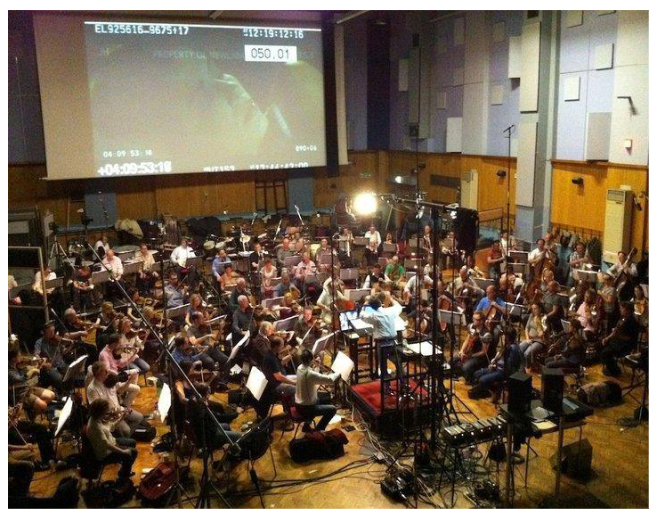
<img src="/images/music246/Pasted image 20250123202152.png" alt="" /></p>

<h3 id="mixing">Mixing</h3>
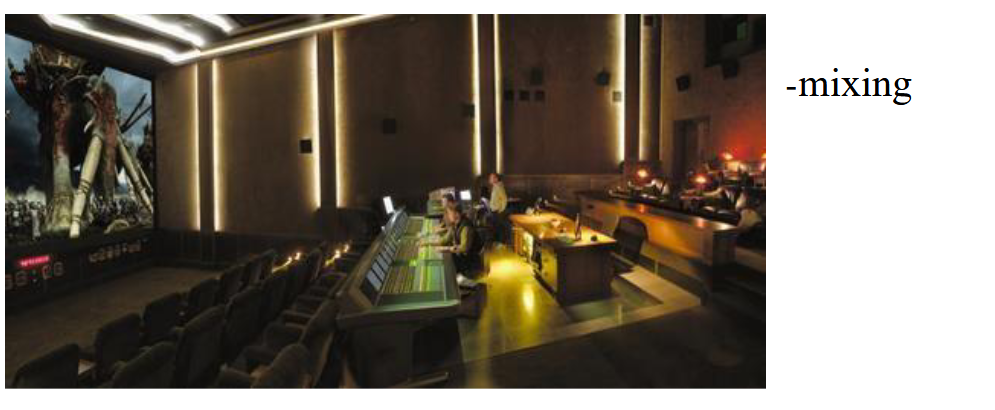
<p><img src="/images/music246/Pasted image 20250123202323.png" alt="" /></p>

<p>After recording, the director works with mixing engineers to balance dialogue, music, and sound effects in the final soundtrack.</p>

<hr />

<h2 id="western-classical-music-history">Western Classical Music History</h2>

<p>Understanding classical music history helps explain how film music developed in North America.</p>

<h3 id="baroque-period-1600-1750">Baroque Period (1600-1750)</h3>
<p><strong>Key Composers</strong>: Vivaldi, Handel, <em>Bach</em></p>

<p>Development of “Common Practice” that musicians still use today, including the <em>major/minor</em> system. <strong>Music structure held highest priority</strong>—strict rules mattered more than emotions. While pleasant, the music remained very rigid.</p>

<p>Consistent tempos and textures throughout, with <mark style="background: #ADCCFFA6;">terraced</mark> (阶梯式的) dynamics that change suddenly between preset levels.</p>

<p><strong>Example</strong>: J.S. Bach, “Brandenburg Concerto No. 6” 3rd Movement (1721)</p>

<p>This style proves unsuitable for film because it <em>cannot react to emotions</em>. If a scene turns intense but the music is in a soft section, it can’t adapt.</p>

<h3 id="classical-period-1730-1820">Classical Period (1730-1820)</h3>
<p><strong>Key Composers</strong>: Mozart, Haydn, <em>Beethoven</em></p>

<p>Baroque’s polyphonic complexity gave way to melody plus chords. <strong>Melody and emotion became more important</strong>, though structure remained paramount. Expanding variety of tempo, texture, and dynamics allowed more emotional responsiveness.</p>

<p><strong>Example</strong>: W.A. Mozart, “Symphony No. 40” 1st Movement (1788)</p>

<h3 id="romantic-period-1800-1910">Romantic Period (1800-1910)</h3>
<p><strong>Key Composers</strong>: Wagner, <em>Tchaikovsky</em>, Strauss</p>

<p><strong>Expression of emotion became supreme</strong>—more important than structure. Even greater range of tempo, texture, and dynamics served emotion and narrative.</p>

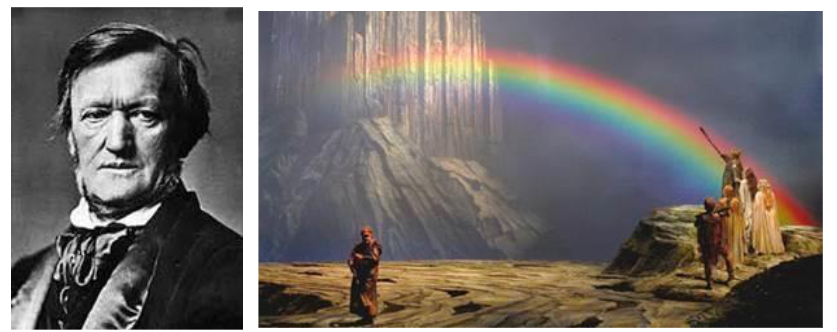
<p><strong>Example</strong>: R. Wagner, “The Magic Fire Music” from <em>Die Walküre</em> (1870)
<img src="/images/music246/Pasted image 20250123211154.png" alt="" /></p>

<p>“This sounds very much like film music.” Actually, it’s the reverse: film music sounds like Wagner. Wagner’s music dominated the 1860s-1880s. When motion pictures emerged in 1895, early film composers learned from Wagner’s innovations.</p>

<hr />

<h1 id="progression-of-movies">Progression of Movies</h1>

<h2 id="the-silent-era-1895-1927">THE SILENT ERA (1895-1927)</h2>

<p><mark style="background: #FFB8EBA6;">Melodramas</mark>: Films had theatrical precursors. While most plays used little music, <em>melodramas</em>—popular working-class entertainment in the 1800s—featured extensive musical accompaniment. These were essentially “soap dramas” on stage.</p>

<p><mark style="background: #ADCCFFA6;">The Persistence of Vision</mark>: Scientists discovered that images played at approximately 11-12 pictures per second create the illusion of motion rather than static images.
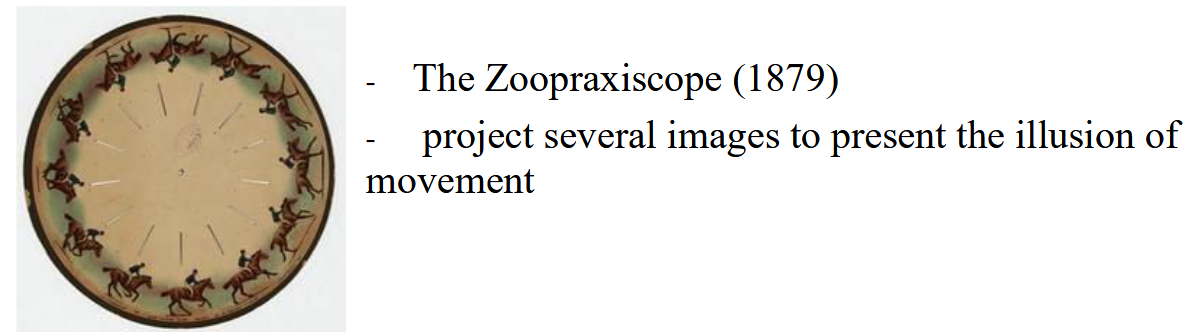
<img src="/images/music246/Pasted image 20250123212218.png" alt="" /></p>

<h3 id="thomas-edisons-work">Thomas Edison’s work</h3>
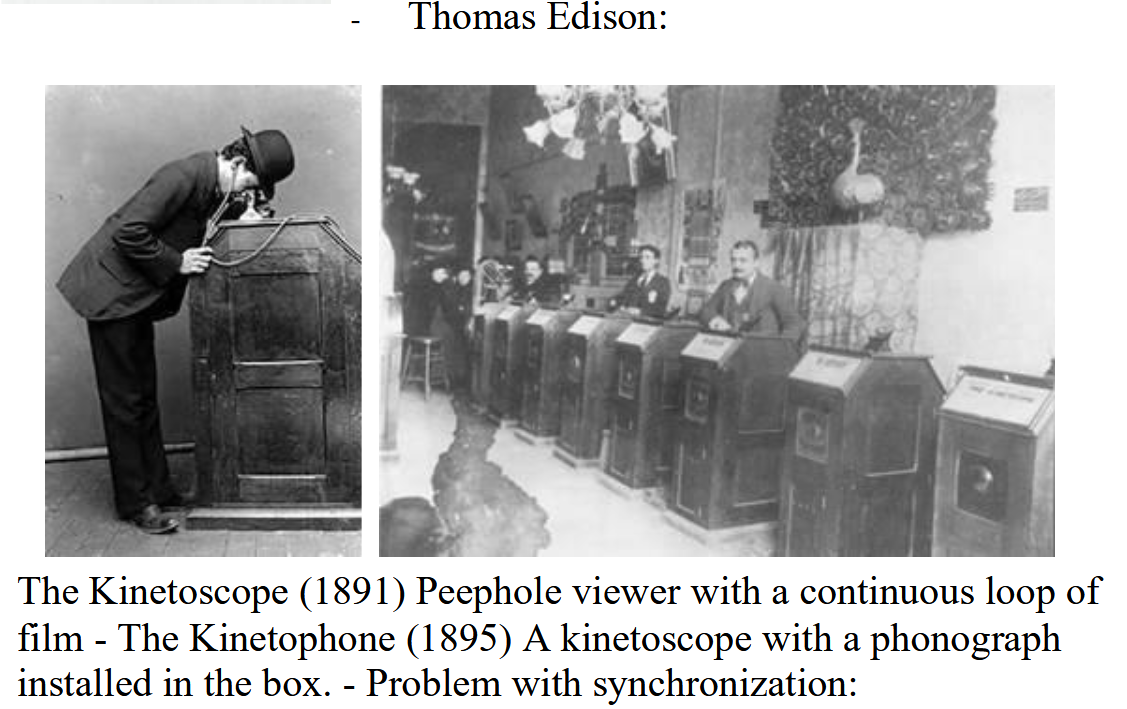
<p><img src="/images/music246/Pasted image 20250123212241.png" alt="" /></p>

<p>Edison’s Kinetoscope could record and play images fast enough to create motion illusion. He also developed audio recording, later combining them. However, viewers had to <em>peek through a small hole</em> to see images, and <em>audio and video were intentionally unsynchronized</em>.</p>

<h3 id="first-projected-films">First Projected Films</h3>

<p><strong>The Lumière Brothers</strong>, Paris, December 28th, <strong>1895</strong>, are documented as the <strong>inventors of motion pictures</strong>. While Edison had working video devices, the Lumières were <strong>first to project video onto screens so multiple people could watch together</strong>.</p>

<p>Their first motion pictures showed everyday scenes: street views, picnics, trains demonstrating the technology. The train was famous because audiences thought it might burst through the wall. <strong>Notice that there was music with the video from the very beginning.</strong></p>

<p><a href="https://www.youtube.com/watch?v=6Uo3hV-BWv4">Watch early films</a></p>

<p><strong>Why did the Lumière Brothers include music from the start?</strong></p>

<ol>
  <li>
    <p><strong>Pragmatic</strong>: Mechanical noise and problems. Music entertained audiences during technical difficulties and covered projector noise.</p>
  </li>
  <li>
    <p><strong>Psychoanalytic</strong>: Audiences were disturbed by ghost-like images. First-time viewers found black-and-white, soundless moving people creepy. Music made them seem more alive, less supernatural.</p>
  </li>
  <li>
    <p><strong>Continuity of Tradition</strong>: Long history of musical accompaniment for visual presentations. Music naturally accompanied visual entertainment.</p>
  </li>
</ol>

<h3 id="during-the-silent-era">During the Silent Era</h3>

<p>What did movies do with music during the long gap before synchronized sound?</p>

<ol>
  <li>Adaptations/compilations of classical music</li>
  <li>Adaptations/compilations of pop songs (which were also emerging)</li>
  <li>Originally composed scores or improvised scores by talented musicians</li>
</ol>

<h3 id="venues-vaudeville-theatres">Venues: Vaudeville Theatres</h3>
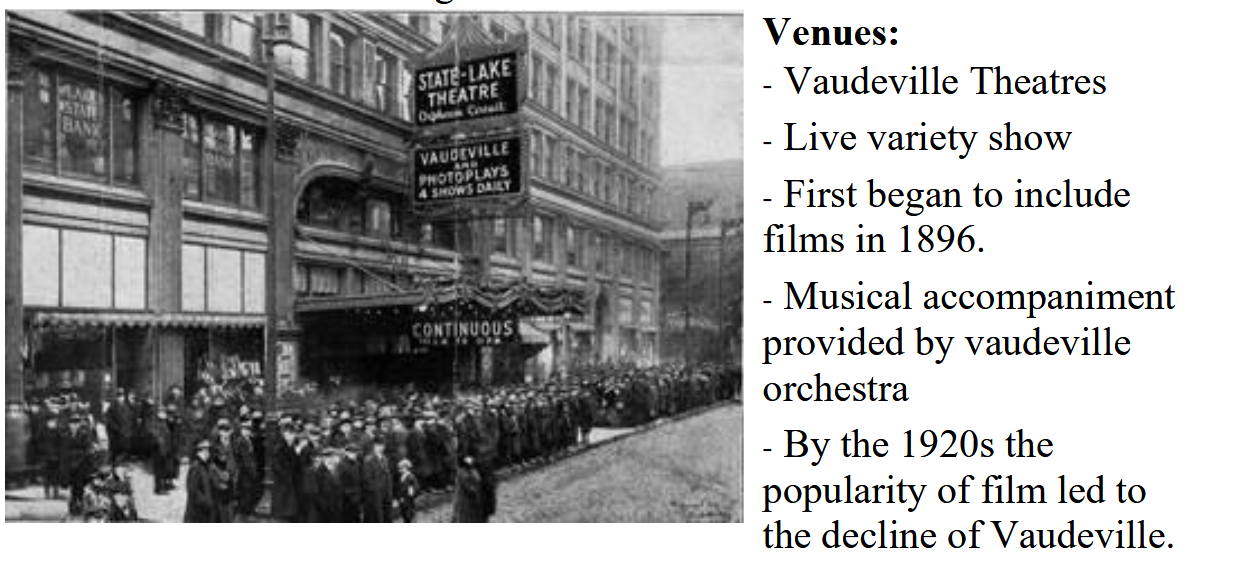
<p><img src="/images/music246/Pasted image 20250123215010.png" alt="" /></p>

<p>Live variety shows featuring comedians, skits, dancers—all <em>with musical accompaniment</em>. Found everywhere, they began including films in 1896, initially as brief intermissions that grew increasingly popular. By the 1920s, film-specific venues had largely replaced Vaudeville theatres.</p>

<h3 id="nickelodeons">Nickelodeons</h3>
<p><img src="/images/music246/Pasted image 20250123230904.png" alt="" /></p>

<p>After Vaudeville’s decline, Nickelodeons—local stores converted for movie showing—took over. From 3,000 in 1907 to over 10,000 by 1910. These weren’t real theatres, just spaces with chairs and a projector.</p>

<p>“Nickelodeons” cost five cents to enter. Music came from piano, <em>player piano</em> (programmable piano using punch-card-like sheets), small ensembles (about 3 musicians in better establishments), or gramophones playing records.
<img src="/images/music246/Pasted image 20250123231113.png" alt="" /></p>

<h3 id="the-shift-to-narrative">The Shift To Narrative</h3>

<p>Entering the 20th century, audiences had grown accustomed to motion pictures, and films began <em>telling stories</em> while <em>film directors</em> emerged as creative forces.</p>

<p><img src="/images/music246/Pasted image 20250130192323.png" alt="" /></p>

<p><mark style="background: #FFB8EBA6;">Georges Méliès</mark> stands among the first true film directors. While not creating the first narrative motion picture, he produced some of the more “mature” examples: 10-minute films with multiple scenes, proper sets and costumes (not just whatever people happened to be wearing), and experimental camera effects. He pioneered techniques like starting the camera, having a person get “bombed,” stopping the camera, letting the person walk away, then restarting the camera to create the illusion of disappearance.</p>

<p>“<em>A Trip to the Moon</em> (1902)” featured original scoring and hand-colored prints created frame-by-frame by women workers. These colored versions were nearly impossible to copy, making them extremely rare.
<a href="https://www.youtube.com/watch?v=A0XOsjwLO9w">Watch the film</a></p>

<p>However, musical practices remained haphazard. Musicians played whatever they felt like, with no intentional effort to match scenes. Music varied drastically from venue to venue: some places had skilled musicians, others had different repertoires, and some had no music at all.</p>

<h3 id="1905-1910">1905-1910</h3>

<p>Narrative films gained popularity while growing longer and more complex. Directors began recognizing music’s importance. Though musical choices still varied by venue, it became clear that musicians who <em>tried to synchronize with the movie</em> created superior experiences.</p>

<p>Music’s purpose shifted from mere <em>audience entertainment to “playing the picture”</em>: supporting the drama and helping audiences follow the plot. Music should be “fitting” or “synchronizing.” However, this wasn’t universal; many musicians continued playing whatever they preferred, following decade-old habits.</p>

<h3 id="1910-1920">1910-1920</h3>

<p><img src="/images/music246/Pasted image 20250130193620.png" alt="" /></p>

<p>The film industry matured significantly, but <em>Thomas Edison attempted to patent every single movie</em> for royalty payments. Most districts supported Edison, <strong>except Hollywood</strong>, where California viewed Edison as a monopolist. Filmmakers rushed to Hollywood, which proved geographically ideal: excellent weather and diverse landscapes perfect for various scenes. The map above shows where in Hollywood you could film as “Africa,” “New England,” and other locations.</p>

<p>Films became longer and more sophisticated.</p>

<p><img src="/images/music246/Pasted image 20250130194129.png" alt="" /></p>

<p>The first “<em>Movie Palaces</em>” opened in <em>1912</em>: venues built <strong>specifically for showing movies</strong>. This marked the first time movie exhibition wasn’t a side project. Quality Movie Palaces employed orchestras to accompany films, providing good employment for musicians and enhanced experiences for audiences.</p>

<p>Venues unable to afford full orchestras hired single musicians to play <em>Theatre Organs</em>. These instruments could change tone (woodwind, piano, etc.), providing rich instrumentation for movie scenes. Organ pipes also created sound effects: starter pistols simulated gunshots, coconuts mimicked footsteps.</p>

<h3 id="how-did-music-develop">How Did Music Develop?</h3>

<p>Early attempts at original scores existed, but standard practice involved compilation of classical or popular music, or improvisation. The major problem: the same movie featured different music at different venues.</p>

<p>Efforts emerged to standardize movie music:</p>

<h4 id="1909-edison-film-company">1909: Edison Film Company</h4>
<p>Thomas Edison began providing “<em>musical suggestions</em>”: scene-by-scene recommendations for appropriate music. These lacked strict timing, organizing only by scenes.</p>

<h4 id="1912-max-winkler-carl-fischer-music">1912: Max Winkler (Carl Fischer Music)</h4>
<p><img src="/images/music246/Pasted image 20250130195559.png" alt="" /></p>

<p><em>Max Winkler</em> called himself a <strong>music fitter</strong>, specifying which music pieces to play with precise timings. He effectively created <em>cue sheets</em>, wanting musicians to follow them consistently across venues, carrying sheets from one Movie Palace to the next.</p>

<p>This approach had problems: sheet music often got lost during travel, and some venues lacked musicians or had musicians unwilling to follow cue sheets. A good attempt that didn’t quite work.</p>

<h4 id="resource-books">Resource Books</h4>
<p><img src="/images/music246/Pasted image 20250130200051.png" alt="" /></p>

<p>Another standardization attempt: instead of carrying music for every movie, musicians could purchase compiled books organized by mood. The famous <em>Sam Fox Moving Picture Music (Vol 1, 1913)</em> by J.S. Zamenik included categories like “Hurry Music” and “Fighting Music.”</p>

<p><a href="https://www.youtube.com/watch?v=pupCeh1zqbo">Listen to “Movie for Duel”</a></p>

<p>Musicians generally didn’t want to purchase these books, so this approach also failed.</p>

<h4 id="trade-papers-about-film-music">Trade Papers About Film Music</h4>
<p><img src="/images/music246/Pasted image 20250130200740.png" alt="" /></p>

<p>Despite being silent, the film industry had become commercially mature and productive, with Hollywood producing numerous movies annually. Filmmakers paid intense attention to improving music, including standardization efforts.</p>

<p>This focus appeared in heated “trade paper” discussions (商业新闻): magazines functioning like modern blog posts. They debated rules film music should follow. Some debates were questionable but interesting:</p>

<ol>
  <li>
    <p>Music should be <em>continuous</em> because in silent films, music provided the entire audio experience. It should start with the film and end with the film, often requiring multiple musicians for seamless coverage.</p>
  </li>
  <li>
    <p>Musicians recognized the difference between diegetic (source) and non-diegetic music, arguing musicians should <em>always try to play source music</em>. If an army marches with a military band in the movie, the musician should play military music regardless of their instrument (piano instead of brass).</p>
  </li>
  <li>
    <p>Wagner’s “<em>musical theme</em>” concept worked well for films: use the same song for a character every time they appear.</p>
  </li>
  <li>
    <p>Some argued movies should only feature “good music” (classical like Mozart) to “<em>educate</em>” audiences. This was mostly arrogance; the most important thing is music that fits the film, not “high” or “low” culture.</p>
  </li>
</ol>

<p>Despite heated trade paper discussions, most 1920s film music remained unstandardized. Musicians varied in skill across venues, cue sheets and scores went missing, and some venues had no musicians at all. <em>The ultimate solution</em>: technology that embeds music into films for consistent synchronization across all venues.</p>

<hr />

<h2 id="transitioning-to-sound">Transitioning To Sound</h2>

<p>Sound and silent films coexisted for several years. People didn’t immediately consider sound films superior due to economic and cultural factors.</p>

<p><strong>Economic issues</strong>: Sound films required microphones during filming, amplifiers and speakers for projection—significantly more expensive.</p>

<p><strong>Cultural resistance</strong>: Silent films had existed for over 20 years. People were accustomed to them and found sound films (“<em>talkies</em>”) weird.</p>

<p>Sound film demonstrations appeared as early as <strong>1922</strong>, with two major approaches:</p>

<h3 id="1-sound-on-film">1. Sound On Film</h3>
<p>Print <em>photographs of sound waves</em> on film tape edges.
<img src="/images/music246/Pasted image 20250130204734.png" alt="" /></p>

<p><strong>Main companies</strong>: Phonofilm, Movietone</p>

<p><strong>Pro</strong>: Sound and picture on the same film tape created <em>perfect synchronization</em></p>

<p><strong>Con</strong>: Playing sound through sound wave photographs produced <em>horrible sound quality</em></p>

<h3 id="2-sound-on-disk">2. Sound On Disk</h3>
<p>Record audio on phonograph disks like records, synchronized with film projectors.
<img src="/images/music246/Pasted image 20250130204745.png" alt="" /></p>

<p><strong>Developed by Warner Brothers</strong>, called <em>Vitaphone</em>. Phonograph disks used soft materials for better quality but wore out quickly, marked with 20-box grids—cross out one box per use, discard after 20 plays.</p>

<p><strong>Pro</strong>: <em>Excellent sound quality</em>—recording music on disks was mature technology</p>

<p><strong>Con</strong>: Playing sound and picture on separate machines with inconsistent motors created <em>poor synchronization</em></p>

<h4 id="example-don-juan-1926">Example: <em>Don Juan</em> (1926)</h4>
<p><img src="/images/music246/Pasted image 20250130205220.png" alt="" /></p>

<p>Used Vitaphone technology with recorded score primarily by <em>William Axt</em>, performed by the New York Philharmonic Orchestra. Featured music and sound effects but <em>no dialogue</em>—still essentially a silent film because audio-picture synchronization was too poor for dialogue. Also included a second score for “live” musicians since most theaters lacked Vitaphone equipment.</p>

<h3 id="example-the-jazz-singer-1927">Example: <em>The Jazz Singer</em> (1927)</h3>
<p><img src="/images/music246/Pasted image 20250130205550.png" alt="" /></p>

<p><strong>The first important film with synchronized dialogue.</strong></p>

<p>Jakie, born into a Jewish family expected to become a cantor (religious singer), wants to be a pop jazz singer instead. Kicked out of his family, he returns as a successful jazz star to perform for his mother (in a scene with sound). Played by a real-life pop and movie star.</p>

<p>Most of the score was compiled or adapted. Used Vitaphone System to record <em>brief dialogue</em>, while most of the film remained music-only. Synchronizing even short dialogue required projectionists to constantly adjust tape speed. Long silences followed dialogue as projectionists switched from dialogue to music disks.</p>

<p>Most theaters still lacked Vitaphone, so the film had to remain mostly silent for compatibility. “Hey, if you watch this in a big New York theater, you can hear them talk!”</p>

<p>This became a major financial and cultural success, signaling the <em>“beginning of the end” of the silent era</em>. Hollywood realized sound films would dominate.</p>

<h3 id="change-to-sound-on-film">Change To Sound On Film</h3>

<p>Sound on Disk had early advantages, but Sound on Film became standard by the late 1920s and early 1930s. Synchronization proved king—as technology improved, audio quality became adequate. However, the prolonged battle between systems made most theaters hesitant to invest in either, delaying sound system adoption until the early 1930s.</p>

<p>Sound film dominance changed many aspects of filmmaking:</p>

<h4 id="1-aesthetics">1. Aesthetics</h4>
<p>Film had developed as a silent visual medium. Silent film actors had to adjust their acting styles and voices. Without dialogue, emotions required exaggeration; with sound, continued exaggeration looked weird. Many silent stars had poor voices, accents, or didn’t speak English.</p>

<p>Many <em>directors worried about using non-diegetic music</em>: “Where does the music come from?” Previously, audiences knew music came from live musicians, avoiding confusion. With sound now including dialogue, music created confusion: “I can hear this music—can the characters hear it too?” Though non-diegetic music was everywhere in silent films, it largely disappeared from 1928-1932.</p>

<h4 id="2-making-films">2. Making Films</h4>
<p><img src="/images/music246/Pasted image 20250130212421.png" alt="" /></p>

<p>All <em>sound had to be recorded in real time</em> during filming. Music and dialogue required balanced mixing—if orchestra was too loud, “move them 5 steps back” for softer sound.</p>

<p>Since sound recorded during shooting, loud cameras required large soundproof booths, eliminating camera movement during recording (unlike the dynamic camera work of silent films). Expensive “<em>sound stages</em>” (soundproofed buildings) were built to reduce outside noise.</p>

<p><em>Script writing was just invented</em>—no dialogue before meant no scripts needed until now!</p>

<h4 id="3-showing-films">3. Showing Films</h4>
<p><img src="/images/music246/Pasted image 20250130212823.png" alt="" /></p>

<p>The prolonged technology battle made theaters uncertain about purchases, so they waited. Few of the 20,000 theaters were equipped for sound when <em>The Jazz Singer</em> was released. By end of 1929, about 1,000 theaters had sound equipment. By 1935, the transition was complete.</p>

<h4 id="example-singin-in-the-rain-1952">Example: <em>Singin’ in the Rain</em> (1952)</h4>
<p>A movie about making sound films in 1927 and the challenges faced. Issues with filming: speaking into microphones, actors not following scripts. Issues with projection: sound-picture synchronization, sound mixing.</p>

<hr />

<h3 id="max-steiner-1888-1971">Max Steiner (1888-1971)</h3>
<p><img src="/images/music246/Pasted image 20250130213757.png" alt="" /></p>

<p>The first major film score composer we’ll examine in detail. We explore composers’ backgrounds because it influences their music, and discuss how they entered film scoring—most people stumbled into it accidentally.</p>

<p>Born in 1888, five years after Wagner’s death, receiving significant Wagnerian influence. Born in Vienna to a middle-class family; his father owned a theater. <em>Vienna</em> was the center of European classical music.</p>

<p>Formally trained in traditional European classical music, he was a child prodigy: conducting in his father’s theater by age 12, touring as a conductor by 16, writing operettas with his first completed by 17.</p>

<p>He worked as composer and conductor for stage productions in England. However, <em>WWI</em> broke out in <em>1914</em> while he was there. As an Austrian citizen, he was considered an enemy of England and faced imprisonment in a camp. A friend helped him <em>escape to the U.S.</em> in 1914.</p>

<p>He worked on <em>Broadway</em> for 15 years, where large musicals dominated. Steiner excelled at these productions. In <strong>1929</strong>, he was invited to Hollywood to compose for a musical called <strong>Rio Rita</strong>.
<img src="/images/music246/Pasted image 20250206201537.png" alt="" /></p>

<p>Hollywood sought singers and composers after <em>The Jazz Singer</em>’s success, wanting to adapt large musicals from Broadway. Steiner decided to stay in Hollywood, impressed by the quality of musicians and facilities.</p>

<p>This proved problematic: by 1930, directors worried about audiences being confused by “<em>where does the music come from</em>,” so <em>little score music was used</em> in narrative films.</p>

<h3 id="cimarron-1931">Cimarron (1931)</h3>
<p><img src="/images/music246/Pasted image 20250206201902.png" alt="" /></p>

<p>When scores were largely absent from films due to audience confusion concerns, Max Steiner composed music for <em>Cimarron</em>. In a scene featuring a couple dancing at a club, moving on and off the dance floor:</p>

<ul>
  <li><strong>On the dance floor</strong>: Steiner used club dancing music</li>
  <li><strong>Walking down from the stage</strong>: Steiner dimmed the music and shifted to a love theme (this was not source music)</li>
  <li><strong>Walking back onto the stage</strong>: Club dancing music returned</li>
</ul>

<p>This music enhanced the movie’s effectiveness. <em>David Selznick</em>, a leader at RKO studio, recognized Steiner’s excellent work.</p>

<h4 id="symphony-of-6-million--bird-of-paradise-1932">Symphony of 6 Million / Bird of Paradise (1932)</h4>
<p><img src="/images/music246/Pasted image 20250206202331.png" alt="" /></p>

<p>Recognizing Steiner’s talent, David Selznick commissioned him for these two films, asking for <em>wall-to-wall music</em>: music playing throughout the films.</p>

<p>Both movies succeeded, and audiences weren’t confused about music’s source. They even complimented the music’s effectiveness. Critics and reviews noted how music contributed to the films’ success.</p>

<p>This began changing perceptions about music’s power, though some directors still worried about audience confusion.</p>

<h3 id="king-kong-1933">King Kong (1933)</h3>
<p><img src="/images/music246/Pasted image 20250206202623.png" alt="" /></p>

<p><em>King Kong</em> spent enormous amounts on special effects and was originally made without music. Initial screenings received poor reviews as sound effects without music felt awkward. <em>Audiences laughed</em> even though the movie was supposed to be scary.</p>

<p>David Selznick called Max Steiner at the last minute to add music. He asked for compiled music due to time constraints, but <em>Steiner insisted on creating an original score</em>. Working 12 hours daily in brutal recording sessions, the movie became a massive success when released with music.</p>

<p>The <em>only difference was with/without music</em>—audiences went from laughing to screaming.</p>

<p>This is considered <strong>the film that convinced the general public that films should use non-diegetic music.</strong> Before this, consensus didn’t exist. Since this marked the beginning of music in sound films, people had no idea how to create such music. Max Steiner was effectively <em>defining new rules</em>.</p>

<p><em>King Kong</em> tells of a mysterious island surrounded by fog, rumored to house mysterious creatures. Main characters venture to the island to photograph these creatures.</p>

<p>Kong’s theme plays during opening credits, then no music until the ship enters the fog surrounding the island. <strong>General pattern</strong>: <em>Music starts the moment of entering the supernatural world</em>—moving from the real, rational world into the supernatural realm.</p>

<p>Music isn’t atonal but also not tonal—somewhere in between. Relatively quiet with no clear melodic sense. This creates <em>mysterious, uncertain feelings</em>, uncertainty about what will happen, matching audience emotions.</p>

<p>When they think they’re hearing wave echoes off rocks, it’s actually drums from the island. Drums play while non-diegetic Kong theme plays simultaneously—one of the first times composers had to consider <em>what happens when diegetic and non-diegetic music play together</em>.</p>

<p>As crew members view the beach, one character says “listen,” but nothing new happens musically—still Kong’s theme plus drums. It’s unclear what diegetic music the characters hear. This lack of distinction shows the <em>immaturity of non-diegetic music use</em> at this time.</p>

<h3 id="the-informer-1935">The Informer (1935)</h3>
<p><img src="/images/music246/Pasted image 20250206205607.png" alt="" /></p>

<p>Gypo, a naive Irish fighter, and Katie, his manipulative prostitute girlfriend, have the opportunity to turn in Gypo’s friend for tickets to America. She manipulates Gypo into selling his friend, but the Irish resistance discovers Gypo is the informer and chases them.</p>

<p><strong>Gypo’s theme</strong> is folk-influenced, depicting innocence and naivety. Steiner pioneered extreme <em>Mickey Mousing</em> (hitting the action to extreme extent)—a key part of his style. In scenes where Gypo walks to a “wanted” poster of his friend offering $20 reward, music Mickey Mouses to match his steps’ rhythm, pulling down the poster, etc. Gypo’s actor was bad with rhythm, so music had to accommodate his steps.</p>

<p>Steiner used musical quotes, rearranging <em>Rule Britannia</em> to sound loud, overpowering and oppressive (with brass) as Gypo takes down his friend’s wanted poster. Through thematic transformation, Steiner <em>portrayed Britain as villains</em>.</p>

<p><strong>Katie’s theme</strong> is jazz-influenced. Jazz can feel smart and urban, but here creates dark urban atmosphere reflecting Katie’s profession as a prostitute. It suggests she’s smarter than Gypo. Katie dresses like the Virgin Mary stereotype (pure, innocent), then transforms appearance when removing her head covering, revealing her true nature.</p>

<p>Excellent action-hitting occurs as she solicits customers, a client smokes, Gypo discovers this and throws out the client, she looks at the $20 poster for two tickets to America, and Gypo questions what she’s thinking about regarding the $20.</p>

<p>Steiner quotes a thematically transformed version of <em>Yankee Doodle</em>.</p>

<p>This movie won the Academy Award for <em>“Best Original Score”</em>—one of the first because original scores were just beginning to appear. Much more advanced musically compared to <em>King Kong</em>.</p>

<h3 id="more-on-max-steiner">More On Max Steiner</h3>
<p><img src="/images/music246/Pasted image 20250206211441.png" alt="" /></p>

<p>Also composed for <em>Gone with the Wind</em> (1939), <em>Casablanca</em> (1942), and <em>A Summer Place</em> (1959). Steiner disliked pop songs, so he composed scores that sounded like pop songs. He created the main theme for <em>A Summer Place</em>, which was later rearranged into a successful pop song.</p>

<p>He started at RKO, moved to head of music at Warner Bros from 1937-1953, with most important works in the 1930s-50s. Credited for over 300 films throughout his career.</p>

<hr />

<h3 id="1930s-defining-sound-film-conventions">1930s: Defining Sound Film Conventions</h3>

<p>Sound films began as extensions of silent films, but by the end of the 1930s, they became their own medium through technical and aesthetic changes. <em>King Kong</em>, despite having sound and music, still carried much silent era characteristics due to immaturity. By the late 1930s, films had developed significantly and resembled modern cinema.</p>

<h3 id="studio-system">Studio System</h3>

<p>The 1930s began with many small studios, but as the industry evolved, larger ones acquired smaller ones, leaving 5 major and 3 minor big studios. The Studio System meant everyone involved in moviemaking became employees of big studios, paid weekly salaries.</p>

<p>This was problematic for actors: if someone signed a 5-movie contract at $100/week, then became a star after the first movie, they still had to complete the remaining 4 at the same low rate.</p>

<p>However, for productive filmmaking, this was beneficial because <em>you knew exactly what a movie would cost</em>—just add up the salaries. Thus, the 1930s became Hollywood’s most productive period. This was the height of the “Studio System.”</p>

<h3 id="the-émigré-composer">The “Émigré” Composer</h3>
<p><img src="/images/music246/Pasted image 20250206213402.png" alt="" /></p>

<p>“Émigré”: 流亡者 (exile/refugee)</p>

<p>Nazis forced out many great European artists and intellectuals (especially Jewish). Many became famous film composers. <em>Alfred Newman</em> and <em>Herbert Stothart</em> were among the few important American-born composers in this period.</p>

<ul>
  <li>Alfred Newman: Thomas Newman’s father, composed the famous <em>20th Century Fox intro theme</em></li>
  <li>Herbert Stothart: composed the score for <em>The Wizard of Oz</em></li>
</ul>

<p>The next composer we’ll discuss extensively is an émigré.</p>

<h3 id="erich-wolfgang-korngold-1897-1957">Erich Wolfgang Korngold (1897-1957)</h3>
<p><img src="/images/music246/Pasted image 20250206214259.png" alt="" /></p>

<p>Born in Vienna, similar to Steiner. “Wolfgang”—Mozart’s name too, creating big expectations. Child prodigy like Steiner. His father was a notable music critic (Steiner’s father owned a theater—both fathers in the music industry).</p>

<p>His father had connections with major musical figures who frequented their house since Erich was young. His piano teachers included <em>Richard Strauss</em> and <em>Gustav Mahler</em>.</p>

<p>He became a famous conductor, known for interpreting <strong>Felix Mendelssohn</strong>’s music for Shakespeare’s “<strong>A Midsummer Night’s Dream</strong>” (which includes the Wedding March). <em>A Midsummer Night’s Dream</em> is the only Shakespeare play originally designed with music.</p>

<p>Hollywood wanted to film <em>A Midsummer Night’s Dream</em> and needed someone for the music. Since Mendelssohn had long passed away, they hired Erich, known for conducting Mendelssohn’s music, in <strong>1934</strong>.</p>

<p>Erich enjoyed his Hollywood experience, impressed like Steiner by the quality of musicians and facilities. However, he didn’t want studio contract constraints. He was the <em>only major 1930s composer not on a studio contract</em>. He worked in operas and returned to Hollywood annually when called for film music.</p>

<p>He won the Academy Award for <em>Anthony Adverse</em> (1936). In 1938, asked to score <em>Robin Hood</em>, he initially declined, feeling his romantic style didn’t fit action films; he actually recommended Max Steiner. But executives persisted.</p>

<p>However, he received a telegram upon returning to his hotel saying Austria was occupied by Nazis, forcing him to stay permanently in the U.S. He took the job to make a living, and his family managed to escape to America.</p>

<p>He won the <em>Academy Award for Robin Hood</em>, marking the first time the award went directly to the composer rather than the head of the music department (music director). Previously, composers didn’t receive awards—their music directors did.</p>

<p>After WWII, Korngold wanted to return to concert writing, but his style was considered old-fashioned, losing his standing as a “serious composer.” He felt depressed because he was no longer recognized for operas and concerts. His father also thought film music work was childish.</p>

<p>He wrote only 19 film scores in 12 years (much slower than Steiner) as a freelancer.</p>

<h3 id="korngolds-style">Korngold’s Style</h3>

<p>Since Korngold studied in Vienna in the early 1900s, his style resembled 19th century romanticism (like Wagner). As one of the early film musicians “writing the rulebook” for film music, he considered his film scores to be like “<em>little operas</em>“—treating them as instrumental bits of opera without singing. He focused on “extended melodies” through thematic transformation.</p>

<p>Korngold pioneered music for <em>battle scenes</em>, which became the standard:</p>

<ul>
  <li><mark style="background: #ADCCFFA6;">Loud dynamics</mark>: battles feature many sounds (swords, horses, etc.)</li>
  <li><mark style="background: #ADCCFFA6;">Rapid scale passages</mark>: rapid playing generates excitement, and scales are easier than complex melodies for musicians sight-reading under time pressure (expensive studio time)</li>
  <li><mark style="background: #ADCCFFA6;">Irregular, aggressive accents</mark>: accents between beats rather than on downbeats create unstable feelings, making audiences nervous</li>
  <li><mark style="background: #ADCCFFA6;">Occasional motive reference</mark>: interjecting villain themes when bad guys are winning, or hero themes when good guys triumph</li>
</ul>

<h3 id="the-sea-hawk-1940">The Sea Hawk (1940)</h3>
<p><img src="/images/music246/Pasted image 20250227192701.png" alt="" /></p>

<p>Korngold’s music for this film set in 1585, when Spain and England were at war. Spain had larger, slower ships (无敌舰队), while Britain employed smaller, agile ships operating like pirates to damage Spanish vessels—these were the “sea hawks.”</p>

<h4 id="opening-credits">Opening Credits</h4>
<p>Korngold wrote an <em>overture</em> during opening credits, including snippets of main themes to come. Used an <mark style="background: #ADCCFFA6;">ABA structure</mark>: hero theme / love theme / hero theme.</p>

<p><strong>Heroic theme</strong> uses brass <em>fanfare</em> (喇叭或号角嘹亮的吹奏声): constant, rigid tempo with precise notes, used for grand, solemn occasions like royal events and associated with military.</p>

<p><strong>Love theme</strong> uses <em>strings</em>: the orchestral section most effective at appealing to emotions, employing <mark style="background: #ADCCFFA6;">rubato</mark> (自由速度) where the orchestra slows at certain parts but speeds up later, contrasting the heroic theme’s rigid tempo.</p>

<h4 id="the-battle">The Battle</h4>
<p>Applied the four battle music techniques discussed earlier. Used <mark style="background: #FFB8EBA6;">framing the narrative</mark> (phrasing the drama) to parallel the battle.</p>

<p>Music can shift between “playing the drama” and “hitting the action” if scenes change slowly enough. When changes occur too rapidly, music can’t capture everything; composers create music to “set the overall mood,” only hitting action or playing drama for particular moments. This mood-setting music is “framing the narrative.”</p>

<p>Harp (竖琴) featured prominently for easy rapid note playing. Music dropped during dialogue for clarity. Sustained notes built anticipation when English forces nearly surrendered, also providing pacing after intense action. The score shifted from framing narrative to hitting action more closely, allowing natural conclusion when music stops.</p>

<p>At battle’s end, a natural horn plays source music to signal surrender, blending source and score. Natural horns can only play certain major notes, but when this “natural horn” plays notes only possible on trumpet, it signals transition from source to score as orchestra enters—an opera technique.</p>

<h3 id="the-adventures-of-robin-hood-1938">The Adventures of Robin Hood (1938)</h3>
<p><img src="/images/music246/1_Cr1T0lnTC5j009a7uwrAhw.png" alt="" /></p>

<p>Korngold’s music for the story where Normans (French descent) rule England unfairly over Saxons. Evil Prince John, a Norman, treats Saxons poorly, prompting Robin, also noble, to rob the rich and help the poor.</p>

<h4 id="opening-credits-1">Opening Credits</h4>
<p><strong>Overture: ABC structure - 3 Themes</strong></p>

<p>First two themes based on marches. Since marches are group activities, these aren’t “Robin Hood’s theme” but represent Robin Hood’s gang (“merry men”). Placing these first emphasizes the movie’s core message: “more people stronger.”</p>

<p>Final theme sounds like the love theme: rubato, strings.</p>

<p><strong>Transition into diegesis</strong>: Opening credits aren’t immersive since they remind viewers this isn’t real. The end must transition smoothly into story for “suspension of disbelief.” Korngold achieved this by building to a <em>fanfare</em> at credits’ end, <em>syncing drums</em> with the drum player’s actions in film.</p>

<h4 id="robins-theme">Robin’s Theme</h4>
<p>Robin has his own theme: not in opening credits, fanfare style (since he’s a hero), short.</p>

<h4 id="meets-little-john">Meets Little John</h4>
<p>Introduces a recurring theme playing when each main character joins the merry men. Little John’s version, first played, uses <em>French horn</em> (tough instrument, suggesting he’s a skilled hunter or woodsman).</p>

<p>The happy theme plays through their playful fight, implying no one gets hurt. Music blends with source music for comedy. Hits the action during short staff duel (also comedic). Mickey Mousing occurs when sidekick plays lute. Woodwind “water” theme plays when Robin falls—a common opera technique. Concludes with merry men theme.</p>

<h4 id="meets-friar-tuck">Meets Friar Tuck</h4>
<p>Similar to Little John scene. Initial theme played with <em>bassoon</em> (too high for bassoon) and <em>muted trumpet</em> for comedy effect.
<img src="/images/music246/Pasted image 20250227204118.png" alt="" /></p>

<p>Sword fight uses same theme as Little John’s staff battle but more exciting since swords are more dangerous. Woodwind “water” theme returns when Friar Tuck falls. Concludes with merry men theme, this time played with bassoon, associated with Friar Tuck.</p>

<h4 id="love-themes">Love Themes</h4>
<p>Two love themes appear: one in opening credits, another when Robin kisses Marion. Why do both play when Robin meets Marion?</p>

<p>One theme represents <em>romantic love</em> between Robin and Marion: big strings, moment of spectacle.</p>

<p>The other (from opening credits) represents Robin’s <em>patriotic love</em> for King Richard, played when discussing saving the country. Most dramatic when King Richard reveals himself: quiet cello.</p>

<h3 id="summary-korngolds-style">Summary: Korngold’s Style</h3>
<p>Wrote in 19th century Wagner romantic style from his symphonic and opera instrumental background. Focused on thematic transformations, often framing narrative. Limited Mickey Mousing, using it only for comedy—contrasting with Steiner who Mickey Moused everything, even serious scenes.</p>

<h3 id="1930s-the-great-depression">1930s: The Great Depression</h3>
<p><img src="/images/music246/Pasted image 20250227210734.png" alt="" /></p>

<p>The Great Depression only really ended with WWII.</p>

<p><img src="/images/music246/Pasted image 20250227210756.png" alt="" /></p>

<p>Worsened by the Dustbowl, where farmlands were destroyed.</p>

<p><img src="/images/music246/Pasted image 20250227210815.png" alt="" /></p>

<p>Depression-era films often featured fantasy or distant settings so audiences could escape their lives: <em>Lost Horizon</em> (1937), <em>Robin Hood</em> (1938), <em>Wizard of Oz</em> (1939).</p>

<h3 id="into-the-1940s">Into the 1940s</h3>

<p><strong>The 1940s</strong>: Stories became more realistic, often set in the real world with psychological drama bringing character-driven narratives. Unlike Robin Hood’s absolute good versus Prince John’s absolute evil, 1940s characters existed somewhere between extremes, revealing the “dark side” of human condition.</p>

<h3 id="film-noir">Film Noir</h3>

<p>Influenced by German <mark style="background: #FFB8EBA6;">Expressionism</mark> (表现主义). German films were quite mature before WWII. During the 1930s, many German directors fleeing Nazis ended up in Hollywood.</p>

<p>Expressionism presented humanity’s dark side through nightmarish images, making extensive use of shadows and lights. Example: <em>Nosferatu</em> (1922).</p>

<p>German film 1930s example:
<img src="/images/music246/Pasted image 20250227212422.png" alt="" />
Dracula’s shadow claws pierce someone’s heart.</p>

<p>Compare with Hollywood 1940s Film Noir:
<img src="/images/music246/Pasted image 20250227212519.png" alt="" />
Shows clear German 1930s influence. Often features rain for more reflections to play with lights and shadows. French audiences watching American films after WWII were shocked how much darker (affairs, murders) they were compared to pre-war films like <em>Wizard of Oz</em>. They called them “black films”—<em>Film Noir</em>.</p>

<h3 id="miklós-rózsa-1907-1995">Miklós Rózsa (1907-1995)</h3>
<p><img src="/images/music246/Pasted image 20250227212714.png" alt="" /></p>

<p>Hungarian composer born later than Steiner and Korngold, so he studied beyond just Wagner. Concert hall composers began turning away from major scales to explore more scales—a trend called <mark style="background: #FFB8EBA6;">modernism</mark>. Rózsa <strong>studied modernism</strong>.</p>

<p>His mother was a classical pianist. He studied in Leipzig and Paris—Paris being the “second-best place” to study traditional western music after Vienna. France treated movies as serious art, not just “popular entertainment.”</p>

<p>After a successful career as composer, at Arthur Honegger’s suggestion, Rózsa entered film scoring (<em>1934</em>). Did film work in England, <em>1934-1939</em>. Due to WWII making England inconvenient for filmmaking, he moved to Hollywood while completing “<strong>The Thief of Bagdad (1940)</strong>.”
<img src="/images/music246/Pasted image 20250227213709.png" alt="" /></p>

<h4 id="jungle-book-1942">Jungle Book (1942)</h4>
<p><img src="/images/music246/Pasted image 20250227213809.png" alt="" />
Rózsa’s music; first soundtrack released on record in the U.S.</p>

<h4 id="double-indemnity-1944">Double Indemnity (1944)</h4>
<p><img src="/images/music246/Pasted image 20250227213900.png" alt="" /></p>

<p>Moving into Film Noir, Rózsa worked on this film about insurance companies creating near-impossible clauses, then adding extra money for clauses doubling payouts.</p>

<p>Features short, unpredictable, unsettling themes. <strong>Modernism example</strong>: main theme isn’t in major scale, with greater dissonance use, moving away from clear tonality.</p>

<p>Many Film Noir films lack heavy action—slow scenes with suspense. Images alone aren’t scary; music drives intensity.</p>

<p>Why black and white again when <em>Robin Hood</em> (1938) was in color? Similar to sound film debates when technology first became possible, color films didn’t immediately dominate. Many films remained black and white for considerable time. Also, color films were expensive.</p>

<p>Big studios had difficulties accepting “modernism”:</p>

<blockquote>
  <p>[!quote] Quotation from Palmer, Christopher: Miklós Rózsa. A Sketch Of His Life And Work. (1975)
“When it was pointed out by the head of Paramount’s music department that the score for “Double Indemnity” (1944) was anything but “attractive”, Rózsa shot back that the film was about ugly people doing vicious things to each other and the music reflected precisely that. Paramount’s music director was furious, but Rózsa enjoyed the support of the director Billy Wilder, and the music remained as Rózsa wanted.”</p>
</blockquote>

<hr />

<h3 id="spellbound-1945-and-the-lost-weekend-1945">Spellbound (1945) and The Lost Weekend (1945)</h3>
<p><img src="/images/music246/Pasted image 20250306191645.png" alt="" /></p>

<p>Both composed by <em>Miklós Rózsa</em>, both film noir. Same year, both nominated for Academy Best Original Score Awards. <em>Spellbound</em> won, though Rózsa personally preferred <em>The Lost Weekend</em>.</p>

<p>Both films are psychological dramas dealing with disturbed characters:</p>
<ul>
  <li><em>Spellbound</em>: psychiatrist falls in love with a schizophrenic woman</li>
  <li><em>The Lost Weekend</em>: writer struggling with alcoholism</li>
</ul>

<p>To reflect psychological drama, Rózsa used <mark style="background: #ADCCFFA6;">Theremin</mark>, an electronic instrument producing eerie, unsettling sounds. <em>One of the first times an electronic instrument appeared in film scores</em>.</p>

<p>Played by controlling distance between hands and antenna. Invented by <em>Leon Theremin</em>, a Russian.
<img src="/images/music246/Pasted image 20250306192156.png" alt="" /></p>

<p>Theremin hoped his instrument would join orchestras (image shows him posing as conductor), though this never happened. Famous Theremin player: <em>Clara Rockmore</em>.</p>

<h4 id="the-lost-weekend-video-sample-i">The Lost Weekend Video Sample I</h4>
<p>Author protagonist (Burnham) finishes drinking at a bar, determined to start writing, returns home. Music is consonant and energetic. Writes briefly, then sees empty liquor bottle, wants to drink again. Theremin theme starts, going from consonant to dissonant.</p>

<p>Music intensifies as he searches for alcohol he knows he hid while drunk. Doesn’t find alcohol, calms down, music settles with only theremin remaining.</p>

<p>This is visually a small scene—just a guy looking for alcohol at home. Nobody dies. However, <em>music made the visually small scene intense and horrifying</em>. Music is the monster here. This is common in film noir: no intense action, but dialogue and details make scenes intense.</p>

<p>Alcohol in 1945 was common and rarely criticized. This movie was rare in taking alcohol issues seriously.</p>

<h4 id="the-lost-weekend-video-sample-ii">The Lost Weekend Video Sample II</h4>
<p>Scene where Burnham drinks at a bar but has no money, steals a lady’s purse, goes to bathroom for money, returns wanting to pay.</p>

<p><em>Only source music plays</em>: piano player performing pop song at bar. Plays constantly during stealing. Instead of intentional score representing stealing, constant source music makes stealing more subtle, like watching a real person steal.</p>

<p>When he returns from washroom wanting to pay but gets caught stealing, source music instantly stops, creating shocking contrast. As he gets kicked out, source music resumes, piano singing “someone stole a purse,” mocking Burnham.</p>

<p>This scene and music largely change audience perception of Burnham to pathetic drunk man.</p>

<p>We’ll pause Rózsa here. He’s also important in the 1950s with very different pictures than film noir. Rózsa’s career divides into three major periods.</p>

<hr />

<p>The 1940s saw increased numbers of American-born composers rising to prominence, such as Bernard Herrmann and David Raksin, after the 1930s “Émigré” period of European immigrants.</p>

<h3 id="david-raksin-1912-2004">David Raksin (1912-2004)</h3>
<p><img src="/images/music246/Pasted image 20250306195247.png" alt="" /></p>

<p>Born in Philadelphia; father conducted for silent films. Raksin studied music with <em>Arnold Schoenberg</em>, one of the most important composers in transitioning to <em>modernism</em>. Unlike older composers, Raksin studied modernism from the beginning.</p>

<p>Early career as pianist and arranger for Jazz bands in NY (<em>Benny Goodman</em>) during big band era. Worked on Broadway for 15 years.</p>

<h4 id="charlie-chaplin">Charlie Chaplin</h4>
<p><img src="/images/music246/Pasted image 20250306200043.png" alt="" /></p>

<p>Charlie Chaplin was a good musician but self-taught, unable to read or write sheet music. Chaplin wanted his own music for <strong>Modern Times (1935)</strong> but couldn’t write sheet music. Raksin was hired to help Chaplin compose musical ideas into notation.</p>

<p>Raksin made connections with Chaplin and director friends, entering film industry through these relationships.</p>

<h3 id="laura-1944">Laura (1944)</h3>
<p><img src="/images/music246/Laura.jpg" alt="" /></p>

<p>Film noir without action. Music by <em>David Raksin</em>. Story about a young popular businesswoman murdered at the beginning; suspense about who killed her.</p>

<p>Director Otto Preminger wanted to use Duke Ellington’s pop song “<em>Sophisticated Lady</em>.” Ironically, this song is about a popular woman aging and losing charm.</p>

<p>Raksin wanted original score but director preferred “Sophisticated Lady.” Raksin made a deal: he’d create a theme by Monday. If director liked it more, use it; otherwise use “Sophisticated Lady.”</p>

<p>Raksin had no good ideas until his wife sent a letter saying she fell in love with another man and was filing for divorce. Depressed and drunk, Raksin wrote a masterpiece that convinced the director.</p>

<p><em>Laura</em>’s music has strong <em>American popular music influence</em>. Though played with orchestra and classical instruments, chord and harmony structures are very pop, especially apparent in trumpet playing—completely pop style. <em>Non-European</em> classical style.</p>

<p><em>Monothematic</em>: just one theme (Raksin’s replacement for “Sophisticated Lady”). Raksin chose this because Laura is dead, so he used this theme representing her ghost, which doesn’t change since she’s dead. Music is closely associated with Laura, representing her “ideal” and her ghost, giving insight into McPherson’s mind.</p>

<p>After movie fame, many pop singers covered Laura’s theme with added lyrics.</p>

<h4 id="video-example-laura-1">Video Example: Laura 1</h4>
<p>Focus shot on Laura’s portrait—sophisticated/urban, almost unearthly, ethereal. Laura’s theme plays during opening credits. After credits, we hear main character McPherson’s inner thoughts; Laura’s theme continues. Theme stops as McPherson speaks his first line, indicating we’re now out of his mind into real diegesis.</p>

<p>Hearing characters’ inner monologue is common in film noir.</p>

<h4 id="video-example-laura-2">Video Example: Laura 2</h4>
<p>Lydecker’s Story Part A. Lydecker and McPherson go to restaurant. Since it’s a restaurant, music begins with source music of piano player performing Laura’s theme.</p>

<p>Recall Raksin made Laura’s theme after shooting (director intended “Sophisticated Lady”; Raksin created Laura’s theme last minute), so piano player played dummy music during shooting. Raksin made special arrangement of Laura’s theme fitting piano player’s finger movements.</p>

<p>Lydecker talks about his story with Laura; music transitions to score entering the story. Laura’s theme.</p>

<p>In Lydecker’s memory story, Laura approaches wanting endorsement for a pen advertisement, but Lydecker refuses while eating lunch. Laura’s theme switches to Waltz—metaphor for the struggle between Laura and Lydecker, where Laura wants endorsement and Lydecker wants to play with her patience. They’re “dancing” like a waltz.</p>

<p>Laura loses patience and argues back. Laura’s theme returns, demonstrating she’s no longer hiding feelings to play “waltz” with Lydecker. She’s showing true feelings.</p>

<h4 id="video-example-laura-3">Video Example: Laura 3</h4>
<p>Lydecker’s Story Part B: Lydecker becomes intrigued, starts dating Laura. Talks about helping her career; she’s good because she doesn’t talk much, just listens.</p>

<p>Theme grows in complexity as Laura’s career grows. Notice Laura doesn’t speak—Lydecker and music speak for her. Mirrors Lydecker’s desire for Laura to just listen, not talk. Lydecker is a collector wanting to collect Laura as an object.</p>

<p>Montage of Lydecker discussing dates with Laura—music creates continuity. Seamless transition between source and score of Laura’s theme.</p>

<h4 id="video-example-laura-4">Video Example: Laura 4</h4>
<p>Scene of McPherson in Laura’s apartment. McPherson cycles between: restless (agitated music), sees something about Laura and calms down (Laura’s theme plays briefly).</p>

<p>Music balances following action and reflecting McPherson’s internal state as he searches. When taking action, music is agitated. When seeing Laura’s portrait or belongings, Laura’s theme plays briefly, and he calms down. Note music’s connection to the portrait.</p>

<p>Laura returns to her apartment. Turns out her friend with similar body was murdered. Since it was shotgun to head in Laura’s house, everyone thought it was Laura. She was just at cottage, letting friend care for apartment.</p>

<p>Laura’s theme was used frequently until this point for anything about Laura. However, when Laura actually appears in flesh, Raksin left the scene with <em>absolutely no music</em>. The idea: Laura’s theme was about her ghost or “idealized,” “perfect” version. When Laura finally returns, she isn’t the “goodness” or “perfect young woman” discussed. Thus, this <em>“idealized” Laura theme doesn’t play for real, flawed Laura</em>, and never appears again for the rest of the movie.</p>

<hr />

<h1 id="the-1950s">The 1950s</h1>

<h3 id="end-of-the-studio-system">End of the Studio System</h3>

<p>Prior to the 1950s, the movie industry was dominated by 8 major studios where everyone involved in filmmaking was a studio employee. Benefits: studios knew exact movie budgets. Downside: this was monopoly—you couldn’t make movies outside the 8 major studios.</p>

<p>Government monopoly complaints existed long ago but were ignored during WWII while government focused on war. In the 1950s, with war over, government pressed monopoly issues. Finally, the Studio System broke down in the 1950s.</p>

<h3 id="competition-with-tv">Competition With TV</h3>

<p>TV was invented long ago but really popularized in North America in the 1950s. Why travel to movie theaters when you can watch at home?</p>

<p>Movies competed with TV in two main ways:</p>

<h3 id="competition-technology">Competition: Technology</h3>

<p>Movie theaters had color films; TVs couldn’t. This led to more colored films, though some remained black and white.</p>

<p>Movies used to be only 4:3 (all previous discussed movies). TVs were also 4:3. To make experiences more unique, movies started using much wider aspect ratios:
<img src="/images/music246/Pasted image 20250306212307.png" alt="" /></p>

<p>Multiple competing technologies emerged for wider aspect ratios: Cinerama, CinemaScope, Panavision, and VistaVision. This competition resembled the “sound on film” vs. “sound on disk” battle during sound film implementation.</p>

<p>First multi-channel sound systems for theaters developed, no longer just mono sound. TVs remained mono.</p>

<h4 id="epic-films">Epic Films</h4>

<p>To leverage technology, movies started filming “big scenes” just to “be big”—”big enough that watching on TV isn’t suitable.”</p>

<p>This created “epic films” set in ancient Rome or similar, where people fought with swords. Also called “sword and sandals” films because people fought with swords and wore sandals.</p>

<p>Examples: <em>Quo Vadis</em>, <em>The Robe</em>, <em>Julius Caesar</em>, <em>Lawrence of Arabia</em>, <em>Cleopatra</em>, <em>The Ten Commandments</em></p>

<h4 id="ben-hur-1959">Ben-Hur (1959)</h4>
<p><img src="/images/music246/Pasted image 20250306212930.png" alt="" /></p>

<p>Music by <em>Miklós Rózsa</em> (famous for film noir; his second stage featured epic films). About a Jewish prince betrayed and sent into slavery, who becomes chariot driver, then Roman army general, seeking revenge on betrayers.</p>

<p>Visually spectacular but essentially no narrative development during scenes. Focus is on sound and image grandeur. Music is tonal/orchestral again—somewhat back to “traditional” Wagner tonal music because atonal Modernism doesn’t fit epic films.</p>

<h3 id="competition-subject-matter">Competition: Subject Matter</h3>

<p>Movie and TV content competed. Movies had been getting increasingly sexy and violent, drawing complaints from women and Christians.</p>

<p>March 1930: The Production Code (Hays Office) was created:</p>
<ul>
  <li>No implied sex scenes except married couples</li>
  <li>Criminals must be caught</li>
  <li>etc.</li>
</ul>

<p>Rules were voluntary until 1934. From 1934 briefly after, violations meant fines or no theater showings. Famous example: <em>Gone with the Wind</em>—”Frankly my dear, I don’t give a damn” incurred language fines.</p>

<p>Compared to movies, TVs were <em>even more restricted</em> since children could potentially watch at home, and TV content was completely controlled by advertisers worrying parents.</p>

<p>Movies tried using more controversial content, pushing Production Code boundaries to compete with TV. Since movie theaters could restrict audiences (unlike home TVs), some places started showing adult-only films.</p>

<p>This was strengthened by foreign films: Italian and French films didn’t conform to production codes and featured more provocative content.</p>

<p>Hollywood wanted to compete with TV and foreign films, pushing for more controversial content. This period saw movie ratings introduction (G for everyone, F for family, etc.).</p>

<p>Finally, in <em>1968</em>, the Production Code was officially abolished.</p>

<h3 id="dimitri-tiomkin-1894-1979">Dimitri Tiomkin (1894-1979)</h3>
<p><img src="/images/music246/Pasted image 20250306221102.png" alt="" /></p>

<p>Born in Russia. Played piano in Russian silent movie theaters. 1925 USA: worked in vaudeville during the period when movies became the most popular vaudeville section. Began Hollywood work during 1930s after breaking his arm, preventing concerts.</p>

<p>Important films include: <em>Lost Horizon</em> (1937); <em>It’s a Wonderful Life</em> (1946)</p>

<h4 id="high-noon-1952">High Noon (1952)</h4>
<p><img src="/images/music246/Pasted image 20250306221211.png" alt="" /></p>

<p>Western film with country and western music by Dimitri Tiomkin. First to use a “<mark style="background: #FFB8EBA6;">movie song</mark>.”</p>

<p>Pop songs were used in movies before, but usually without connection beyond being suitable for the film. Sometimes, like <em>Laura</em>, original scores were covered by pop singers after movie hits, thinking lyrics and singing would be successful.</p>

<p>However, “movie song” refers to a <em>pop song specifically written for film, “pre-released” before movie release</em>. Pre-released pop song promotes movie before release. DJ plays song: “this song is for this upcoming movie!” When song loses popularity, movie comes out and promotes song in reverse.</p>

<p>Example: James Bond movies always feature pre-released songs co-written by movie composer and big pop star.</p>

<p><em>High Noon</em>’s movie song is “High Noon,” remembered by opening line “<em>Do not forsake me</em>.” Became hit for singer <em>Tex Ritter</em>.</p>

<h4 id="video-example-high-noon-1">Video Example: High Noon 1</h4>
<p>Opening Credits—movie-song example. First part is protagonist sheriff Will Kane’s theme. Second part is villain Frank Miller’s theme.</p>

<h4 id="video-example-high-noon-2">Video Example: High Noon 2</h4>
<p>Scene before final battle. Protagonist writing will while clock ticks. Rare example (at this time) where score was composed before scene cutting. Movie director cut scenes to fit score.</p>

<p>Score’s beat syncs with clock ticking. Scene cuts every score downbeat. Score used Frank Miller’s villain theme to anticipate battle. During battle toward end, Will’s theme represents protagonist, Frank Miller’s villain theme represents villain.</p>

<h3 id="bernard-herrmann-1911-1975">Bernard Herrmann (1911-1975)</h3>
<p><img src="/images/music246/Pasted image 20250313202843.png" alt="" /></p>

<p>Born in New York City, Herrmann studied composing and conducting at <em>Juilliard</em>, the prestigious New York music school. Though a prodigy, he wasn’t as extreme as Steiner and Korngold. He established himself as a concert hall (not film) composer by age 20 and often supported young composers by performing their lesser-known works.</p>

<p>Herrmann was notably harsh and direct with movie directors about their films’ quality. He joined CBS Radio in 1934, writing radio dramas and conducting the CBS orchestra. Radio in the 1930s was essentially TV before television existed, featuring various dramas (suspense, comedy, etc.) with sound only. Afternoon advertisements targeting housewives often promoted soaps, hence “soap operas.” Herrmann excelled at this music and stayed very busy.</p>

<p>Later, he worked for <em>Mercury Players</em>, owned by <strong>Orson Welles</strong>, an even younger man. In October <em>1938</em>, Welles’ radio show adapted H.G. Wells’ novel <em>The War of the Worlds</em>, presenting it as a series of “fake news” reports about alien invasion.</p>

<p>Many Americans tuned in after the disclaimer, thinking the news was real. Many were scared; one person even shot someone. This made headlines the next day as “The Night that Panicked America.” Welles was forced to apologize.</p>

<p>Hollywood wanted Welles: if you can cause that much disturbance with radio, you’d make a good movie director. Welles demanded complete control of his films, which was too bold for many studios. Eventually, in 1940, a studio accepted his demands and brought him to Hollywood. Following Welles, <em>that’s how Bernard got into Hollywood</em>.</p>

<h4 id="citizen-kane-1941">Citizen Kane (1941)</h4>
<p><img src="/images/music246/Pasted image 20250313205119.png" alt="" /></p>

<p>Directed/produced/starred by Orson Welles for his first movie. Considered excellent for a debut and said to inspire later film noir movies. Music by <em>Bernard Herrmann</em>.</p>

<p>We focus on the “breakfast montage” clip: two passionate lovebirds become hostile after years, shown through gradual relationship changes during dinners. They progress from sitting corner-to-corner to opposite ends of a long table. Music evolves from playful to dark.</p>

<p><a href="https://www.youtube.com/watch?v=CMkPIW22bq4">Watch the scene</a></p>

<p>Herrmann’s music here is very operatic, <em>tonal, like Erich Korngold’s music. No modernism here</em>.</p>

<hr />

<p>Since Orson Welles took time with his movies, Herrmann worked with other directors.</p>

<h3 id="the-day-the-earth-stood-still-1951">The Day the Earth Stood Still (1951)</h3>
<p><img src="/images/music246/Pasted image 20250313210159.png" alt="" /></p>

<p>Music by <em>Bernard Herrmann</em>. About an alien who comes to Earth warning that humanity will be destroyed.</p>

<p><strong>Instrumentation</strong>: violin, cello, and bass (all three electric), two <em>theremins</em>, three electric organs, three vibraphones, two glockenspiels, two pianos, two harps, three trumpets, three trombones, and four tubas.</p>

<p>This very unusual instrumentation pioneered modernism. Definitely not tonal.</p>

<h4 id="video-example">Video Example</h4>
<p>Scene of alien landing; American soldiers point guns at alien and shoot. Then a “destroyer of worlds” alien appears and starts destroying.</p>

<p>When the alien first lands, music creates a “sound cloud”: music focusing on texture, not themes or melody. Just stationary notes with rich, dark texture from unusual instrumentation. Makes you anticipate something.</p>

<p>A soldier shoots the alien. Sound cloud suddenly stops. Unlike <em>Alien Resurrection</em>, there’s no buildup—it just stops. Even though you were anticipating something, it still shocks you. Sound cloud needs good conclusion; it’s so noticeable you can’t just fade away. Music stops at gunshot.</p>

<p>Then the destroyer alien appears with very rich, dark textural music. Modernist approach.</p>

<h3 id="not-standard-instrumentation">Not “Standard” Instrumentation</h3>

<p>Herrmann’s biggest contribution to film scores was realizing movie music can use “non-standard” instrumentation.</p>

<p><strong>Symphony Orchestra</strong>: a standardized performance ensemble. In music, certain instrument sets have become standardized over years. Composers write for symphony orchestras because many such orchestras exist worldwide, so your music can be performed. If you write weird instrumentation, no one can play it.</p>

<p>However, Herrmann realized film scores only need to be played once in recording studios, never again. Thus, he doesn’t need standard instrumentation everyone can play; he just needs instrumentation fitting the scene best.</p>

<h4 id="beneath-the-12-mile-reef-1953">Beneath the 12-Mile Reef (1953)</h4>
<p><img src="/images/music246/Pasted image 20250313211841.png" alt="" /></p>

<p>Music by Herrmann. Instrumentation included <em>9 harps</em>—very unusual. Music was good, though the movie wasn’t.</p>

<h4 id="herrmann-and-alfred-hitchcock">Herrmann and Alfred Hitchcock</h4>
<p><img src="/images/music246/Pasted image 20250313211957.png" alt="" /></p>

<p>Herrmann began collaborating with Alfred Hitchcock in 1955, including <em>Vertigo</em> (1958) and <em>North by Northwest</em> (1959). Herrmann uses standard orchestra and tonal music when they fit well—not always atonal and unusual instrumentation.</p>

<h3 id="psycho-1960">Psycho (1960)</h3>
<p><img src="/images/music246/p283_v_h8_ap.jpg" alt="" /></p>

<p>Hitchcock directed. Color films were common by 1960, but limited budget meant shooting in <em>black and white</em>.</p>

<p>Herrmann decided to make “black and white music” for the black and white film:</p>

<ul>
  <li><em>Only use strings</em> for the score: seems bold, but strings can perform the most sound variety</li>
  <li>Very frequently just frames narrative. Cues come in and don’t change for long periods, <em>not reacting to scene events</em>: cues set single moods with little minute-by-minute response. All cues frame narrative with little action reflection. Creates weird, cold, unsympathetic feeling</li>
</ul>

<p>Overall mood is bleak with little emotional warmth. Achieved by strings holding long notes <em>without vibrato</em> (揉弦), sounding cold. Overall score is dissonant.</p>

<h4 id="psycho-1-the-money">Psycho 1: The Money</h4>
<p>Marion debates in her room whether to take money and disappear. Short repetitive theme that fractures. Quiet but unsettled—Marion’s discomfort with theft. Theme grows slightly as she decides. Notice sustained string notes without vibrato—very cold.</p>

<p>Almost like film noir era scene: visually small, but music intensifies and highlights inner turmoil.</p>

<h4 id="psycho-2-flight">Psycho 2: Flight</h4>
<p>Marion wants to buy a new car since people could track her current one. She buys one but gets called by police; apparently she left her suitcase in the old car. She escapes.</p>

<p>Music enters as she makes her “escape” and <em>does not change</em>. Initially seems to play her fear of being caught. However, she starts thinking she’ll get away and smiles evilly. As she becomes evil, music seems to play her fall to the “dark” side. Throughout this transformation, music doesn’t change; it just creates mood.</p>

<h4 id="psycho-3-normans-theme">Psycho 3: Norman’s Theme</h4>
<p>After brief chat between Marion and Norman, Norman’s theme starts as he watches her walk to her room.</p>

<p>Theme made of <em>only semitones</em>, creating uncertainty since semitones are very close; you can’t tell “which note is dominant.” Definitely not major scale. Gives weird feeling of “where will this cue start or end.”</p>

<p>As he looks through peephole to spy on Marion’s room, violins play “harmonics” (泛音). Uncomfortable to listen, no emotion.</p>

<h4 id="psycho-4-the-shower">Psycho 4: The Shower</h4>
<p>Scene of Marion being stabbed in shower. <em>No music until attack</em>. No tonality at all. <em>Strings were “shrieking”</em>—very violently striking strings with bow.</p>

<p>As murderer runs away, music played is <em>actually Norman’s theme</em> with semitones after thematic transformation. This hints the <em>murderer is actually Norman</em>. Also illustrates that despite modernism, old techniques like thematic transformation still work.</p>

<p><strong>Trivia</strong>: Censorship people demanded film censoring, especially shower scene bits. Alfred Hitchcock waited three days, sent exact same film back saying “yeah good advice we’ve fixed it.” Executives said “yeah that’s much better great film.” Good example studied in film school. No direct stabbing shots on body, just implied through shots.</p>

<p>Hitchcock initially insisted no music for shower scene. When vacationing for a weekend, Herrmann said “yeah let’s add music because Hitchcock’s dumb.” Monday Hitchcock returned saying “yeah with music is better haha.”</p>

<p>Fake blood didn’t look right in black and white, so they used chocolate sauce instead.</p>

<hr />

<p>Unfortunately, <em>Psycho</em> was the collaboration peak between Herrmann and Hitchcock. Herrmann was very opinionated and hated pop music in films. Hitchcock asked him to score <em>Torn Curtain</em> (1964) using pop music. Arguments heated up and Herrmann decided never to collaborate with Hitchcock again.</p>

<p>Bitter, Herrmann moved to Europe, making music for <em>Fahrenheit 451</em> (1966), directed by Truffaut—a sci-fi dystopian film.</p>

<p>His last movie was <em>Taxi Driver</em> (1975). Herrmann returned to the U.S. to make this film but passed away during filming due to heart attack. Credits were dedicated to him.</p>

<hr />

<h1 id="the-1960s">The 1960s</h1>
<p><img src="/images/music246/Pasted image 20250320193933.png" alt="" /></p>

<p>The 1960s was a chaotic period for the U.S.: civil rights movement, Vietnam War (first time people didn’t want to fight), “generational gap” with most young people disagreeing with previous generations and wanting to break the status quo. Young people were major movie audiences.</p>

<p><strong>Films in the 1960s</strong>:</p>
<ul>
  <li>Cultural revolution of late 1960s resulted in films with strong irony and cynicism</li>
  <li>End of Studio System: movie industry workers became freelancers and independent productions, causing movie costs to explode</li>
  <li>When tested: Studio <strong>system started collapsing in the 1950s, finished collapsing in 1960s</strong></li>
  <li>While orchestral scores continued, big orchestras weren’t used as often: more expensive to shoot movies, so smaller ensembles were used, or just popular music. This was also when popular music exploded—The Beatles era.</li>
</ul>

<p><strong>General 1960s film music observations</strong>:</p>
<ul>
  <li>Continuing growth of popular music influences</li>
  <li>Continuing growth of dissonance, atonality, following modernism</li>
</ul>

<h3 id="john-barry-1933-2011">John Barry (1933-2011)</h3>
<p><img src="/images/music246/Pasted image 20250320194653.png" alt="" /></p>

<p>Classically trained pianist and trumpet player who pursued pop music career in his 20s in England. By early 1960s, he was a well-known English pop star with his group “<em>The John Barry Seven</em>.”</p>

<p>Unlike the U.S., England was bombed by Nazis in WWII, so pop music industry didn’t really exist until late 1950s. John Barry’s style was very “British”—a blend of American rock and roll and big band music.</p>

<h4 id="dr-no-1962">Dr. No (1962)</h4>
<p><img src="/images/music246/Pasted image 20250320195125.png" alt="" /></p>

<p>First James Bond movie. Originally had <em>Monty Norman</em>, a famous composer, making both songs and film score. However, Norman only knew songs, not film scores.</p>

<p>Running out of time, the producer knew John Barry and called him for help making a major theme in 2 days. Barry talked to Norman for 20 minutes asking what he had. Getting little, Barry essentially made the James Bond theme in 6 hours.</p>

<p>Because time was so tight, they <em>didn’t even arrange the James Bond theme differently for different scenes</em>. Every time James Bond appeared, the same theme played without variation. Sometimes weird: dramatic climax of theme plays while Bond just makes a phone call in a booth, then abruptly fades away.</p>

<p><strong>Copyright battle</strong>: Norman enforced his contract and claimed IP to the James Bond theme. Credits say “James Bond Theme by Monty Norman—Arranged by John Barry.”</p>

<p>Even though Barry created most of the theme, Norman’s only contribution seemed to be a musical phrase originally written in very different tone and style. Barry basically revamped that phrase using electric guitar and new rhythm, creating the catchy theme. Norman really didn’t contribute beyond “a set of notes” used for a phrase.</p>

<p>After this first movie, Barry wrote scores for 11 total James Bond movies, not Norman. However, Norman is still credited today for the James Bond theme, earning him about 5-6 million.</p>

<p>A lawsuit occurred between Barry and Norman, but Norman won by showing a 1950s musical score containing the notes he contributed to the James Bond theme, claiming this is what he showed Barry in their 20-minute meeting. The notes were true but sounded very different from the James Bond theme in style and tone.</p>

<p>This marks the first electric guitar mention in class, showing pop music influence on film scores. James Bond movies still use <em>“movie-songs”</em> today. Barry writes (or co-writes) all James Bond movie-songs using his pop music background.</p>

<h4 id="john-barrys-orchestral-music">John Barry’s Orchestral Music</h4>
<p><img src="/images/music246/Pasted image 20250320202352.png" alt="" /></p>

<p>Despite pop music background, Barry also wrote good orchestral music. However, you can clearly hear pop music influence in his orchestral work.</p>

<p>His technique of <em>block orchestration</em>: each section (brass, string, woodwinds) does one thing. His style is clear, tonal, melody-focused music showing pop music influence.</p>

<p><strong>John Barry exemplifies how pop music started influencing film music.</strong></p>

<h3 id="jerry-goldsmith-1929-2004">Jerry Goldsmith (1929-2004)</h3>
<p><img src="/images/music246/Pasted image 20250320202618.png" alt="" /></p>

<p>Born in Los Angeles in 1929, already in the sound film era. Unlike older composers, he grew up learning sound film music conventions. Not a child prodigy.</p>

<p>He clearly remembers <em>Spellbound</em> as the moment he realized film music’s power and <em>consciously decided to become a film composer</em>. We said most film composers randomly became film composers; <em>Goldsmith is a rare exception</em>.</p>

<p>He studied at University of Southern California for film music composing—one of the first university programs specifically for film music. His teacher was <em>Miklós Rózsa</em> (recall: made music for <em>Spellbound</em>). However, he disliked academic courses except Rózsa’s, so dropped out for community college.</p>

<p>He started at <em>CBS radio</em> in 1950, initially hired as typist even though he couldn’t type. They didn’t hire him as music composer. He bribed typist colleagues to do his work while sneaking into the music department. Friends there secretly let him make music.</p>

<p>One day an executive found out: “this music nice, who made it?” His friends said “Jerry Goldsmith.” That’s how Jerry got to CBS’s music department.</p>

<p>By early 1950s, TV was overtaking radio, so Jerry jumped to CBS TV shows instead of radio shows. First composer we discuss who came from <em>TV show</em> music. He did music for The Twilight Zone, though not the main theme.</p>

<p>His TV work gained attention, and he started writing film music in 1957. Alfred Newman recommended him to Universal music. Goldsmith’s famous work: <em>The Universal Fanfare</em>.
<img src="/images/music246/hqdefault.jpg" alt="" /></p>

<h4 id="patton-1970">Patton (1970)</h4>
<p><img src="/images/music246/Pasted image 20250320203154.png" alt="" /></p>

<p>A war film. Music by <em>Jerry Goldsmith</em>. Very sparse film score: 3-hour movie with only 40 minutes of music.</p>

<p>Goldsmith’s philosophy: “I should only add music if it actually helps the scene.” If scenes work just as well without music, he won’t write music. Though directors sometimes force him since it’s his job.</p>

<p>Jerry Goldsmith wrote 3 themes for protagonist Patton (U.S. military general):</p>

<ol>
  <li><strong>“March theme”</strong>: very tonal, used for military marching</li>
  <li><strong>Chorale</strong>: Patton has strong Christian beliefs, believing God blesses him for battle victories. Recall from <em>Apollo 13</em>: chorale is sacred church song type. Simple melody in small steps because chorales were meant for laypeople to sing</li>
  <li><strong>“Call to war” theme</strong>: Patton believes in reincarnation (转世), getting reincarnated as needed heroes. Theme features trumpet solo with 3 notes, but trumpet is echoed repeatedly. Echo reflects Patton’s belief in constant reincarnation. 1960s was when music studios gained much more technology, including echoes. <em>Use of electronic processing on orchestral instruments</em></li>
</ol>

<p>First march theme is very tonal. Second chorale is fairly tonal. Third call to war theme is fairly modernist.</p>

<h4 id="patton-ex-1-north-africa">Patton Ex 1: North Africa</h4>
<p>“Sound cloud” as they arrive at battlefield, creating tension. Note electronic echo use on trumpet—example of “call to war” theme.</p>

<p>We are <em>back to a composer making music matching scenes very closely</em>. When Patton says “two thousand years ago,” chorale plays reflecting his Christian belief. His next line “I was here” triggers “call to war” theme reflecting reincarnation belief.</p>

<p>When chorale plays, it overlays the sound cloud, creating weird feeling.</p>

<h4 id="patton-ex-2-advance-in-europe">Patton Ex 2: Advance in Europe</h4>
<p>Montage blending all three themes. When shot switches to Patton marching to Berlin, march theme plays. When commanding officers discuss Patton, chorale plays, reflecting Patton as God-sent hero. When scene switches to German side where Germans write casualty numbers, call to war theme plays.</p>

<p>Most prior films portrayed Germans and Japanese as absolutely evil, U.S. generals as absolutely good. This film shows empathy for Germans and protagonist Patton also has many flaws.</p>

<p>Patton demonstrates Jerry Goldsmith’s comfort writing both tonal and modernist music.</p>

<h4 id="planet-of-the-apes-1968">Planet of the Apes (1968)</h4>
<p><img src="/images/music246/Pasted image 20250320210430.png" alt="" /></p>

<p>Music by Jerry Goldsmith. A social and political critique of western society. Orangutans are rulers; the darker the ape color, the lower the social status—reflecting western society racism. Film isn’t meant literally but as societal symbolism, making it good sci-fi.</p>

<p>Uses orchestra plus unusual instruments like animal horns (hollow tubes), mixing bowls, thunder sheets (metal sheets sounding like thunder). Uses <em>prepared piano</em>: piano with objects on strings changing texture and sometimes pitch. Putting screws at certain string positions, ping pong balls, etc.</p>

<p>Lots of electronic processing on film music, like echoes. This is Jerry Goldsmith’s big contribution: using electronic processing in film music.</p>

<h4 id="planet-of-the-apes-ex-1-the-crossing-part-1">Planet of the Apes Ex 1: The Crossing (Part 1)</h4>
<p>Scene of astronauts just landing on planet of apes, unsure where to go. No clear music organization—more like “sound” than music. Uses electronic echo, metal thunder sheets.</p>

<h4 id="planet-of-the-apes-ex-2-the-crossing-part-2">Planet of the Apes Ex 2: The Crossing (Part 2)</h4>
<p>Compared to just “sound,” music is more organized with clear melodic structure. Melodic structure uses <em>12-Tone technique</em>: play 12 notes, 3 at a time, so 4 sets of 3 notes. In fact, entire score themes are just these 12-note patterns.</p>

<p><em>Arnold Schoenberg</em> (2nd Viennese School) developed 12-Tone technique. Schoenberg is Raksin’s teacher. He and a group of musicians, called the “2nd Viennese School,” developed this technique.</p>

<p>The idea: traditional tonal approach prioritizes white keys over black keys. He wanted music equally valuing all 12 semitones in chromatic scale.</p>

<p>Thus, 12-tone technique says you can only use the same note twice after using all other 11 semitones. This forces equal weight to all 12 semitones.</p>

<p>In 1923, “<em>tone rows</em>” were introduced:
<img src="/images/music246/Pasted image 20250320212639.png" alt="" /></p>

<p>You assign numbers to each of 12 semitones and write a permutation as a “tone row,” drawing notes from subarrays when making music. You can make related tone rows by shifting pitch, playing notes backwards, or “inverting” the tone row—if your row originally goes down 3 semitones, you’d go up 3 semitones, etc.</p>

<p>Though modernism tries abandoning old rules, <em>12-tone technique gives consistency and structure over random notes without rules</em>.</p>

<p>Planet of Apes score notably integrates modernism by using 12-tone technique in film music.</p>

<h4 id="planet-of-the-apes-ex-3-the-takers">Planet of the Apes Ex 3: The Takers</h4>
<p>Scene where astronauts shower, unaware of apes on planet. Apes steal clothes; astronauts chase them.</p>

<p>When shot focuses on astronauts, music is atonal but strongly organized—clear even rhythm supported by snare drum. When shot focuses on apes (“Takers”), music is chaotic—”chirping” woodwinds, log drums; more “primitive” sound.</p>

<p>Music characterizes humans and takers very differently, not through tonality vs. atonality but through <em>“organization” vs. “chaos”</em> feeling.</p>

<p>Throughout scene, music switches rapidly between humans and takers; <em>Jerry Goldsmith follows scenes very closely</em>.</p>

<h4 id="planet-of-the-apes-ex-4-no-escape">Planet of the Apes Ex 4: No Escape</h4>
<p>Protagonist tried escaping apes’ prison but was caught. He couldn’t speak due to throat injury. When captured in net, he spoke for first time, shocking apes who thought he couldn’t speak.</p>

<p>At this moment, a long, loud tonal note plays. This is the <em>only time a tonal note plays</em> in entire score because this is the only time <em>protagonist is in control</em> by shocking apes.</p>

<h4 id="planet-of-the-apes-ex-5-the-end">Planet of the Apes Ex 5: The End</h4>
<p>At ending, protagonist found proof humans existed before apes on Earth, but ape doctor bombed it to preserve ape faith (propaganda).</p>

<p>12-tone theme plays, sounding more comfortable now because we’ve heard it many times. Protagonist ends in despair; movie concludes.</p>

<p><em>No music at end</em>, just waves, <em>leaves dramatic image</em> in your head. If dramatic music ended instead, it reminds you “it’s a movie” and provides relief. Without music, it doesn’t pull you out, making you resonate with human race despair.</p>

<hr />

<p><img src="/images/music246/Pasted image 20250320214955.png" alt="" /></p>

<p>Jerry Goldsmith had 18 Academy Award nominations, winning in 1977 for “The Omen.” Closely associated with Star Trek franchise.</p>

<h1 id="the-1970s">The 1970s</h1>

<p>We said the 1960s saw increased film costs as the big studio system collapsed. However, in the 1970s, filmmaking costs really rocketed:</p>

<ul>
  <li>From <em>1972-1977</em>: costs increased <em>178%</em>, almost doubling</li>
  <li>From <em>1977-1979</em>: <em>200%</em>, doubling again from 1977</li>
</ul>

<p>However, movie ticket prices weren’t increasing as much. Thus, Hollywood became more cautious about films, making far fewer overall; they had to create films attracting large audiences to recoup costs.</p>

<ul>
  <li>1937: 538 films in one year</li>
  <li>1970s: 160 films per year</li>
</ul>

<p>Consequently, Hollywood made movies following specific formulas, called “<em>formula films</em>”:</p>
<ul>
  <li>Romantic comedy: mismatched people gradually like each other, crisis occurs, happy ending</li>
  <li>Western, sci-fi are also formulas</li>
</ul>

<p>They also made “safer” genres naturally having large audiences. For example, many sci-fi fans would pay to watch any sci-fi movie. However, not many people would pay to watch any horror movie.</p>

<p>For film scores, movies started using <em>much more pop music</em> for scores. Pop music was very popular, so using it helped promote movies. Also, using pop music meant not hiring expensive composers from Vienna and orchestras or choirs—much cheaper. “Old school” (orchestral) scores seemed outdated and irrelevant.</p>

<h3 id="john-williams-1932-present">John Williams (1932-Present)</h3>
<p><img src="/images/music246/Pasted image 20250327192317.png" alt="" /></p>

<p>Born in 1932 to musical parents. Trained as concert pianist at <em>Juilliard</em> (like Bernard Herrmann). He’s also a good jazz pianist and writes music daily.</p>

<p>Went to do military music in Newfoundland. Newfoundland wanted him to write music for a tourism film—that’s how he entered film music. Made music for popular <em>TV shows</em> in late 1950s. We discussed how after TV became popular, writing TV show music became the “academy” for film music.</p>

<p>Popular TV series: <em>Lost in Space</em>, <em>Land of the Giants</em>, <em>Gilligan’s Island</em>. Miklós Rózsa was an early mentor.</p>

<h4 id="the-sugarland-express-1974">The Sugarland Express (1974)</h4>
<p><img src="/images/music246/Pasted image 20250327192922.png" alt="" /></p>

<p>First collaboration between John Williams and <em>Steven Spielberg</em>. This was Spielberg’s first movie; he was in his 20s while Williams was about 40. However, John and Steven became close friends with long-term collaboration since. This movie was successful.</p>

<p>Set in southern U.S., music featured jazz, almost blues influence. Used harmonica (口琴)—folk music, southern style.</p>

<h4 id="jaws-1975">Jaws (1975)</h4>
<p><img src="/images/music246/Pasted image 20250327193339.png" alt="" /></p>

<p>Another Spielberg movie; he called Williams for music again. 400 theaters simultaneously aired it, making money back in 13 days—a record then.</p>

<p>In modern standards, this isn’t impressive because social media reviews accelerate word of mouth. If a movie has good reviews, it can recoup in 3 days. If bad reviews, you can tell within 3 days. This also means all theaters must show movies simultaneously; otherwise if bad reviews emerge, they can’t show it anymore.</p>

<p>However, in 1975, 400 theaters airing simultaneously and recouping in 13 days was huge success.</p>

<p>Williams used much more orchestral, tonal music, like Korngold’s style, dating back to Wagner’s era. However, when scary moments were needed, he still used dissonant, modernist music. That is, while using orchestral tonal techniques, you don’t discard modernism when needed.</p>

<p>This combination is called “<mark style="background: #FFB8EBA6;">Neo-romantic</mark>,” where Wagner romantic music returns, but modernism is also used when needed.</p>

<p><em>Jaws</em> began shifting attitudes toward orchestral music in film, <em>helping re-establish orchestra as important force in film music</em>—a trend reaching its peak with <em>Star Wars</em> two years later.</p>

<p>The main spooky shark theme is modernist: just two repeated notes, but played with strong accents and changing dynamics. This theme was influenced by <em>The Rite of Spring</em> (1917) by Igor Stravinsky. Steven wanted “pirate music,” but Williams made this simple but effective theme with repeated notes.</p>

<p>However, lots of orchestral, tonal music like Korngold was used—Neo-romantic style.</p>

<p><strong>Trivia</strong>: The mechanical shark didn’t work in the first half, so they couldn’t show the shark until the second half. However, this made the movie better because “not showing the monster” actually makes it scarier. Without the real shark, music was critical for building suspense and mood.</p>

<h4 id="video-example-1-get-out-of-the-water">Video Example 1: Get Out Of The Water</h4>
<p>First shark appearance on beach, killing tourist. Underwater shots as shark’s POV seeing people’s legs.</p>

<p>Shark theme enters with underwater shot, rising in intensity before attack. Modernism-like strings (like <em>Psycho</em>) during Brody’s (sheriff’s) reaction. Brody sees blood in ocean. Camera physically moves toward sheriff’s face while zooming out simultaneously—cool effect.</p>

<p>During this zoom shot, music has very modernistic, dissonant strings like in <em>Psycho</em>. Theme fades away, implying shark departure.</p>

<h4 id="video-example-2-the-fishermen">Video Example 2: The Fishermen</h4>
<p>Fisherman on dock with underwater baits. Shark theme enters as tire (with food bait) is pulled to sea, then grows in intensity. Shark pulls hard on bait, destroying dock with fisherman on it.</p>

<p>Dock changes direction while fisherman swims to shore, suggesting shark pursuit. Fisherman barely makes it back; theme fades, suggesting shark departure.</p>

<h4 id="video-example-3-he-made-me-do-it">Video Example 3: He Made Me Do It</h4>
<p>In previous attacks, setup was always: underwater shot, people screaming, shark theme builds up. In this scene, same setup happens except shark theme wasn’t played. To emphasize shark theme absence, John even included source music of band playing on beach.</p>

<p>Turns out attack is prank with kids making shark fin-looking object. This gives audiences feeling that shark is only real if shark theme plays.</p>

<h4 id="video-example-4-a-youre-gonna-need-a-bigger-boat">Video Example 4 (A): You’re gonna need a bigger boat</h4>
<p>The rug pull: sheriff Brody goes on boat with Quint (captain) to catch shark. But no music when shark suddenly appears, creating visual jumpscare.</p>

<p>Audience got impression shark appears iff shark theme plays. Thus, no shark theme but shark appearance gives jumpscare. This makes rest of film scarier: now shark can appear anytime.</p>

<p>Now that audiences are scared out of their comfort zone (only scary when music comes), Brody says famous line “You’re gonna need a bigger boat.”</p>

<p>Jumpscare shot uses classic “negative space”: main character on screen side with nothing at center, setting up something scary to happen at center.</p>

<h4 id="video-example-4-b-the-barrel">Video Example 4 (B): The Barrel</h4>
<p>They decide shooting harpoon at shark with attached empty barrel, thinking floating barrel will prevent shark submersion.</p>

<p>Shark theme builds after first sighting. When whole shark passes boat, new theme appears with wondrous/amazement feel.</p>

<p><em>Quint’s theme</em> plays on top (as fugue): highly structured, deliberate, focused (as captain). <em>Hooper’s theme</em> (oceanographer) as he tries photographing shark: childlike, wonder, excitement, very tonal.</p>

<p>Theme builds to harpoon shot (Quint trying to capture shark). Arrow hits; music feels like “pirate music,” very romantic and Korngold, giving excitement and uplift.</p>

<p>At end, barrel disappears underwater unexpectedly, suggesting shark is much stronger than thought. Pirate music gets lower and slower, bringing scene to conclusion—good pacing example. <em>Similar to how Korngold concluded Sea Hawk scenes</em>. After all modernism, music sounds like it could be straight from 1930s.</p>

<p><em>Jaws</em> was major hit; everybody, including audiences, realized John Williams’ music importance. People started singing shark theme whenever indicating danger or someone messing up silly. Williams was first composer having music famous beyond films.</p>

<h4 id="star-wars-1977">Star Wars (1977)</h4>
<p><img src="/images/music246/Pasted image 20250327202712.png" alt="" /></p>

<p>Music by John Williams. <em>Jaws</em> began transition into neo-romanticism but was mainly still modernist score with neo-romantic elements. Main theme was still modernist.</p>

<p><em>Star Wars’ score is truly neo-romantic</em>. All main protagonist themes are tonal and romantic, but atonal and modernist music are still used when needed (like Sand people’s theme).</p>

<p>George Lucas (director) wanted Korngold-sounding score, so Spielberg recommended Williams to Lucas. Lucas wanted literally Korngold’s style—temp tracks were Korngold’s music.</p>

<p>Williams composed for standard orchestra with completely tonal themes and thematic transformations—totally Korngold. However, when needed, some score parts can be modernist, like Sand people’s theme.</p>

<hr />

<p><strong>John Williams’ style</strong>:</p>
<ul>
  <li>Neo-romantic, influenced by traditional Wagner/Korngold and recent modernist styles</li>
  <li>Williams <em>never used contemporary pop</em> music but was capable of jazz-influenced styles</li>
</ul>

<p>John Williams is perhaps the most famous film composer, with Hans Zimmer being only recent competition. Why?</p>

<p><img src="/images/music246/Pasted image 20250327205958.png" alt="" /></p>

<p>1980-1993 Williams conducted Boston Pops Orchestra. This orchestra had TV show. He started reworking film scores into orchestral works—self-contained concert pieces.</p>

<p>Orchestra initially resisted, thinking musicians were “selling out” playing film music. However, these reworked film scores quickly became very popular.</p>

<p>More orchestras started playing film music, frequently playing Williams’ music because they were “readily available”—Williams already reworked them into orchestral works. Further, high school bands started playing simplified Williams versions (<em>Star Wars</em>, <em>Jurassic Park</em>), and they’ve been playing it for 40 years.</p>

<p>That’s why John Williams is this famous.</p>

<h1 id="1980s">1980s</h1>

<p>The 1980s operated under John Williams’ shadow. All film scores were strongly influenced by Williams’ work. Composers moved back to orchestra as starting point. Neo-Romantic fused with modernism elements became dominant film music style. Main themes tend to be tonal.</p>

<p>Notable composers becoming prominent: James Horner, Michael Kamen, and Alan Silvestri.</p>

<h4 id="back-to-the-future-1985">Back to the Future (1985)</h4>
<p><img src="/images/music246/Pasted image 20250327210750.png" alt="" /></p>

<p>Composer: <em>Alan Silvestri</em>. Made very serious music for comedy film. Again, comedy films are only funny when music is full-on serious. Lots of similarity between his style and John Williams.</p>

<p>Alan Silvestri still writes scores, such as for Avengers franchise.</p>

<h3 id="james-horner-1953-2015">James Horner (1953-2015)</h3>
<p><img src="/images/music246/Pasted image 20250327211134.png" alt="" /></p>

<p>Born in LA; father was Academy Award-winning set designer/art director. In this nepotistic industry, this paved Horner’s way to becoming film composer.</p>

<p>Horner grew up in England attending Royal College of Music, a special school for music kids. Returned to Los Angeles in teens.</p>

<p>Initially, Horner had no interest in writing film music, regarding it as “not serious music.” Until he composed for friend’s request while studying at UCLA, composing for American Film Institute (AFI) in <em>1978</em>.</p>

<p>The moment he saw his music play with movie, he fell in love with film music. Deciding to become film composer, he aimed to write music for featured film in 18 months. Writing tons of music and sending to studios, he got first feature film job for <strong>The Lady in Red (1979)</strong> in 12 months.</p>

<p>Horner’s breakthrough score was <strong>Star Trek II: The Wrath of Khan (1982)</strong>. Jerry Goldsmith did first <em>Star Trek</em> movie but was too expensive, so they wanted cheaper film composer—James Horner.</p>

<p>Most well-known works include <em>Aliens</em> (1986), <em>Field of Dreams</em> (1989), <em>Braveheart</em> (1995), <em>Apollo 13</em> (1996).</p>

<p><img src="/images/music246/Pasted image 20250327212352.png" alt="" /></p>

<p>Horner had only 2 weeks for <em>Aliens</em> music. He had arguments and fights with director James Cameron about tight timeline. However, they became friends again in 1997 and made:</p>

<h4 id="titanic-1997">Titanic (1997)</h4>
<p><img src="/images/music246/Pasted image 20250327212418.png" alt="" /></p>

<p>Horner won two Academy Awards (Best Original Score + Best Original Song), and recording is still best-selling orchestral album of all time. Previous record was <em>Star Wars</em>. Movie-song (“My Heart Will Go On”) was great hit, lyrics by Will Jennings.</p>

<p><strong>James Horner’s style</strong>:</p>
<ul>
  <li>Strong melody composer</li>
  <li>Capable of both neo-romantic and modernist sounds</li>
  <li><em>Capable of incorporating electronic instruments and effects</em> (contrast: Williams isn’t as good at electronic sounds)</li>
  <li>Though Horner doesn’t have strong pop music background, he’s actually pretty good at writing pop melodies (such as “My Heart Will Go On” with Celine Dion)</li>
  <li>Very good at synchronizing music to visual elements, such as camera cuts and scene changes</li>
  <li>By camera cuts, we mean literally scene cuts, not actions in scenes</li>
  <li>We call this <mark style="background: #ADCCFFA6;">hitting the cuts</mark>, different from hitting action—not Mickey Mousing</li>
</ul>

<h4 id="star-trek-ii-the-wrath-of-khan-1982">Star Trek II: The Wrath of Khan (1982)</h4>
<p><img src="/images/music246/Pasted image 20250327223949.png" alt="" /></p>

<p>First <em>Star Trek</em> movie wasn’t great success but good enough for sequel. However, this time they didn’t want to spend much money, so movie is just “better version” of TV series episodes with “cheaper” composer James Horner.</p>

<p>Score is primarily orchestral and tonal, also includes modernist elements and <em>electronic instruments</em> that Horner excels at.</p>

<h4 id="star-trek-ii-1-main-theme">Star Trek II 1: Main Theme</h4>
<p>Starts with electronic instruments. Starts with fanfare-sounding theme (from old television series), transitions to grand theme. This fanfare reference to TV show assures audiences this is same classic <em>Star Trek</em> from TV series.</p>

<p>Main theme isn’t typical “action hero” theme, hinting this movie isn’t stereotypical action hero movie; it’s more ambiguous, discussing how hero is now old and less capable.</p>

<h4 id="star-trek-ii-2-leaving-space-dock">Star Trek II 2: Leaving Space Dock</h4>
<p>As exterior ship shots show, strong fanfare plays. Music and camera cuts closely synced, “playing the cuts.” Music drops as Kirk enters bridge, bringing wonder and uncertainty feeling.</p>

<p>Mood doesn’t change through comedic moment. Not doing intentional funny music makes scene funnier. Where Kirk witnesses student (cadet officer) drive his ship first time—Kirk is nervous.</p>

<p>Music builds as ship about to leave dock, leading to grand theme statement syncing with full ship reveal shot. This is Kirk and Enterprise’s theme.</p>

<h4 id="star-trek-ii-3-khan">Star Trek II 3: Khan</h4>
<p>Scene about Khan revealing himself from mask. Theme builds as he shows face. Horner used tonal theme for Kirk (and Enterprise). For Khan’s theme, he demonstrates modernist side.</p>

<p>Uses high strings, constant bass drum pulse. Theme based on semitones, dissonant: first time demonstrating Khan’s revenge desire. As narrative develops, slow pulse and Khan’s semitones theme pick up tempo and grow in intensity, illustrating Khan’s rage.</p>

<h4 id="star-trek-ii-4-surprise-attack">Star Trek II 4: Surprise Attack</h4>
<p>Khan launches surprise attack on Enterprise, but Kirk and crew don’t sense danger. Violins do “Col Legno,” <em>striking strings with bow’s back wooden side</em>.</p>

<p>Music was composed lower during dialogues, don’t even need much mixing. Battle between Kirk and Khan, also <em>battle of their musical themes</em>.</p>

<p>When shot switches to inside Enterprise ship, Kirk’s tonal theme plays. When shot switches to Khan’s ship or exterior shot of two ships battling, Khan’s theme plays.</p>

<p>Since Khan launches surprise attack Kirk doesn’t sense, Khan’s theme gradually dominates Kirk’s theme. Kirk’s theme becomes quieter, eventually gone. Once attack actually strikes, music is completely Khan’s theme variations for while.</p>

<p>Until Khan calls Kirk to surrender and Kirk agrees. Kirk’s theme plays again briefly, but in minor (thematic variation), implying defeat.</p>

<p>Horner <strong>hits cuts</strong> very well. Music reflects all shot switching from interior vs. exterior, Kirk vs. Khan.</p>

<h4 id="star-trek-ii-5-kirks-reply">Star Trek II 5: Kirk’s Reply</h4>
<p>Kirk agrees to turn himself in but leave other Enterprise students alive. Kirk says “clear the bridge” as he’ll surrender himself. However, music when clearing bridge is quiet and uncertain, but it’s not Khan’s theme, suggesting Kirk has plan.</p>

<p>Khan’s theme plays again with exterior shot of Khan’s ship, but no longer clear and focused. <em>Kirk’s theme returns when Kirk puts on “antique” glasses</em>, meaning Kirk embraced fact he’s getting old.</p>

<p>Kirk successfully removes Khan’s ship defense while stalling surrender, defeating Khan.</p>

<p>Horner died from plane crash where he flew in mountains as hobby in 2015, when he finished initial work for <em>The Magnificent Seven</em> (2016).</p>

<hr />

<p>For our very last section, we’ll discuss Danny Elfman and Hans Zimmer.</p>

<p><strong>80s innovation</strong>: MIDI system was invented, advancing synthesizer technology, allowing cheap ways to make orchestral sounds. Allows single film composer to play entire idea himself with synthesizer.</p>

<p>Also, even if composer doesn’t have formal music training, he can write in MIDI and easily turn into sheet music for musicians to play.</p>

<h3 id="danny-elfman-1953-present">Danny Elfman (1953-Present)</h3>
<p><img src="/images/music246/Pasted image 20250403194653.png" alt="" /></p>

<p>American born. Primarily <em>influenced by Bernard Herrmann</em>, particularly his music for <em>The Day the Earth Stood Still</em>.</p>

<p>Had some formal training but mostly self-taught. Thus benefits from MIDI and synthesizer invention; he can play demo on MIDI, get trained musician to translate to sheet music and arrange into orchestra.</p>

<h4 id="weird-science-1985">“Weird Science” (1985)</h4>
<p><img src="/images/music246/Pasted image 20250403195233.png" alt="" /></p>

<p>Brother created Mystic Knights of <em>Oingo Boingo</em>, and Elfman wrote music for them. Movie song from <em>Weird Science</em> (1985) by Oingo Boingo became pop hit.</p>

<h4 id="pee-wees-big-adventure-1985">Pee-wee’s Big Adventure (1985)</h4>
<p><img src="/images/music246/Pasted image 20250403195642.png" alt="" /></p>

<p><em>Tim Burton, Oingo Boingo fan</em>, mostly student filmmaker then, got opportunity to make film, <em>Pee-wee’s Big Adventure</em> (1985)—weird but popular TV series adapted to movie.</p>

<p>Burton approached Elfman after hearing movie song, got him to make score for <em>Pee-wee’s Big Adventure</em>. One notable scene: Pee-wee’s bike is stolen, where Danny used <em>Psycho</em>-like nightmarish music, showing Bernard Herrmann influence.</p>

<p>Tim Burton became long-time Elfman collaborator.</p>

<h3 id="danny-elfmans-style">Danny Elfman’s style:</h3>
<ul>
  <li><strong>Frantic/Carnivalesque</strong> (childlike in nightmarish way): sounds crazy fun like carnival but has dark side</li>
  <li>Frequent use of 3/4 time (waltz rhythm) and 2/4 (polka rhythm), sometimes tweaking polka to sound darker</li>
  <li>Frequent use of glockenspiel/celeste, low woodwinds (bass clarinet), harp glissandi, and wordless choir
<img src="/images/music246/Pasted image 20250403200212.png" alt="" /></li>
</ul>
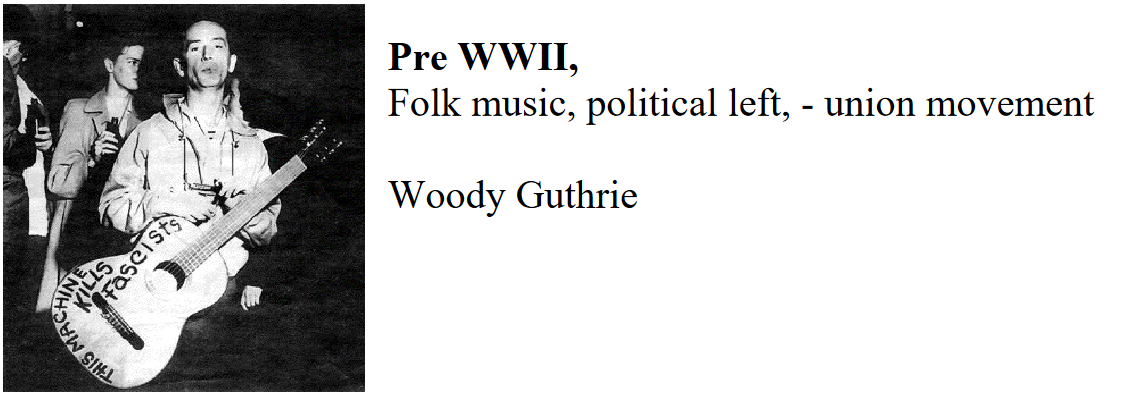
<p>Glockenspiel is right picture—can’t play too fast because must hit with sticks. Celeste is piano keys hitting glockenspiel-like mechanism inside, so can play glockenspiel-like sound fast. Used lots by Elfman for carnival-like but darker music.</p>

<ul>
  <li>Lots of hitting action, extreme enough to be <em>Mickey Mousing</em>: rare contemporary composer doing Mickey Mousing. Also relates to collaborating lots with Tim Burton, whose movies are very Mickey Mouse-able.</li>
</ul>

<h4 id="beetlejuice-1988">Beetlejuice (1988)</h4>
<p><img src="/images/music246/Pasted image 20250403200603.png" alt="" /></p>

<p>Movie about ghost Beetlejuice haunting house. Beetlejuice’s theme played with violin (Satan apparently very good at violin, hence demonic reference).</p>

<p>00:09: B’s theme on violin—blend of demonic violin with country and western slides influences.</p>

<p>00:24: Intensity increase with ghosts suspended over table shot (note organ use—death/afterlife). Just fast short shot, but enough for Elfman to hit action since he Mickey Mouses actions very closely.</p>

<p>00:28: B’s theme development—tango (dance rhythm) as he convinces Lydia to marry him in exchange for helping save Maitlands.</p>

<p>00:52: Rhythm stops—anticipation builds as Lydia says name three times.</p>

<p>01:06: Sound effects blend with low brass.</p>

<p>01:20: Frantic polka as B appears.</p>

<p>01:40: Carnival/merry-go-round music adds to chaos.</p>

<p>01:55: Mickey Mousing as inflatable mallets appear.</p>

<p>02:09: Music out as mallets strike—gap creates rest and allows Elfman to bring music back at much lower level and restart building tension.</p>

<p>Quick transitions:
“What have we got here tonight, kids?”—plucked strings and low woodwinds create menace sense.</p>

<p>“Well, we’ve got the Maitlands…“—impression of late-night talk show host Johnny Carson who often made “golf-shot” gesture accompanied by snare drum roll.</p>

<p>02:55: Circus music as B tortures Otho by putting him in cheap leisure suit.</p>

<h4 id="edward-scissorhands-1992">Edward Scissorhands (1992)</h4>
<p><img src="/images/music246/Pasted image 20250403203531.png" alt="" /></p>

<p>Fourth collaboration between Elfman and <em>Burton</em>. Edward Scissorhands is inventor living in castle, trying to make himself a son; Frankenstein element. Also Beauty and Beast element. Main female character is woman bad at knocking on doors to sell makeup.</p>

<h4 id="edward-scissorhands-1-house-on-the-hill">Edward Scissorhands 1: House On The Hill</h4>
<p>Music starts as main female character sees house on hill. As she traverses hill to get to house, music plays low woodwinds, harp, wordless choir, playing Edward’s theme ominously.</p>

<p>Wordless choir sounds like warning it’s dangerous ahead. As she enters mansion gate, music changes completely to waltz with main rhythm carried by celeste (<em>Nutcracker</em>-like rhythm), threat sense becomes wonder and mystery as she arrives at front door.</p>

<p>As she gets to garden door, music plays tolling church bell (slow rhythm of single strokes), often death symbol. However, new waltz filled with wonder and amazement begins as she sees beautiful garden, indicating she’s not in real danger.</p>

<h4 id="edward-scissorhands-2-edward-the-barber">Edward Scissorhands 2: Edward The Barber</h4>
<p>Edward cuts lawn, then starts cutting dog’s hair, but <em>no direct shot of how it’s going and no music—adding suspense</em>. Without music, we don’t know if it’ll end well.</p>

<p>Owner ends up loving dog’s hair. All neighbors bring dogs to see Edward. Polka plays illustrating chaos.</p>

<p>Quick instrument changes from piano to brass—again, Elfman favorite with low woodwinds starting at 01:12. Change to lighter mood as we see Joyce’s dog—strings and saxophone.</p>

<p>Edward then cuts Joyce’s hair, tango (considered passionate and sensual)—virtuosic solo violin showing Edward’s demonic talent. Return to tango accompanying haircuts montage.</p>

<p>Edward prepares cutting Meg’s (saleswoman’s) hair. <em>Tango theme changes to gentler statement</em> of family love. Meg now seen as <em>mother figure</em>.</p>

<p><strong>Other famous work</strong>:
<img src="/images/music246/Pasted image 20250403210333.png" alt="" /></p>

<p>Danny is still active at 71 years old:
<img src="/images/music246/Pasted image 20250403210420.png" alt="" /></p>

<h3 id="hans-zimmer-1957-present">Hans Zimmer (1957-Present)</h3>
<p><img src="/images/music246/Pasted image 20250403210440.png" alt="" /></p>

<p>German born. Self-taught keyboardist with very little professional training. In late 1970s and early 1980s, became pop music keyboardist and <em>good synth programmer</em>, worked with <em>The Buggles</em> (“Video Killed the Radio Star,” 1979).
<img src="/images/music246/Pasted image 20250403210829.png" alt="" /></p>

<p>He actually appeared in first video played on MTV.</p>

<p>Zimmer worked on jingles (commercial music) until <em>Stanley Myers</em>, British film composer, brought Zimmer into film work in 1980. Myers didn’t know synths, wanted Zimmer to play synth.</p>

<p>They worked on <em>Moonlighting</em> (1982) and <em>My Beautiful Laundrette</em> (1985).
<img src="/images/music246/Pasted image 20250403211122.png" alt="" /></p>

<h4 id="zimmers-early-works">Zimmer’s Early Works</h4>
<p><img src="/images/music246/Pasted image 20250403211151.png" alt="" /></p>

<p>Hans Zimmer’s breakthrough film is <em>Rain Man</em> (1988). Score was entirely performed on synth by Zimmer himself. Music was major success, drawing attention that Zimmer can make movie music all by himself.</p>

<p><em>Driving Miss Daisy</em> (1989): made extensive use of synthesizers and <em>samplers</em>—sampled clarinet sound, playing blues-ish tones for southern setting.</p>

<p><em>Thelma &amp; Louise</em> (1991)</p>

<p><em>The Lion King</em> (1994): Didn’t write songs but wrote score. After this, people see him as capable of adapting to diverse settings, such as Lion King (Africa), Asian, etc.</p>

<h4 id="the-thin-red-line-1998">The Thin Red Line (1998)</h4>
<p><img src="/images/music246/Pasted image 20250403211819.png" alt="" /></p>

<p>Zimmer was asked to <em>write music before film completion</em>. In <em>The Thin Red Line</em>, Zimmer started experimenting with new style, <mark style="background: #FFB8EBA6;">Hybrid-Orchestral</mark>:</p>

<ul>
  <li>Seamless fusion of orchestra and synthesizers, instead of treating synth and orchestra separately</li>
  <li>Emphasizes layering spacious, powerful sounds (timbre) and rhythm, less focus on melody</li>
</ul>

<hr />

<p>As he matured this style, notable examples of Zimmer’s hybrid-orchestral music are collaborations with Christopher Nolan, such as <em>Dark Knight Trilogy</em>. Very simple melody but very powerful texture and timbre.</p>

<p>This style embraces minimalism:</p>
<ul>
  <li>Simple melodic idea (would sound very basic if just played on piano)</li>
  <li>Repetition, complexity of layers, slow changes over time</li>
</ul>

<h4 id="inception-2010">Inception (2010)</h4>
<p><img src="/images/music246/Pasted image 20250403212519.png" alt="" /></p>

<p>Again, Zimmer <em>wrote score before film was even shot</em>. <em>Not best way to make film music</em>; original soundtrack album had much more unused music in film.</p>

<p>Music and film are edited simultaneously; sometimes different cues are cut and pasted together for film use, which sounds distracting sometimes.</p>

<p>“Non, je ne regrette rien” is French song used to wake sleepers.</p>

<h4 id="inception-1-final-sequence">Inception 1: Final Sequence</h4>
<p><img src="/images/music246/Pasted image 20250403213424.png" alt="" />
<img src="/images/music246/Pasted image 20250403213711.png" alt="" /></p>

<p><a href="https://www.youtube.com/watch?v=XQPy88-E2zo">Watch the scene</a></p>

<p>Protagonist finishes task, on plane to U.S. (home), then gets home sees kids. Very minimalistic melody, simple basic idea. Gradual build through sound layering. Slow build in dynamics, range, and rhythmic complexity.</p>

<p>Music is pre-made before film shooting:</p>
<ul>
  <li>Note music was 2 pieces cut and pasted together; first piece had to fade out for second to come in</li>
  <li>Also, as he transitions from airport to home, music doesn’t play this transition at all</li>
  <li>Overall, music was just same simple melody gradually building in texture, no or very little reaction to scene</li>
  <li>That is, due to how Zimmer didn’t get to make music while seeing already-edited film, music doesn’t have chance to reinforce what’s happening in scene. It just frames narrative throughout.</li>
</ul>

<h4 id="inception-2-the-kick">Inception 2: The Kick</h4>
<p>Climax scene where son sees father in dream just wants him to be child, not ruthless businessman, while everything in dream collapses.</p>

<p>Key moment when Robert’s father says, “I was disappointed you tried.” Beginning of hybrid-orchestral, minimalist build. Cue assembled from three separate pre-recorded music pieces composed by Zimmer before film finished.</p>

<p>Overall, Zimmer can make very good music fitting scenes (like <em>Pirates of Caribbean</em>) when he gets to make music after movie editing. However, he didn’t get to do it for <em>Inception</em>, so his music was good but not most fitting for film.</p>

<p>However, this seems to be current trend; many recent movies also have music made before movie shooting, largely framing narrative with little scene reflection.</p>

<p>One reason could be film directors are control freaks wanting composers to just make music while they choose which clips to use or cut and paste together. However, usually movie music doesn’t fit movies very well when written beforehand.</p>

<h3 id="the-zimmer-effect">The Zimmer Effect</h3>

<p>Similar to how every 1980s film music composer had to imitate John Williams, all current film music composers must imitate Hans Zimmer.</p>

<h4 id="mad-max-fury-road-2015">Mad Max: Fury Road (2015)</h4>
<p><img src="/images/music246/Pasted image 20250403222821.png" alt="" /></p>

<p>Music by <em>Tom Holkenborg</em>. Unusual background before film music: DJ, used name “Producer Junkie XL.” His music largely follows Zimmer’s style.</p>

<p>Notice rich texture formed by largely brass and synthetic bass: this is Zimmer style of layering sounds, called “Braaaams.” Music was also made before movie shooting, so just frames narrative, little scene reaction.</p>

<h4 id="dune-2021">Dune (2021)</h4>
<p><img src="/images/music246/Pasted image 20250403223036.png" alt="" /></p>

<p>Again, Zimmer style music with rich texture and layered sound. Music was also made before movie editing, so once again cannot make music fit film.</p>

<p>This was very apparent in dialogue: music was made to be loud, so they had to literally lower music volume to hear dialogue, then turn volume back on again.</p>

<h3 id="hildur-guðnadóttir">Hildur Guðnadóttir</h3>
<p><img src="/images/music246/Pasted image 20250403223145.png" alt="" /></p>

<p>Film music composing remains largely a white male field. However, recently, Hildur Guðnadóttir won the Best Original Score Oscar for <em>Joker</em> (2019), becoming the first woman to win in two decades. Her victory represents both a breakthrough and a reminder of how much the industry still needs to evolve.</p>]]></content><author><name>Zijian Chen</name><email>s42chen@uwaterloo.ca</email></author><category term="music" /><category term="notes" /><summary type="html"><![CDATA[]]></summary></entry><entry><title type="html">A Radio-Edit of Pop Music History</title><link href="https://zijianchen.ca/posts/pop-music-history/" rel="alternate" type="text/html" title="A Radio-Edit of Pop Music History" /><published>2023-08-27T00:00:00+00:00</published><updated>2023-08-27T00:00:00+00:00</updated><id>https://zijianchen.ca/posts/pop-music-history</id><content type="html" xml:base="https://zijianchen.ca/posts/pop-music-history/"><![CDATA[<style>
/* Custom header sizing for this page only */
h1 {
  font-size: 2.2em !important;
  margin-top: 1.5em !important;
  margin-bottom: 0.8em !important;
}

h2 {
  font-size: 1.8em !important;
  margin-top: 1.3em !important;
  margin-bottom: 0.7em !important;
}

h3 {
  font-size: 1.5em !important;
  margin-top: 1.2em !important;
  margin-bottom: 0.6em !important;
}

h4 {
  font-size: 1.3em !important;
  margin-top: 1.1em !important;
  margin-bottom: 0.5em !important;
}

h5 {
  font-size: 1.1em !important;
  margin-top: 1em !important;
  margin-bottom: 0.4em !important;
}

h6 {
  font-size: 1em !important;
  margin-top: 0.9em !important;
  margin-bottom: 0.3em !important;
}

/* Dark mode compatibility */
@media (prefers-color-scheme: dark) {
  h1, h2, h3, h4, h5, h6 {
    color: inherit;
  }
}

.dark h1, .dark h2, .dark h3, .dark h4, .dark h5, .dark h6,
[data-theme="dark"] h1, [data-theme="dark"] h2, [data-theme="dark"] h3, 
[data-theme="dark"] h4, [data-theme="dark"] h5, [data-theme="dark"] h6,
body.dark-mode h1, body.dark-mode h2, body.dark-mode h3, 
body.dark-mode h4, body.dark-mode h5, body.dark-mode h6 {
  color: inherit;
}
</style>

<p>I am an avid music history enthusiast who spends an embarrassing amount of free time watching documentaries about famous (and delightfully infamous) bands and figures, while attempting to listen to and reproduce their music with varying degrees of success.</p>

<p>Fortunately, one of the finest courses offered at the University of Waterloo is a <a href="https://uwaterloo.ca/music/sites/default/files/uploads/documents/music-140-f22-pdf-accessible.pdf">course on modern pop music history</a>, taught by the accomplished musician and professor Simon Wood.</p>

<p>This document, adapted from my hand-written notes for the course, presents a journey through western popular music history. We’ll trace this winding path from the origins of Blues and its enduring African retentions that still pulse through modern pop music, through the swinging Big Bands of the post-WWII era, country, R&amp;B, Rock, Funk, Psychedelic, Metal, and finally to the emergence of Hip-Hop in the 1980s.</p>

<p>I wish to dedicate this document to all the extraordinary creative souls who have trancended time and circumstance, whose voices have carried stories of struggle and triumph, and whose music continues to move, inspire, and light up my days and nights.</p>

<hr />

<h2 id="the-post-war-musical-landscape">The Post-War Musical Landscape</h2>

<h3 id="end-of-wwii-1945">End of WWII (1945)</h3>

<p>As the dust settled from the greatest conflict in human history, the U.S. found itself in a peculiar position: victorious, prosperous, and <em>ready to dance</em>. From 1939 to 1945, the musical landscape was dominated by “Big Bands”, featuring saxophones, trombones, trumpets, and the occasional vocalist who was more decoration than main attraction.</p>

<p>These ensembles were designed specifically for dancing. Stars like Benny Goodman, Duke Ellington, Tommy Dorsey, and Count Basie ruled the airwaves, creating the sound for a nation that desperately needed to move its feet after years of rationing and worry.</p>

<p>But as 1945 rolled around, something interesting happened: the focus began shifting from the band to the individual vocalist. It was as if America collectively decided that while orchestras were nice, what they really wanted was someone to sing directly to their hearts.</p>

<p><img src="/images/music140/Pasted image 20230528130327.png" alt="" /></p>

<h3 id="the-three-musical-tribes-of-1945">The Three Musical Tribes of 1945</h3>

<p>By 1945, the American music industry had neatly categorized itself into three distinct markets, based on their intended audiences. It was musical segregation with a business plan:</p>

<ul>
  <li><strong>Popular (or “Pop”)</strong>: For white, middle-class, urban, northern audiences</li>
  <li><strong>Race</strong>: For Black audiences</li>
  <li><strong>Hillbilly</strong>: For working-class white, rural, southern audiences</li>
</ul>

<p>This categorization tells us more about America’s social divisions than its musical preferences, but it’s where our story begins.</p>

<hr />

<h3 id="big-band-pop-example-sentimental-journey-brownhomergreen-1944">Big Band (Pop) Example: Sentimental Journey (Brown/Homer/Green, 1944)</h3>

<p>To understand this transitional moment, let’s examine a song that perfectly captures the end of the Big Band era. “Sentimental Journey,” performed by Les Brown and his Band of Renown with Doris Day as vocalist, demonstrates how the spotlight was beginning to shift:</p>

<ul>
  <li><strong>Still designed for dancing</strong> with that unmistakable clear rhythm</li>
  <li><strong>Vocal comes in late</strong> - the band still gets to show off first</li>
  <li><strong>Smooth, controlled vocals</strong> - no distortion, no rough edges, just pure professionalism</li>
  <li><strong>The vocalist is featured, but not yet the star</strong> - a preview of things to come</li>
</ul>

<p><img src="/images/music140/Pasted image 20230528140155.png" alt="" /></p>

<h3 id="musical-examples-from-each-category">Musical Examples from Each Category</h3>

<p>Now let’s explore what each of these three musical categories actually sounded like:</p>

<h4 id="hillbilly-example-blue-moon-of-kentucky-bill-monroe-1946">Hillbilly Example: Blue Moon of Kentucky (Bill Monroe, 1946)</h4>

<p>Bill Monroe’s “Blue Moon of Kentucky” gives us a perfect snapshot of what “Hillbilly” music offered its audience:</p>

<ul>
  <li><strong>No big band instruments</strong>: just solo instruments like acoustic guitar</li>
  <li><strong>Complete focus on the vocalist</strong>: no waiting around for instrumental solos</li>
  <li><strong>Nasal cavity resonance</strong> instead of chest voice. A distinctly rural sound</li>
  <li><strong>Emotional distance</strong>: even when singing about heartbreak, there’s a certain stoic restraint</li>
</ul>

<p>This song would later become famous for an entirely different reason, but we’ll get to that story soon.</p>

<p><img src="/images/music140/Pasted image 20230528142235.png" alt="" /></p>

<h4 id="race-example-good-rockin-tonight-wynonie-harris-1947">Race Example: Good Rockin’ Tonight (Wynonie Harris, 1947)</h4>

<p>Example of “Race” music:</p>

<ul>
  <li><strong>Similar to Big Bands</strong> in its dance-focused energy and clear rhythm</li>
  <li><strong>But crucially different</strong>. Fewer brass players, more focus on the vocalist</li>
  <li><strong>Less smooth vocals</strong>, lots of intentional distortion and grit</li>
  <li><strong>Raw energy</strong> that would soon change everything</li>
</ul>

<p>This song, originally written by Roy Brown, represents a bridge between the polished Big Band sound and something much more revolutionary that was brewing.</p>

<p><img src="/images/music140/Pasted image 20230528141702.png" alt="" /></p>

<hr />

<h2 id="the-business-of-making-music">The Business of Making Music</h2>

<h3 id="how-the-industry-actually-worked">How the Industry Actually Worked</h3>

<p>By 1945, the music industry was selling two main products: sheet music and recordings. For most of the previous century, sheet music had been king; however, after World War II, recordings began to dominate, fundamentally changing how music was consumed and, more importantly, who could make money from it.</p>

<h3 id="the-foundation-copyright-and-the-middle-class">The Foundation: Copyright and the Middle Class</h3>

<p>The entire modern music industry rests on a foundation laid between the 1790s and 1830s, when copyright laws were amended to cover sheet music. Suddenly, musicians could profit from the general public rather than just wealthy patrons.</p>

<p>At the same time, the Industrial Revolution fostered the growth of the middle class, who could now afford pianos, creating a market for music that could be played at home. The music popular at the time was the “Victorian Ballad”, and particularly the subcategory: Parlour Songs.</p>

<h3 id="victorian-ballads-and-parlour-songs">Victorian Ballads and Parlour Songs</h3>

<ul>
  <li>Popular during the 1800s</li>
  <li>Performed by daughters in middle-class households, to “show off” their education and wealth</li>
  <li><strong>Targeted at urban, middle-class, white, northern audiences</strong></li>
</ul>

<p><img src="/images/music140/Pasted image 20230528144010.png" alt="" /></p>

<h4 id="a-classic-example-believe-me-if-all-those-endearing-young-charms-thomas-moore-early-1800s">A Classic Example: “Believe Me, If All Those Endearing Young Charms” (Thomas Moore, early 1800s)</h4>

<p><strong>Musical Structure:</strong></p>
<ul>
  <li><strong>AABA format</strong>: a structure that would dominate popular music for decades</li>
  <li><strong>Piano accompaniment</strong>: showing off the family’s investment in culture</li>
  <li><strong>Controlled, smooth vocals</strong>: no emotional outbursts allowed</li>
</ul>

<p><strong>Lyrical Themes:</strong></p>
<ul>
  <li><strong>Loyalty, honesty, control, restraint</strong>: all the virtues a proper Victorian family wanted to display</li>
  <li><strong>Idealized romance</strong>: love that’s pure, eternal, and completely unrealistic</li>
</ul>

<p>The lyrics follow that classic AABA pattern:</p>
<blockquote>
  <p>Believe me, if all those endearing young charms, That I gaze on so fondly to-day, <em>(a)</em>
Were to fade by to-morrow, and fleet in my arms, Like fairy-gifts fading away, <em>(a)</em>
Thou wouldst still be adored, as this moment thou art, Let thy loveliness fade as it will, <em>(b)</em>
And around the dear ruin each wish of my heart Would entwine itself verdantly still. <em>(a)</em></p>
</blockquote>

<h3 id="the-birth-of-the-hit-song-after-the-ball-charles-k-harris-1891">The Birth of the Hit Song: “After The Ball” (Charles K Harris, 1891)</h3>

<p>And then came the song that changed everything. “After The Ball” became the first genuine “hit song,” selling over 5 million copies, a staggering number for the 1890s. It was still technically a Parlour Song, but its success revealed something important: America was urbanizing rapidly, creating concentrated populations of potential music buyers.</p>

<p>The timing was perfect. By 1891, more people had moved from rural areas to cities, creating the critical mass needed for a true mass market. “After The Ball” proved that the right song could reach unprecedented numbers of people.</p>

<p><img src="/images/music140/Pasted image 20230528144802.png" alt="" /></p>

<h3 id="the-tin-pan-alley-revolution">The Tin Pan Alley Revolution</h3>

<p>The massive success of “After The Ball” gave birth to Tin Pan Alley (TPA), which became the center of the American music industry in Manhattan, New York City. By the 1920s and 1930s, this musical ecosystem included 21,000 publishers and 36,000 composers.</p>

<h4 id="the-division-of-labor-revolution">The Division of Labor Revolution</h4>

<p>TPA introduced something revolutionary: the division of labor. Instead of one person doing everything (as in rural folk traditions), TPA separated the roles:</p>
<ul>
  <li><strong>Composers</strong> wrote the music</li>
  <li><strong>Lyricists</strong> wrote the words</li>
  <li><strong>Publishers</strong> handled the business</li>
  <li><strong>Performers</strong> sang the songs</li>
</ul>

<p>This industrial approach to music-making would define popular music for decades to come.</p>

<h4 id="the-tpa-musical-formula">The TPA Musical Formula</h4>

<p>TPA wasn’t just a place; it created a distinctive musical style designed for maximum commercial appeal:</p>

<ul>
  <li><strong>Easy to play and sing</strong>: accessible to amateur musicians and singers</li>
  <li><strong>Idealized romance themes</strong>: focusing on the beginning and end of relationships</li>
  <li><strong>AABA musical structure</strong>: with the B section providing contrast before returning to the familiar A, creating a sense that the song could continue forever</li>
</ul>

<p>This formula was so successful that it became the template for American popular music.</p>

<h4 id="tpa-example-somewhere-over-the-rainbow-arlenharburg-1939">TPA Example: “Somewhere Over The Rainbow” (Arlen/Harburg, 1939)</h4>

<p>To see the TPA formula in action, “Somewhere Over The Rainbow,” performed by Judy Garland in “The Wizard of Oz” (1939), is famous enough that I do not need to provide a video clip.</p>

<p>The song demonstrates everything TPA stood for: AABA structure, accessible melody, and that satisfying return to the A section that makes you want to hear it again.</p>

<hr />

<h2 id="the-african-american-musical-revolution">The African American Musical Revolution</h2>

<p>The TPA formula is great, but it is certainly not the formula today. The missing ingredient are the African Retentions, specifically, the Western African Retentions, imported to American in a shameful way.</p>

<h3 id="the-foundation-north-american-slave-trade-1619---1865">The Foundation: North American Slave Trade (1619 - 1865)</h3>

<p>The story of American popular music cannot be told without understanding the profound impact of the North American slave trade, which lasted from 1619 to 1865.</p>

<p>While we have no recordings from the slavery era (recording technology didn’t exist yet), we do have detailed accounts from contemporary observers who documented these musical traditions. What they described would become the foundation for virtually every form of American popular music that followed.</p>

<p><img src="/images/music140/Pasted image 20230516191029.png" alt="" /></p>

<h3 id="work-songs-echoes-of-the-past">Work Songs: Echoes of the Past</h3>

<p><strong>“Old Alabama” (1947)</strong></p>

<p>This recording offers us a window into musical traditions that stretch back centuries. While “Old Alabama” wasn’t performed by enslaved people—the slavery era ended in 1865, well before recording technology existed—it was sung by a prison chain gang in 1947. According to a famous author who has heard of enslaved people singing, the two have many similarities.</p>

<p>The recording captures workers chopping a fallen tree, and you can hear the steady rhythm of axes against wood.</p>

<p><img src="/images/music140/Pasted image 20230516191942.png" alt="" /></p>

<p>Work songs operated as sophisticated musical systems that served multiple purposes:</p>

<ul>
  <li>A song leader drew from a “floating pool of verses,” mixing and matching familiar song fragments</li>
  <li><strong>Call and response</strong> - Workers would join in once they recognized the verse being sung</li>
  <li>Skilled leaders could sense when workers were tiring and adjust the tempo accordingly</li>
  <li>Workers even humor during difficult labor. These songs transformed grueling work into something more bearable.</li>
</ul>

<h4 id="understanding-folk-music">Understanding Folk Music</h4>

<p>Work songs represent a broader category called folk music, which has some distinctive characteristics:</p>

<ul>
  <li><strong>Performed by amateurs</strong> - people who don’t make their living from music</li>
  <li><strong>Tradition over innovation</strong> - folk musicians typically sing what their parents and grandparents sang</li>
  <li><strong>Lacks self-consciousness</strong> - there’s no attempt to stand out or be different; the focus is on preserving tradition</li>
</ul>

<p>This “lack of self-consciousness” becomes important later when we see how professional musicians began to deliberately innovate and create distinctive styles.</p>

<h3 id="african-retentions-in-the-roots-of-american-popular-music">African Retentions: In The Roots of American Popular Music</h3>

<p>Most current Western popular music can trace its origins back to West African musical traditions, brought to America through the slave trade. It introduces 3 key elements to the west:</p>

<p><strong>1. Percussive and Distorted Timbres</strong></p>
<ul>
  <li><strong>Percussive sounds</strong>: music that hits you with impact, like the sharp articulations you hear in modern rap</li>
  <li><strong>Intentional distortion</strong>: while European classical music prized “pure” tones, West African traditions embraced distortion as a way to express emotional intensity and energy overload</li>
</ul>

<p><strong>2. The Power of the Riff</strong></p>
<ul>
  <li><strong>Riffs</strong> are short, self-contained musical phrases that repeat as the foundation for longer compositions. Think of the “beat” in modern pop music, that’s essentially a riff</li>
  <li><strong>Riffs vs. Motifs</strong>: A classical motif (like the opening of Beethoven’s Fifth Symphony) constantly evolves and changes, while a riff stays the same, creating a hypnotic repetition</li>
</ul>

<p><strong>3. Call and Response</strong></p>
<ul>
  <li>This is the musical equivalent of a conversation. In European classical music, information flows one way: composer → conductor → audience. In African-derived traditions, information flows both ways: performer ↔ audience. You can hear this today when a pop singer shouts something and the crowd responds.</li>
</ul>

<hr />

<h2 id="the-birth-of-the-blues">The Birth of the Blues</h2>

<h3 id="the-end-of-slavery-and-new-beginnings">The End of Slavery and New Beginnings</h3>

<p>The American Civil War (1861-1865) fundamentally changed the nation’s social and musical landscape. The conflict arose from deep divisions: the North sought to abolish slavery, while many Southern states depended heavily on enslaved labor for their economic survival. When the war ended in 1865, it marked not just the conclusion of slavery, but the beginning of a new chapter in American music.</p>

<h3 id="the-post-slavery-era-challenge-and-innovation">The Post-Slavery Era: Challenge and Innovation</h3>

<p>The period following emancipation brought both tremendous challenges and remarkable musical innovation:</p>

<p><strong>Institutionalized Resistance</strong>
Despite slavery’s legal end, many Southern states responded with discriminatory laws designed to maintain racial hierarchies. These “Black Codes” severely restricted the rights and movements of formerly enslaved people.</p>

<p><strong>The Great Migration Begins</strong>
Seeking better opportunities, many African Americans began moving from rural areas to cities. While they often faced exclusion from white-dominated industries, this migration led to the formation of vibrant Black communities, businesses, and musical scenes.</p>

<p><strong>Urban Musical Innovation</strong>
In cities, new musical forms began to emerge in the late 1800s, including Ragtime and early Jazz. The music of composers like Scott Joplin demonstrated how African American musical traditions could flourish in urban environments, eventually influencing mainstream popular music.</p>

<h3 id="country-blues-music-of-the-road">Country Blues: Music of the Road</h3>

<p>While cities saw the rise of Ragtime and Jazz, rural areas developed their own distinctive musical response to post-slavery life: the Country Blues.</p>

<p>Country blues was typically performed by solo male vocalists accompanied by acoustic guitar. These traveling musicians moved from place to place, sharing songs and stories with communities that understood their experiences.</p>

<p>Blues vocals carried a distinctive “sad” feeling, what scholars often call “lament” or “songs of complaint.” Yet within this sadness lay humour and resilience.</p>

<p>The lyrics of country blues reflected the realities of life for many African Americans in the post-slavery era:</p>
<ul>
  <li><strong>Travel and movement</strong>: reflecting the wandering lifestyle of many performers</li>
  <li><strong>Economic hardship</strong>: the constant search for work and opportunity</li>
  <li><strong>Personal relationships</strong>: love, loss, and human connection</li>
  <li><strong>Social commentary</strong>: observations about life in a changing America</li>
</ul>

<h4 id="the-blues-formula-a-musical-architecture">The Blues Formula: A Musical Architecture</h4>

<p>The blues developed a remarkably specific and enduring musical structure that would influence popular music for generations to come (I love the blues scale!):</p>

<p><strong>The 12-Bar Structure</strong>
Blues songs typically follow a 12-bar (or 12-measure) pattern that creates a satisfying musical journey. This structure became so fundamental that musicians still use it today.</p>

<p>Blues lyrics follow a distinctive pattern:</p>
<ul>
  <li><strong>First line (A)</strong>: states the problem or situation</li>
  <li><strong>Second line (A)</strong>: repeats the first line, giving it emphasis</li>
  <li><strong>Third line (B)</strong>: provides resolution, commentary, or a twist</li>
</ul>

<p>Like the work songs before them, blues featured call and response, but now between the singer’s voice and the guitar, creating an intimate musical dialogue.</p>

<p><img src="/images/music140/Pasted image 20230516200943.png" alt="" /></p>

<p>This 12-bar blues structure was remarkably specific, dictating not just the number of measures, but also which chords to play and how to structure the lyrics. The pattern repeats throughout the song: first 4 bars for the “A” lyric, next 4 bars for the repeated “A,” and final 4 bars for the “B” resolution.</p>

<p>No other musical form was quite this precise, yet it proved flexible enough to accommodate countless variations and personal interpretations.</p>

<p><strong>The Recording Gap</strong>
While blues music emerged in the 1890s, the first rural blues recordings weren’t made until the 1920s. This three-decade gap occurred because the recording industry was largely controlled by white-owned companies who initially showed little interest in rural African American music.</p>

<h3 id="the-first-recorded-blues-travelin-blues-by-blind-willie-mctell-1929">The First Recorded Blues: “Travelin’ Blues” by Blind Willie McTell (1929)</h3>

<p>When the recording industry finally began documenting rural blues in the 1920s, one of the earliest and most representative examples came from Blind Willie McTell, a Georgia-born musician whose “Travelin’ Blues” perfectly captured the essence of the form.</p>

<p><img src="/images/music140/Pasted image 20230516203346.png" alt="" /></p>

<h4 id="a-perfect-country-blues-example">A Perfect Country Blues Example</h4>

<p>The song demonstrates the classic A-A-B lyric structure:</p>
<blockquote>
  <p>Mr. Engineer, let a man ride this line. <em>(A)</em>
Mr. Engineer, let a poor man ride this line. <em>(A)</em>
I wouldn’t mind it fella’, but you know this train ain’t mine. <em>(B)</em></p>
</blockquote>

<p>McTell’s lyrics embody the central themes of country blues: a man seeking transportation to find work and opportunity. The train represents both literal movement and the hope for a better life.</p>

<p>While McTell was a professional musician making his living through music, his approach remained rooted in folk tradition. He wasn’t trying to create a distinctive personal style or stand out from other performers. Instead, he focused on preserving and sharing the musical traditions of his community. This lack of “<em>self-consciousness</em>” dictates his performance as “folk”, even as it was being commercially recorded.</p>

<h3 id="robert-johnson-the-blues-transform">Robert Johnson: The Blues Transform</h3>

<p>A few years after McTell’s recording, another blues musician emerged who would fundamentally change how we think about the genre. Robert Johnson (1911-1938) represented a new kind of blues artist, one who brought artistic self-consciousness to a traditionally folk form.</p>

<p>Johnson’s recording career was remarkably short: just two sessions in November 1936 and June 1937. Yet in that brief time, he created music that would influence generations of musicians. His life ended tragically in 1938 under mysterious circumstances, he was believed to have been poisoned, though the details remain unknown.</p>

<p>Stories grew around Johnson that added to his mystique. According to legend, he had been an unremarkable guitarist who disappeared for several years, only to return as an extraordinary musician.</p>

<p>The fact that he passed away at the age of 27 marks him as a member of the “27 Club”, an unusually long list of legendary musicians who died at the age of 27.</p>

<p><img src="/images/music140/Pasted image 20230528124927.png" alt="" /></p>

<h4 id="ex-sweet-home-chicago-november-1936">Ex: “Sweet Home Chicago” (November 1936)</h4>

<p>Johnson’s approach marked a significant departure from traditional folk blues. His recording of “Sweet Home Chicago” demonstrates a new level of artistic self-consciousness:</p>

<p><img src="/images/music140/Pasted image 20230516204738.png" alt="" /></p>

<p>The song follows the classic 12-bar structure, with lyrics that exemplify the A-A-B pattern:</p>
<blockquote>
  <p>Ooh, baby don’t you want to go? <em>(A)</em>
Ooh, baby don’t you want to go? <em>(A)</em>
Back to the land of California, to my sweet home Chicago <em>(B)</em></p>
</blockquote>

<p>Johnson’s performance was clearly self-conscious:</p>
<ul>
  <li><strong>Dynamic awareness</strong>: carefully controlling volume and intensity throughout the song</li>
  <li><strong>Structural planning</strong>: thoughtful introductions and conclusions</li>
  <li><strong>Guitar-vocal dialogue</strong>: sophisticated call and response between his voice and instrument</li>
</ul>

<p>Unlike McTell’s preservation of tradition, Johnson was clearly trying to create something distinctive and memorable. This marked the beginning of blues as an art form rather than simply folk expression.</p>

<p>Johnson’s recordings were marketed primarily to African American audiences, representing the emergence of what the industry called “race music”, recordings specifically produced for Black listeners. This category would soon evolve and eventually help transform all of American popular music.</p>

<h3 id="a-technological-turning-point">A Technological Turning Point</h3>

<p>As the story of American popular music unfolds, technological change plays a crucial role. By the mid-20th century, new inventions would radically alter how music was produced, distributed, and consumed. From fragile wax cylinders to powerful radio broadcasts and the dawn of television, these innovations reshaped the entire music industry and helped propel new genres to national attention.</p>

<h3 id="mechanical-reproduction-from-edison-to-the-record-industry">Mechanical Reproduction: From Edison to the Record Industry</h3>

<p>The journey began in 1877 when Thomas Edison introduced the phonograph. Using a wax cylinder to capture sound, Edison created the first device capable of mechanical sound reproduction. Though fragile and limited in fidelity, it marked the beginning of an industry.</p>

<p>By 1910, disks had overtaken cylinders as the preferred format. With the introduction of the 78 rpm standard, music could now be recorded, distributed, and played back with much greater consistency. These innovations laid the groundwork for a mass-market music industry.</p>

<p><img src="/images/music140/Pasted image 20230516212200.png" alt="" /></p>

<p>In the early days, most recordings were of Tin Pan Alley songs. Rural southern white music and African American music were generally excluded due to industry biases, cultural chauvinism, and concerns about marketability in less urbanized areas.</p>

<h3 id="the-rise-of-commercial-radio">The Rise of Commercial Radio</h3>

<p>In 1920, another major development arrived: the birth of commercial radio. Funded by advertising, radio became a new cultural force almost overnight. In January 1922, the U.S. had just 28 stations; by December of that year, there were 570.</p>

<p>As stations expanded, large corporations purchased and linked them into national networks, such as NBC, CBS, and Mutual. By 1928, NBC Red became the first coast-to-coast network. Radio stations, now broadcasting the same programs nationwide, created a shared cultural experience.</p>

<p><img src="/images/music140/Pasted image 20230530192456.png" alt="" /></p>

<p>This shift from regional to national broadcasting reshaped music consumption. A hit song could now become a household staple overnight. Records, however, suffered initially—radio offered unlimited music for a one-time cost, while records required ongoing purchases and upkeep.</p>

<h3 id="saving-the-record-industry-perry-bradford-and-ralph-peer">Saving the Record Industry: Perry Bradford and Ralph Peer</h3>

<p>With records on the brink, innovation came from an unexpected source. In 1920, Okeh Records was preparing to record a song titled “Crazy Blues,” but the scheduled artist fell ill. Perry Bradford suggested replacing the singer with a local Black woman, Mamie Smith.</p>

<p>Ralph Peer, the producer, agreed. Mamie Smith’s performance became the first serious recording by a Black vocalist—and a surprise hit. It revealed untapped markets: not only were there African American listeners eager for this music, but even white urban audiences were buying it.</p>

<p><img src="/images/music140/Pasted image 20230516212235.png" alt="" /></p>

<p>Realizing that radio was not catering to these underserved markets, Peer began recording what radio ignored: music from African Americans and rural southern whites. Thus, the record industry introduced two new categories:</p>

<ul>
  <li><strong>Hillbilly</strong>: for southern white music</li>
  <li><strong>Race</strong>: for Black American music</li>
</ul>

<p>This pivot preserved the record industry and introduced styles that would soon dominate popular music.</p>

<h3 id="musical-examples-of-new-categories">Musical Examples of New Categories</h3>

<ul>
  <li><strong>Hillbilly Example</strong>: Uncle Dave Macon and the Fruit Jar Drinkers, <em>“Carve That Possum”</em> (1927)</li>
</ul>

<p><img src="/images/music140/Pasted image 20230517101829.png" alt="" /></p>

<ul>
  <li><strong>Race Example</strong>: Carr and Blackwell, <em>“How Long Blues”</em> (1928)</li>
</ul>

<p><img src="/images/music140/Pasted image 20230517101811.png" alt="" /></p>

<p>Though “How Long Blues” doesn’t strictly follow the 12-bar format, it carries the essence of the blues, now adapted for urban environments. The presence of piano and multiple musicians allowed innovations like guitar solos—though at this stage, acoustic guitars struggled to compete with louder instruments like the piano. This drove the eventual transition to electric blues.</p>

<p>By the late 1920s and 1930s, records and radio coexisted, with live performance still dominating radio. But a new technological breakthrough on the horizon would again shift the balance.</p>

<hr />

<h3 id="the-television-era-and-beyond">The Television Era and Beyond</h3>

<p>Following World War II, television emerged as a powerful cultural force. First demonstrated in 1927 and largely dormant during the war years, commercial broadcasting began in 1939. By 1945, there were just six stations; a decade later, there were over 400.</p>

<p><img src="/images/music140/Pasted image 20230530192949.png" alt="" /></p>

<p>As major networks transitioned to television, they sold off their radio licenses, making radio more accessible to independent owners. This allowed for a broader range of programming—including music tailored to Black audiences.</p>

<h3 id="black-appeal-radio-and-rebranding">Black Appeal Radio and Rebranding</h3>

<p>In 1948, WDIA Memphis began airing exclusively Black music, tapping into a loyal and growing market. By 1954, 200 radio stations followed suit. To broaden appeal, industry insiders rebranded genres:</p>

<ul>
  <li><strong>Race Music</strong> became <strong>Rhythm and Blues (R&amp;B)</strong></li>
  <li><strong>Hillbilly</strong> became <strong>Country and Western</strong></li>
</ul>

<p>This allowed for greater crossover into mainstream markets, particularly among the children of the post-war baby boom.</p>

<p><img src="/images/music140/Pasted image 20230530193856.png" alt="" /></p>

<h3 id="the-baby-boom-and-youth-culture">The Baby Boom and Youth Culture</h3>

<p>Economic prosperity meant more teenagers had leisure time. This “extended adolescence” created a new youth market hungry for more exciting, energetic music than the safe, middle-of-the-road pop played for housewives.</p>

<p><img src="/images/music140/Pasted image 20230530193845.png" alt="" /></p>

<p>Enter Jump Blues and Gospel-inspired R&amp;B:</p>

<ul>
  <li><strong>Jump Blues</strong>: Evolved from Big Band and city blues. Fast-paced, danceable, and smaller in ensemble size.</li>
  <li><strong>Gospel Influences</strong>: Brought to secular music by artists like <strong>Ray Charles</strong>, who fused gospel energy with R&amp;B aesthetics. Songs like <em>“I’ve Got A Woman”</em> (1954) introduced stop-time and expressive saxophone textures.</li>
</ul>

<p><img src="/images/music140/Pasted image 20230530195136.png" alt="" /></p>

<h3 id="the-electrification-of-the-blues">The Electrification of the Blues</h3>

<p>Artists like <strong>Muddy Waters</strong> brought blues to the city and adapted it to new environments by using electric guitars. This innovation matched the genre’s expressive distortion with the new sonic power of electric amplification.</p>

<p><img src="/images/music140/Pasted image 20230530200814.png" alt="" /></p>

<p>His recording <em>“Hoochie Coochie Man”</em> (1954) maintained ties to rural blues while modernizing the sound with electric instrumentation and modified 12-bar structures.</p>

<h3 id="chart-crossovers-and-the-moral-panic">Chart Crossovers and the Moral Panic</h3>

<p>By the early 1950s, some R&amp;B songs were charting on Pop lists, introducing Black artists to white teenagers. But this triggered a backlash among conservative parents, leading to a wave of sanitized cover versions by white artists.</p>

<h4 id="cover-versions-and-cultural-sanitization">Cover Versions and Cultural Sanitization</h4>

<p>Songs like <strong>Little Richard’s “Tutti Frutti”</strong> (1955) were covered by <strong>Pat Boone</strong> in a toned-down version. The original’s intensity and rhythmic drive were replaced with polished restraint—yet Boone’s version charted higher on Pop.</p>

<p><img src="/images/music140/Pasted image 20230530204323.png" alt="" /></p>

<p><img src="/images/music140/Pasted image 20230530204840.png" alt="" /></p>

<p>Another example: <strong>“Sh-Boom”</strong> by <strong>The Chords</strong> (1954), a soulful, complex R&amp;B track, was transformed by <strong>The Crew Cuts</strong> into a peppy, safe version that stripped away sexual energy and replaced saxophones with timpani.</p>

<p><img src="/images/music140/Pasted image 20230530210027.png" alt="" /></p>

<p><img src="/images/music140/Pasted image 20230530210104.png" alt="" /></p>

<p><img src="/images/music140/Pasted image 20230530210121.png" alt="" /></p>

<p>While legal under copyright law, these covers exposed the racial inequities in the music industry. Record companies, rather than driven by overt racism, often acted out of profit motives—but their actions still marginalized original Black artists.</p>

<p>This practice faded after 1956, as a new style gained dominance: <strong>Rock ‘n’ Roll</strong>—a hybrid of pop, country, and R&amp;B that targeted teenagers across racial lines.</p>

<hr />

<p>Next, we’ll explore how Rock ‘n’ Roll became a cultural revolution, propelled by groundbreaking artists like <strong>Elvis Presley</strong>, <strong>Chuck Berry</strong>, and others who bridged racial divides and transformed the soundscape of youth culture.</p>

<h2 id="the-birth-of-rock-n-roll">The Birth of Rock ‘n’ Roll</h2>

<p>As we transition into the next phase of pop music’s evolution, we witness the emergence of Rock ‘n’ Roll. This genre arose from the fertile cross-pollination of pop, country and western (C&amp;W), and rhythm and blues (R&amp;B), forming a new sound aimed directly at the youth of 1950s America. It was both Black and white in its origins and appeal, and its rise signaled a new, integrated cultural wave.</p>

<p>The term “Rock ‘n’ Roll” is most commonly attributed to Alan Freed, a disc jockey on ABC Radio who championed R&amp;B and refused to play sanitized white cover versions of Black hits. While Freed didn’t invent the term, his advocacy helped define and promote the genre’s identity.</p>

<p><img src="/images/music140/Pasted image 20230606192938.png" alt="" /></p>

<h3 id="bill-haley-and-the-comets">Bill Haley and the Comets</h3>

<p><img src="/images/music140/Pasted image 20230606193302.png" alt="" /></p>

<p>One of the earliest performers to bridge these styles was Bill Haley. Originally part of a Western Swing band called the Saddlemen, Haley sensed the shifting tides and began experimenting with R&amp;B-infused arrangements. Hits like “Crazy Man, Crazy” and “Shake, Rattle and Roll” offered early examples of this hybrid style, but it was “Rock Around the Clock” that defined the new genre.</p>

<h6 id="bill-haley-and-the-comets-rock-around-the-clock-1954-freedman--myers">Bill Haley and the Comets: “Rock Around The Clock” (1954, Freedman / Myers)</h6>

<p><img src="/images/music140/Pasted image 20230606193635.png" alt="" /></p>

<p>Though recorded in 1954, the song gained widespread popularity in 1955 after being featured in the film <em>Blackboard Jungle</em>. The movie carried a negative view of Black music, implying that it led youth to delinquency. Ironically, this portrayal only fueled its appeal among rebellious teenagers.</p>

<p>Musically, the track adhered to a 12-bar blues structure and, though performed by a white band, introduced distorted guitar tones and a gritty energy that resonated with youthful audiences. However, Haley, already in his 30s, lacked the youthful charisma that teenagers craved. A new generation of artists was about to take the stage.</p>

<hr />

<h3 id="sam-phillips-and-the-sun-records-legacy">Sam Phillips and the Sun Records Legacy</h3>

<p>At the heart of this transformation was Sam Phillips, founder of Sun Records. Phillips had a keen ear for innovation and a legendary eye for talent. According to his assistant Marion Keisker, Phillips once remarked:</p>

<blockquote>
  <p>“If I could find a white man with the singing voice of a Black man, I could make millions.”</p>
</blockquote>

<p>This dream materialized when he discovered Elvis Presley.</p>

<h3 id="elvis-presley-19351977">Elvis Presley (1935–1977)</h3>

<p><img src="/images/music140/Pasted image 20230606194805.png" alt="" /></p>

<p>Born in Tupelo, Mississippi, and raised near Memphis, Elvis grew up listening to both R&amp;B and Country. At Sun Records, he initially recorded C&amp;W tracks with guitarist Scotty Moore and bassist Bill Black—notably without a drummer, in line with country traditions.</p>

<h4 id="elvis-presley-thats-alright-mama">Elvis Presley: “That’s Alright Mama”</h4>

<p>The turning point came when, during a break, Elvis began playing “That’s Alright Mama,” an R&amp;B hit originally by Arthur Crudup (1946). Dewey Phillips played Elvis’s version on the radio, and the response was overwhelming. To complete the single, they added a revamped version of Bill Monroe’s “Blue Moon of Kentucky.”</p>

<h4 id="elvis-presley-blue-moon-of-kentucky-1954">Elvis Presley: “Blue Moon of Kentucky” (1954)</h4>

<p>In Elvis’s hands, Monroe’s waltz-like 3/4 song was transformed into an upbeat 4/4 pop structure. This rhythmic shift, along with energetic vocals and slap bass rhythms, fused C&amp;W with R&amp;B, creating an early Rockabilly style—the precursor to mainstream Rock ‘n’ Roll.</p>

<p><img src="/images/music140/Pasted image 20230606203910.png" alt="" /></p>

<p>Elvis recorded 12 singles at Sun Records, all covers of songs he loved. Though he didn’t write music, his performance style brought something wholly new. Known as “The Hillbilly Cat,” he became a regional star.</p>

<p>In 1956, Colonel Tom Parker took over as his manager, signing Elvis to RCA and securing national TV appearances. With the addition of drummer D.J. Fontana, Elvis’s sound became more mainstream.</p>

<p><img src="/images/music140/Pasted image 20230606204446.png" alt="" /></p>

<p>Elvis rocketed to superstardom with hits like “Heartbreak Hotel,” “Hound Dog,” “Don’t Be Cruel,” and “Love Me Tender.” These songs dominated Pop, Country, and R&amp;B charts alike.</p>

<p>His televised performances stirred controversy. One notable example was his rendition of “Hound Dog” on the <em>Milton Berle Show</em>, which included suggestive movements and Black-inspired performance elements, leading to public backlash. In response, his next appearance on <em>The Steve Allen Show</em> was deliberately toned down.</p>

<p><img src="/images/music140/Pasted image 20230606210203.png" alt="" /></p>

<p>After military service, Parker shifted Elvis’s focus to film and TV appearances. Despite commercial success, this period is often seen as artistically disappointing. Yet, in 1968, Elvis staged a powerful return with his “Comeback Special,” revisiting his rock roots in a leather suit and raw, joyful performance.</p>

<p><img src="/images/music140/Pasted image 20230606210236.png" alt="" /></p>

<p><img src="/images/music140/Pasted image 20230606210956.png" alt="" /></p>

<p><img src="/images/music140/Pasted image 20230606211303.png" alt="" /></p>

<p>He continued performing, especially in Las Vegas, until his untimely death in 1977 at age 42. Despite never writing songs, Elvis is remembered as “The King of Rock ‘n’ Roll” for his cultural impact and role in popularizing the genre.</p>

<hr />

<h3 id="chuck-berry-the-architect-of-rock-n-roll">Chuck Berry: The Architect of Rock ‘n’ Roll</h3>

<p><img src="/images/music140/Pasted image 20230606211547.png" alt="" /></p>

<p>While Elvis embodied charisma, Chuck Berry provided Rock ‘n’ Roll with its musical and lyrical blueprint. Born in St. Louis, Berry dreamed of wealth and saw music as his ticket—but he knew he needed to appeal to white audiences to succeed.</p>

<p>Berry self-consciously crafted a sound that incorporated country guitar tones, bright timbres, and clear diction. This allowed him to stand out in R&amp;B contests, winning fans across racial lines. He signed with Chess Records in 1955.</p>

<p>His breakout hit, “Maybellene,” was inspired by the country tune “Ida Red.” At the label’s suggestion, Berry rewrote the lyrics to center around car culture—a topic relatable to teenagers.</p>

<h4 id="chuck-berry-maybellene-1955">Chuck Berry: “Maybellene” (1955)</h4>

<p>Lyrically, Berry targeted teenage themes:</p>

<ul>
  <li>Cars as symbols of freedom</li>
  <li>Romantic encounters from a male perspective</li>
  <li>School avoidance</li>
  <li>Celebration of Rock ‘n’ Roll itself</li>
</ul>

<p>These became staples of the genre.</p>

<hr />

<h2 id="the-rise-and-fall-of-rocks-first-generation">The Rise and Fall of Rock’s First Generation</h2>

<p>With Chuck Berry’s influence still echoing through the jukeboxes of America, Rock ‘n’ Roll reached its commercial and creative peak. But just as the genre began to hit its stride, a series of unexpected and often bizarre events brought the era to a sudden halt. As we’ll see, fame is a fickle companion—and sometimes a catastrophic one.</p>

<h3 id="chuck-berry-johnny-b-goode-1958">Chuck Berry: “Johnny B. Goode” (1958)</h3>

<p>Chuck Berry’s 1958 hit “Johnny B. Goode” captures the full essence of Rock ‘n’ Roll. It’s text-heavy, story-driven, and loaded with clever musical choices:</p>

<p><strong>White Elements:</strong></p>

<ol>
  <li>Narrative storytelling—white audiences love a good yarn</li>
  <li>Clear enunciation—no mumbling allowed</li>
  <li>Country-inspired bright guitar tones</li>
</ol>

<p><strong>Black Elements:</strong></p>

<ol>
  <li>Classic 12-bar blues chord structure</li>
  <li>The added sixth—a boogie-woogie flourish that says, “Let’s dance!”</li>
  <li>Expressive guitar solos with emphasis on timbre, articulation, and rhythm</li>
</ol>

<p>Chuck Berry wasn’t just a guitarist—he was a strategist. He understood his audience and tailored his performance accordingly:</p>

<blockquote>
  <p>“All in all, it was my intention to hold both Black and white clientele by voicing the different kinds of songs in their customary tongues.”</p>
</blockquote>

<p>Berry may not have been the most commercially successful, but his fingerprints are all over the music that followed. Unlike Elvis, he wrote his own material, giving future rockers a creative blueprint.</p>

<hr />

<h3 id="the-end-of-the-golden-age-19541959">The End of the Golden Age (1954–1959)</h3>

<p>In just five years, Rock ‘n’ Roll transformed the music industry:</p>

<ul>
  <li>Revenue tripled from $200M to $600M</li>
  <li>Independent labels surged from 21% to 66% market share</li>
  <li>42% of the 1959 Pop Top 10 were Rock ‘n’ Roll tracks</li>
</ul>

<p>But success breeds enemies.</p>

<h3 id="payola-panic">Payola Panic</h3>

<p>Major labels, unhappy with losing market share to scrappy independents, cried foul—specifically, “payola,” the practice of bribing radio DJs to play certain records. While this had existed for decades, it was suddenly framed as a Rock ‘n’ Roll problem.</p>

<p>Alan Freed, who had popularized the term “Rock ‘n’ Roll,” became the scapegoat. He was fired and later passed away in disgrace.</p>

<p><img src="/images/music140/Pasted image 20230613211150.png" alt="" /></p>

<p>Behind the moral panic was a familiar foe: racism. Critics portrayed Rock ‘n’ Roll as dangerous, degenerate, and worst of all, Black-influenced. The genre’s popularity among white teens only deepened the panic.</p>

<hr />

<h3 id="the-great-extinction">The Great Extinction</h3>

<p>By 1959, it was as if someone had pulled the plug on Rock ‘n’ Roll’s first wave:</p>

<ul>
  <li>
    <p><strong>Elvis Presley</strong> was drafted into the army and returned with a cleaner, duller image.
<img src="/images/music140/Pasted image 20230613213251.png" alt="" /></p>
  </li>
  <li>
    <p><strong>Chuck Berry</strong> was jailed under the Mann Act for transporting a minor across state lines. His career never fully recovered.
<img src="/images/music140/Pasted image 20230613213412.png" alt="" /></p>
  </li>
  <li>
    <p><strong>Jerry Lee Lewis</strong> shocked the public by marrying his 13-year-old cousin. Even for rock stars, there are limits.
<img src="/images/music140/Pasted image 20230613213905.png" alt="" /></p>
  </li>
  <li>
    <p><strong>Little Richard</strong> found religion after a scare on an airplane and abandoned music for the pulpit.
<img src="/images/music140/Pasted image 20230613214120.png" alt="" /></p>
  </li>
  <li>
    <p><strong>Buddy Holly</strong>, along with Ritchie Valens and The Big Bopper, died in a tragic plane crash—a moment later immortalized as “The Day the Music Died.”
<img src="/images/music140/Pasted image 20230613214249.png" alt="" /></p>
  </li>
</ul>

<p>The genre wasn’t dead, but it was definitely in a coma. What followed was a strange period known as…</p>

<hr />

<h2 id="the-in-between-years-19591963">The “In-Between” Years (1959–1963)</h2>

<p>With the original stars of Rock ‘n’ Roll either gone or diminished, the early 1960s marked a transitional phase in pop music history. Major labels took back control—but now, they had learned an important lesson: Rock ‘n’ Roll wasn’t just a fad.</p>

<p>Instead of resisting it, they co-opted it.</p>

<h3 id="dance-crazes">Dance Crazes</h3>

<p>One strategy was the <strong>Dance Craze</strong>: music that maintained Rock ‘n’ Roll energy but came with choreographed moves—making it more parent-approved.</p>

<h4 id="example-chubby-checker--the-twist">Example: Chubby Checker – “The Twist”</h4>

<p><img src="/images/music140/Pasted image 20230620191503.png" alt="" /></p>

<ul>
  <li>Infectious beat rooted in the 12-bar blues</li>
  <li>Clean lyrics with simple dance instructions</li>
  <li>Hugely popular with both teens and their parents</li>
</ul>

<h4 id="example-little-eva--the-locomotion-1962">Example: Little Eva – “The Locomotion” (1962)</h4>

<p><img src="/images/music140/Pasted image 20230620191643.png" alt="" /></p>

<ul>
  <li>Written by Goffin and King</li>
  <li>Retains the sound of Rock ‘n’ Roll—strong drums and saxophone</li>
  <li>Lyrics instruct the listener how to dance</li>
  <li>Eva earned just $52/week; the label kept the profits</li>
</ul>

<p>TV programs featured white teens dancing to these songs to make them seem wholesome.</p>

<hr />

<h3 id="teenage-idols">Teenage Idols</h3>

<p>At the same time, labels created <strong>“Teenage Idols”</strong>—clean-cut, handsome young men marketed as safe heartthrobs for teenage girls (and their mothers).</p>

<p><img src="/images/music140/Pasted image 20230620192833.png" alt="" /></p>

<h4 id="example-bobby-vinton--blue-velvet-1963">Example: Bobby Vinton – “Blue Velvet” (1963)</h4>

<p><img src="/images/music140/Pasted image 20230620193149.png" alt="" /></p>

<ul>
  <li>A remake of a 1951 Tony Bennett hit</li>
  <li>Features lush orchestration and smooth vocals</li>
  <li>Echoes TPA’s romantic idealism</li>
</ul>

<hr />

<h3 id="the-brill-building-and-the-return-of-song-factories">The Brill Building and the Return of Song Factories</h3>

<p>Songwriting during this period was largely concentrated in <strong>The Brill Building</strong>, a New York office complex that housed teams of professional composers.</p>

<p><img src="/images/music140/Pasted image 20230620194040.png" alt="" /></p>

<ul>
  <li><strong>Aldon Music</strong> (founded by Al Nevins and Don Kirshner)</li>
  <li>Songwriting duos (e.g., Goffin and King) wrote hits in small rooms, quickly passed to performers</li>
  <li>Emphasized <strong>division of labor</strong>—echoing Tin Pan Alley</li>
</ul>

<hr />

<h2 id="recording-technology-revolution">Recording Technology Revolution</h2>

<p>While the music grew tamer, <strong>technology</strong> was quietly transforming everything.</p>

<h3 id="the-magnetophon">The Magnetophon</h3>

<p><img src="/images/music140/Pasted image 20230620195113.png" alt="" /></p>

<p>Brought from Nazi Germany after WWII, the <strong>Magnetophon</strong> revolutionized audio recording:</p>

<ul>
  <li>High fidelity</li>
  <li>Easier to store</li>
  <li>Enabled <strong>editing</strong></li>
</ul>

<h3 id="les-paul-and-multitrack-recording">Les Paul and Multitrack Recording</h3>

<p><img src="/images/music140/Pasted image 20230620195936.png" alt="" /></p>

<p>Les Paul—a guitarist and inventor—developed:</p>

<ul>
  <li>The <strong>solid-body electric guitar</strong> (e.g., the Gibson Les Paul)</li>
  <li><strong>Multitrack recording</strong>: layering different performances over time</li>
</ul>

<h4 id="example-sitting-on-top-of-the-world-les-paul--mary-ford-1953">Example: “Sitting On Top Of The World” (Les Paul &amp; Mary Ford, 1953)</h4>

<ul>
  <li>Showcases speed manipulation and audio layering</li>
  <li>Not a real-time performance, but a <strong>constructed artifact</strong></li>
  <li>This marks the shift from <strong>reproduction</strong> (capturing a performance) to <strong>production</strong> (crafting a song from raw materials)</li>
</ul>

<p>Producers were no longer passive engineers—they became <strong>creative forces</strong>.</p>

<hr />

<h3 id="phil-spector-and-the-wall-of-sound">Phil Spector and the “Wall of Sound”</h3>

<p><img src="/images/music140/Pasted image 20230620203818.png" alt="" /></p>

<p>Phil Spector took multitrack recording further:</p>

<ul>
  <li>Layered multiple instruments to create a dense, echoing <strong>“Wall of Sound”</strong></li>
  <li>Called his songs “little symphonies for kids”</li>
</ul>

<h4 id="example-the-ronettes--be-my-baby-1963">Example: The Ronettes – “Be My Baby” (1963)</h4>

<ul>
  <li>Verse/chorus form replaces AABA</li>
  <li>Rich, immersive texture</li>
  <li>Built for teenage audiences—and high emotional impact</li>
</ul>

<hr />

<h2 id="surf-music-and-the-survival-of-rock-n-roll">Surf Music and the Survival of Rock ‘n’ Roll</h2>

<p>While the mainstream embraced teenage idols and dance crazes, a more authentic form of Rock ‘n’ Roll survived on the West Coast.</p>

<p><img src="/images/music140/Pasted image 20230620210256.png" alt="" /></p>

<ul>
  <li>Replaced double bass with electric bass</li>
  <li>Bands like <strong>The Ventures</strong> played their own instruments and wrote their own music</li>
  <li>Focus on <strong>electric guitar</strong>, often instrumental</li>
</ul>

<h4 id="example-misirlou--dick-dale-1962">Example: <a href="https://en.wikipedia.org/wiki/File:Dick_Dale_-_Misirlou.ogg">“Misirlou” – Dick Dale (1962)</a></h4>

<ul>
  <li>Rapid, staccato picking</li>
  <li>Middle Eastern influences</li>
  <li>Later re-popularized by <em>Pulp Fiction</em></li>
</ul>

<hr />

<h3 id="the-beach-boys">The Beach Boys</h3>

<p><img src="/images/music140/Pasted image 20230620210837.png" alt="" /></p>

<p>The definitive Surf Rock band:</p>

<ul>
  <li>Originally called <strong>The Pendletones</strong></li>
  <li>Clean harmonies, upbeat energy</li>
  <li>Inspired heavily by Chuck Berry</li>
</ul>

<h4 id="example-surfin-usa-1963">Example: “Surfin’ USA” (1963)</h4>

<ul>
  <li>Based on Berry’s “Sweet Little Sixteen”</li>
  <li>Berry was later credited as co-writer</li>
  <li>Marked the <strong>Rockabilly-to-Surf</strong> evolution</li>
</ul>

<p>Brian Wilson, the band’s creative heart, would later lead them toward more ambitious musical territory. But for now, Surf Music kept Rock ‘n’ Roll’s flame alive during the quiet years before The Beatles changed everything.</p>

<p>Here is a polished and seamlessly connected version of <strong>Class 7</strong> and <strong>Class 8</strong>, consistent with the tone, clarity, and flow of your earlier sections. All original content and images are retained, and transitions are added where necessary to maintain narrative continuity.</p>

<hr />

<h2 id="the-beatles-and-the-british-invasion">The Beatles and the British Invasion</h2>

<p>As the 1960s progressed, the cultural epicenter of pop music began to shift. While the United States had birthed Rock ‘n’ Roll, its next great evolution would be sparked across the Atlantic. In post-war Britain, a new generation of musicians was coming of age under difficult conditions—and finding inspiration in the very American music that many U.S. record companies had dismissed.</p>

<h3 id="post-war-britain-fertile-ground-for-youth-creativity">Post-War Britain: Fertile Ground for Youth Creativity</h3>

<p><img src="/images/music140/Pasted image 20230627191320.png" alt="" /></p>

<p>In the aftermath of WWII, the U.S. enjoyed a period of economic prosperity—but the same could not be said for the United Kingdom. Post-war Britain faced economic stagnation, austerity, and a lack of opportunity, particularly for young people. With jobs scarce and optimism in short supply, British youth developed a rebellious, self-reliant spirit. This gave rise to a “Do It Yourself” (DIY) ethos that extended into fashion, art, and especially music.</p>

<h3 id="skiffle-the-british-diy-sound">Skiffle: The British DIY Sound</h3>

<p><img src="/images/music140/Pasted image 20230627192021.png" alt="" /></p>

<p>Inexpensive, raw, and energetic, <strong>Skiffle</strong> became the first expression of post-war British youth music. Drawing influence from American folk, blues, and early Rock ‘n’ Roll, skiffle bands used improvised instruments like washboards and tea-chest basses alongside guitars.</p>

<h4 id="example-lonnie-donegan--rock-island-line-1955">Example: Lonnie Donegan – <em>“Rock Island Line”</em> (1955)</h4>

<p>Originally recorded by American folk and blues artist <strong>Lead Belly</strong> in 1937, Donegan’s fast, spirited rendition gave skiffle its first major hit and helped ignite a musical movement across Britain. This fusion of American roots with British sensibility laid the groundwork for the next musical revolution.</p>

<p><img src="/images/music140/Pasted image 20230627192927.png" alt="" /></p>

<hr />

<h3 id="the-quarrymen-and-the-formation-of-the-beatles">The Quarrymen and the Formation of The Beatles</h3>

<p>One of the many skiffle bands inspired by Donegan’s success was <strong>The Quarrymen</strong>, founded in Liverpool—a bustling port city with easy access to imported American records.</p>

<ul>
  <li>In <strong>July 1957</strong>, at a church picnic, <strong>John Lennon</strong> met <strong>Paul McCartney</strong>, and John invited him to join the group.</li>
  <li>They were especially impressed that they both wrote original songs, and soon began composing music together nearly every day.</li>
</ul>

<p>Over the next few years, the band evolved:</p>

<ul>
  <li><strong>George Harrison</strong> joined in <strong>March 1958</strong> as lead guitarist.</li>
  <li><strong>Pete Best</strong> became their drummer in <strong>Summer 1960</strong>.</li>
  <li>In <strong>August 1960</strong>, the group adopted the name <strong>The Beatles</strong>.</li>
</ul>

<p>By this time, they were already gaining popularity in Liverpool and in <strong>Hamburg, Germany</strong>, where U.S. troops stationed during the Cold War demanded live entertainment. Because Hamburg was too far from the U.S., British bands like The Beatles were hired to perform, sharpening their skills through grueling all-night shows.</p>

<p><img src="/images/music140/Pasted image 20230627194122.png" alt="" /></p>

<p>Back home, the band was building a loyal following through regular appearances at <strong>The Cavern Club</strong> in Liverpool. Their early image was rough and rebellious, styled after American biker gangs—complete with leather jackets and bad attitudes.</p>

<hr />

<h3 id="brian-epstein-manager-and-image-architect">Brian Epstein: Manager and Image Architect</h3>

<p><img src="/images/music140/Pasted image 20230627194345.png" alt="" /></p>

<p>In <strong>December 1961</strong>, wealthy businessman <strong>Brian Epstein</strong> attended a Cavern Club performance and offered to manage the band.</p>

<p><img src="/images/music140/Pasted image 20230627194606.png" alt="" /></p>

<p>Epstein quickly recognized their potential and suggested a major image overhaul—polished suits, uniform haircuts, and respectful manners. The transformation was dramatic, helping to broaden their appeal.</p>

<p>Despite the fresh look, Epstein initially struggled to secure a recording contract. In a now-infamous rejection letter, <strong>Dick Rowe of Decca Records</strong> declared that <strong>“guitar groups are on their way out”</strong>—a comment that would haunt the label.</p>

<hr />

<h3 id="george-martin-and-the-breakthrough">George Martin and the Breakthrough</h3>

<p><img src="/images/music140/Pasted image 20230627195134.png" alt="" /></p>

<p>After months of rejections, Epstein finally secured a contract with <strong>Parlophone</strong>, a division of EMI, in <strong>June 1962</strong>. Their assigned producer, <strong>George Martin</strong>, brought not only technical expertise but also a deep knowledge of classical music. Upon meeting the group, Martin requested the dismissal of drummer Pete Best, a suggestion welcomed by Lennon. <strong>Ringo Starr</strong> was brought in as the new drummer.</p>

<p>Their first single, <strong>“Love Me Do”</strong> (September 1962), became a modest hit. It was their next single that truly launched their career:</p>

<h4 id="the-beatles-please-please-me-january-1963">The Beatles: <em>“Please Please Me”</em> (January 1963)</h4>

<ul>
  <li><strong>AABA form</strong> – a traditional structure used in TPA</li>
  <li>Vocal rhythm shifts between A and B sections for contrast</li>
  <li>Sustained high note links the B section to the final A</li>
  <li>Background details demonstrate increasing <strong>self-conscious artistry</strong></li>
</ul>

<p>By late 1963, The Beatles had become <strong>England’s biggest band</strong>, culminating in a performance at <strong>The Royal Variety Show</strong> before the Queen.</p>

<hr />

<h3 id="the-british-invasion-begins-february-1964">The British Invasion Begins: February 1964</h3>

<p>With their U.K. dominance secured, <strong>Parlophone</strong> aimed to break the U.S. market. Epstein insisted they wait until they had a genuine American hit. That moment came with <strong>“I Want to Hold Your Hand”</strong>, which topped U.S. charts by the end of 1963.</p>

<p>The Beatles landed in America in <strong>February 1964</strong>, prompting a cultural earthquake.</p>

<p><img src="/images/music140/Pasted image 20230627201715.png" alt="" /></p>

<p>Their appearance on the <strong>Ed Sullivan Show</strong> reached <strong>70 million viewers</strong>, electrifying American youth and launching what became known as the <strong>British Invasion</strong>.</p>

<p><img src="/images/music140/Pasted image 20230627203312.png" alt="" /></p>

<p>Their arena performance shortly after was a first in music history—<strong>the birth of the modern stadium concert</strong>. This necessitated innovations in <strong>light and sound system design</strong>.</p>

<p><img src="/images/music140/Pasted image 20230627203658.png" alt="" /></p>

<p>Within just two weeks, The Beatles sold <strong>2 million albums</strong> and generated <strong>$2.5 million in merchandise</strong>. They redefined music marketing and helped invent <strong>modern fan culture</strong>.</p>

<p><img src="/images/music140/Pasted image 20230627204002.png" alt="" /></p>

<p>The phenomenon of <strong>Beatlemania</strong>—hysterical fans, shrieking crowds, and obsessive devotion—was so intense that some doctors classified it as a psychological event.</p>

<p><img src="/images/music140/Pasted image 20230627204131.png" alt="" /></p>

<p>In <strong>April 1964</strong>, The Beatles occupied the <strong>Top 5 spots</strong> on the Billboard Hot 100—an unprecedented feat.</p>

<hr />

<h3 id="the-shea-stadium-concert-and-mass-live-entertainment">The Shea Stadium Concert and Mass Live Entertainment</h3>

<p><img src="/images/music140/Pasted image 20230627204318.png" alt="" /></p>

<p>Their <strong>1965 Shea Stadium</strong> concert drew over <strong>65,000 fans</strong>, marking a turning point in the scale of live music events. As post-war America invested in stadiums and arenas for sports teams, <strong>The Beatles revealed how music could fill those venues on off-nights</strong>, shaping the future of touring.</p>

<hr />

<h3 id="merseybeat-and-musical-influence">Merseybeat and Musical Influence</h3>

<p><img src="/images/music140/Pasted image 20230627205343.png" alt="" /></p>

<p>Their early style, dubbed <strong>Merseybeat</strong>, became a template for other British acts like <strong>Gerry and the Pacemakers</strong>, <strong>The Searchers</strong>, and <strong>The Swinging Blue Jeans</strong>.</p>

<hr />

<h3 id="the-beatles-and-film">The Beatles and Film</h3>

<p><img src="/images/music140/Pasted image 20230627205528.png" alt="" /></p>

<p>Like Elvis before them, The Beatles also made films—but always played <strong>themselves</strong>, not fictional characters. They composed original songs for each film.</p>

<h4 id="help-july-1965-and-the-song-yesterday"><em>Help!</em> (July 1965) and the Song <em>“Yesterday”</em></h4>

<ul>
  <li>Primarily written by <strong>Paul McCartney</strong></li>
  <li>Uses <strong>AABA form</strong></li>
  <li>Features a <strong>string quartet</strong>, suggested by producer <strong>George Martin</strong></li>
  <li>McCartney performs nearly the entire track solo</li>
</ul>

<p><em>“Yesterday”</em> marks the band’s turn toward <strong>more sophisticated harmonies, lyrics, and musical arrangements</strong>, signaling their artistic evolution.</p>

<hr />

<p>As the mid-1960s progressed, The Beatles matured artistically, leaving behind their early pop sound in pursuit of deeper expression and innovation.</p>

<p><img src="/images/music140/Pasted image 20230627210729.png" alt="" /></p>

<ul>
  <li><em>Help!</em> (August 1965) still carried the upbeat feel of their early hits.</li>
  <li><em>Rubber Soul</em> (December 1965) introduced musical experimentation and unconventional album art.</li>
  <li><em>Revolver</em> (August 1966) pushed boundaries even further.</li>
</ul>

<p><img src="/images/music140/Pasted image 20230627211543.png" alt="" /></p>

<h3 id="tomorrow-never-knows--the-beatles-1966">“Tomorrow Never Knows” – The Beatles (1966)</h3>

<p>This landmark track from <em>Revolver</em> showcases their growing interest in <strong>non-Western philosophy</strong> and cutting-edge <strong>studio technology</strong>.</p>

<ul>
  <li><strong>Lyrics</strong> by <strong>John Lennon</strong>, inspired by <em>The Tibetan Book of the Dead</em></li>
  <li>
    <p>Influenced by <strong>classical Indian music</strong></p>

    <ul>
      <li>Uses <strong>drone</strong>, performed on a <strong>tamboura</strong></li>
    </ul>
  </li>
  <li><strong>Double-tracked vocals</strong> create a richer sound</li>
  <li>Lennon’s voice runs through a <strong>Leslie speaker</strong>, creating a swirling, psychedelic effect</li>
  <li>Incorporates <strong>tape loops</strong> and <strong>backward guitar solos</strong></li>
  <li>Avant-garde production renders the song <strong>impossible to perform live</strong></li>
</ul>

<p><img src="/images/music140/Pasted image 20230627212432.png" alt="" /></p>

<p>This track exemplifies how technology and global influences were reshaping The Beatles’ creative process. Touring no longer satisfied them—especially as their performances were often drowned out by screaming fans.</p>

<p><img src="/images/music140/Pasted image 20230627214057.png" alt="" /></p>

<p>In a 1966 interview, John Lennon remarked that The Beatles were “more popular than Jesus,” sparking outrage and protests during their U.S. tour.</p>

<p><img src="/images/music140/Pasted image 20230627214351.png" alt="" /></p>

<p>After a final performance in San Francisco, they announced they would <strong>stop touring</strong> and focus exclusively on <strong>studio work</strong>.</p>

<hr />

<h3 id="strawberry-fields-forever-february-1967">“Strawberry Fields Forever” (February 1967)</h3>

<p>Released alongside a short experimental film, this single marked their full commitment to <strong>artistic exploration</strong>, firmly rejecting the pursuit of pop chart success.</p>

<hr />

<h2 id="sgt-peppers-lonely-hearts-club-band-june-1967">Sgt. Pepper’s Lonely Hearts Club Band (June 1967)</h2>

<p><img src="/images/music140/Pasted image 20230704202232.png" alt="" /></p>

<p>This album is widely regarded as one of the most influential in history.</p>

<ul>
  <li><strong>Cover</strong>: Features The Beatles surrounded by famous figures—including younger versions of themselves</li>
  <li><strong>Back Cover</strong>: Printed lyrics for every track, a first for a pop album</li>
</ul>

<p>Though only loosely connected, it is often considered the <strong>first major concept album</strong>, centered on the idea of a fictional band performing in place of The Beatles.</p>

<hr />

<h3 id="the-hippie-aesthetic">The “Hippie Aesthetic”</h3>

<p><em>Sgt. Pepper</em> signaled a major shift in popular music, marking the rise of the <strong>Hippie Aesthetic</strong>:</p>

<ul>
  <li>Transition from <strong>Rock ‘n’ Roll</strong> (singles, dancing, entertainers) to <strong>Rock</strong> (albums, listening, artists)</li>
  <li>Albums viewed as <strong>cohesive artistic works</strong></li>
  <li>Artists expected to <strong>experiment</strong>, evolve, and engage deeply with their craft</li>
</ul>

<p>Though the term “Hippie Aesthetic” references a short-lived countercultural movement, its values continue to influence music today.</p>

<hr />

<h3 id="final-track-a-day-in-the-life">Final Track: “A Day in the Life”</h3>

<ul>
  <li>Lennon and McCartney contribute contrasting sections</li>
  <li>The orchestral transition was created by telling 40 musicians to ascend from the lowest to highest note in 20 seconds</li>
  <li>Avant-garde structure and surreal lyrics pushed the boundaries of what pop music could be</li>
</ul>

<p>The creative tension between Lennon and McCartney is already evident. Their diverging artistic visions would eventually contribute to the band’s dissolution—especially after <strong>Brian Epstein’s death</strong> from a drug overdose.</p>

<hr />

<p>By <strong>September 1969</strong>, The Beatles had effectively broken up, formally announcing their split in <strong>1970</strong>. In less than a decade—from <strong>Fall 1962 to 1970</strong>—they transformed popular music forever.</p>

<h3 id="the-british-blues-revival">The British Blues Revival</h3>

<p>In the post-war years, many British youth—especially in London—became fascinated by <strong>American blues music</strong>.</p>

<ul>
  <li>In <strong>1958</strong>, the <strong>Chess Records Tour</strong> brought American bluesmen like <strong>Muddy Waters</strong> to the U.K. for the first time.</li>
  <li>Ironically, Waters was struggling in the U.S. as Rock ‘n’ Roll overtook R&amp;B in popularity. But in England, teenagers were captivated by his sound.</li>
</ul>

<p>This transatlantic admiration sparked what became known as the <strong>British Blues Revival</strong>, which shaped a generation of bands:</p>

<ul>
  <li><strong>Fleetwood Mac</strong></li>
  <li><strong>Cream</strong></li>
  <li><strong>Eric Clapton</strong></li>
  <li><strong>Led Zeppelin</strong></li>
  <li><strong>The Rolling Stones</strong></li>
</ul>

<p>These artists revered American blues as both inspiration and foundation. Their covers and adaptations of blues standards introduced Black American music to a broader global audience—often without credit or compensation for the originators.</p>

<hr />

<h3 id="the-rolling-stones">The Rolling Stones</h3>

<p><img src="/images/music140/Pasted image 20230704210352.png" alt="" /></p>

<p>The <strong>leader</strong>, <strong>Brian Jones</strong>, had deep knowledge of American blues and assembled the band to honor that tradition.</p>

<ul>
  <li>Debuted at the <strong>Marquee Club</strong> in <strong>July 1962</strong></li>
  <li>They had no name at the time, but picked one spontaneously from a <strong>Muddy Waters</strong> record—“Like a Rolling Stone”</li>
</ul>

<p>Soon after, they gained traction performing at the <strong>Crawdaddy Club</strong>.</p>

<h4 id="andrew-loog-oldham">Andrew Loog Oldham</h4>

<p><img src="/images/music140/Pasted image 20230704210859.png" alt="" /></p>

<p>In <strong>April 1963</strong>, <strong>Andrew Loog Oldham</strong> and <strong>Eric Easton</strong> approached the band about management.</p>

<ul>
  <li>Oldham rebranded the group’s image: <strong>wild, messy, sullen</strong>, and unpolished—<strong>the anti-Beatles</strong></li>
  <li>He coined the phrase: <em>“Would you let your sister go with a Rolling Stone?”</em></li>
  <li>This made them <strong>stand out</strong> in a Beatle-dominated market</li>
</ul>

<p><img src="/images/music140/Pasted image 20230704211112.png" alt="" /></p>

<p>Interestingly, while their <strong>public image was rebellious</strong>, most of the members were from <strong>middle-class backgrounds</strong>. For example, <strong>Mick Jagger</strong> studied at the <strong>London School of Economics</strong>.</p>

<ul>
  <li><strong>Dick Rowe</strong>, the Decca executive who had famously rejected The Beatles, later asked them who else to sign—they recommended The Rolling Stones.</li>
</ul>

<p>Their early recordings (1963–64) were all <strong>covers</strong>, mostly by:</p>

<ul>
  <li><strong>Chuck Berry</strong></li>
  <li><strong>Buddy Holly</strong></li>
  <li><strong>Willie Dixon</strong></li>
</ul>

<p>Jones favored pure blues covers, but others wanted a more balanced repertoire.</p>

<hr />

<h4 id="i-wanna-be-your-man--november-1963-lennonmccartney">“I Wanna Be Your Man” – November 1963 (Lennon/McCartney)</h4>

<p><img src="/images/music140/Pasted image 20230704212058.png" alt="" /></p>

<p>Oldham pushed them to write original material. With no songwriting experience, he invited <strong>Lennon and McCartney</strong> to the studio, who composed “I Wanna Be Your Man” on the spot for them.</p>

<ul>
  <li>Included in their debut album: <strong><em>England’s Newest Hitmakers</em></strong></li>
  <li>Album was still mostly blues covers; <strong>Brian Jones</strong> remained the dominant figure.</li>
</ul>

<hr />

<h4 id="the-rolling-stones-king-bee-april-1964">The Rolling Stones: “King Bee” (April 1964)</h4>

<ul>
  <li>Cover of a 1957 song by <strong>Slim Harpo</strong></li>
  <li>Classic <strong>12-bar blues</strong></li>
  <li>The band tried to <strong>imitate American Black vocal styles and accents</strong></li>
</ul>

<p>This performance—by white, working-class Londoners—demonstrated how British musicians were earnestly studying and emulating African American blues.</p>

<hr />

<h4 id="birth-of-the-jaggerrichards-songwriting-team">Birth of the Jagger/Richards Songwriting Team</h4>

<p>Lennon and McCartney advised them: “Keep a tape recorder by your bed for ideas.”</p>

<p>One night, <strong>Keith Richards</strong> awoke to find he’d recorded <strong>15 seconds</strong> of a riff—and <strong>45 minutes</strong> of snoring.</p>

<p>That short riff became:</p>

<hr />

<h4 id="i-cant-get-no-satisfaction--february-1965-jaggerrichards">“(I Can’t Get No) Satisfaction” – February 1965 (Jagger/Richards)</h4>

<ul>
  <li>Lyrics critique <strong>American consumer culture</strong></li>
  <li>Keith Richards wanted the riff played by a <strong>horn section</strong></li>
  <li>Instead, they used a <strong>distorted guitar</strong> as a placeholder—but liked the sound so much they kept it</li>
</ul>

<p>This became the <strong>Rolling Stones’ first U.S. #1 pop hit</strong>, establishing them as a global force.</p>

<hr />

<h3 id="the-beatles-vs-the-rolling-stones">The Beatles vs. The Rolling Stones</h3>

<table>
  <thead>
    <tr>
      <th><strong>The Beatles</strong></th>
      <th><strong>The Rolling Stones</strong></th>
    </tr>
  </thead>
  <tbody>
    <tr>
      <td>Working-class origins</td>
      <td>Middle-class origins</td>
    </tr>
    <tr>
      <td>Clean-cut, suited image</td>
      <td>Rebellious, messy image</td>
    </tr>
    <tr>
      <td>Popular with the <strong>middle class</strong></td>
      <td>Popular with the <strong>working class</strong></td>
    </tr>
    <tr>
      <td>Focused on the <strong>product</strong> (ideal version)</td>
      <td>Focused on the <strong>process</strong> (improvisation)</td>
    </tr>
    <tr>
      <td>Songs rarely varied in performance</td>
      <td>Songs changed with each performance</td>
    </tr>
  </tbody>
</table>

<p>These differences reflect racialized musical traditions:</p>

<ul>
  <li><strong>Product-focus</strong> = white musical culture (e.g. TPA)</li>
  <li><strong>Process-focus</strong> = black musical culture (e.g. gospel, blues)</li>
</ul>

<p><strong>Rock and Roll fused these worlds</strong>, creating hybrid styles that transcended racial and cultural divides.</p>

<hr />

<p><img src="/images/music140/Pasted image 20230704214618.png" alt="" /></p>

<p>Despite starting in 1962, <strong>The Rolling Stones are still touring today</strong>.</p>

<p>But <strong>Brian Jones</strong>, the band’s founder, became increasingly isolated:</p>

<ul>
  <li>Focused only on <strong>R&amp;B covers</strong></li>
  <li>Disengaged from rehearsals</li>
  <li>Struggled with <strong>drug problems</strong></li>
  <li>Was <strong>forced out</strong> of the band in 1969</li>
</ul>

<p><strong>Six weeks later</strong>, he was found dead in his swimming pool at the age of <strong>27</strong>—a tragic precursor to the “27 Club.”</p>

<h2 id="soul-and-funk-music-as-politics-and-identity">Soul and Funk: Music as Politics and Identity</h2>

<p>Music is inherently political: who gets power, who doesn’t, who gets attention, who’s ignored. The development of Soul and Funk is intimately linked to <mark style="background: #D2B3FFA6;">The Civil Rights movement</mark> and the evolution of <mark style="background: #D2B3FFA6;">African American identity</mark>.</p>

<p>Consider <em>Star Trek</em>: while the Captain was a white American, other crew members included a Russian, a Japanese officer, and a black woman. Martin Luther King commented that this black woman was significant for his daughters to see on television—representation matters.</p>

<p>As the Civil Rights movement progressed, Black Americans began viewing <em>R&amp;B as the music of the past</em>—tied to the rural South and slavery. They needed something new and optimistic: <em>Soul</em>.</p>

<h3 id="soul-a-musical-revolution">Soul: A Musical Revolution</h3>

<p>Soul emerged as a powerful fusion of three key elements:</p>

<ol>
  <li><strong>Vocal style from <mark style="background: #D2B3FFA6;">Gospel</mark></strong> (both traditional Gospel and Ray Charles’ innovations)</li>
  <li><strong>Rhythm beat of <mark style="background: #D2B3FFA6;">R&amp;B</mark></strong>, but sped up and targeted at dancing and celebration</li>
  <li><strong>Arrangements and lyric styles from <mark style="background: #D2B3FFA6;">TPA</mark></strong> (Tin Pan Alley):
    <ul>
      <li>Lyrics focused on idealized romance rather than direct, sexual content</li>
      <li>Arrangements becoming increasingly sophisticated</li>
    </ul>
  </li>
</ol>

<p>Two major centers emerged for Soul music, each with distinctly different philosophies and sounds.</p>

<hr />

<h3 id="motown-the-hit-factory---detroit">Motown: The Hit Factory - Detroit</h3>
<p><img src="/images/music140/Pasted image 20230711192806.png" alt="" /></p>

<p>Notice it says “Hitsville, USA”—not Motown. This wasn’t accidental.</p>

<p><img src="/images/music140/Pasted image 20230711193200.png" alt="" /></p>

<p>Founded by <em>Berry Gordy</em> in <em>1959</em>, Motown represented a revolutionary approach to music production. Gordy brought a unique background: professional boxer, Ford assembly line worker, record store owner, and one of the first successful black entrepreneurs who also wrote songs.</p>

<p>Inspired by the Ford assembly line, Gordy created a music assembly line. Beyond division of labor, he wanted <mark style="background: #D2B3FFA6;">everything under one roof</mark>. His goal: make music <mark style="background: #D2B3FFA6;">targeted at Black Americans</mark> while maintaining appeal to middle-class white audiences.</p>

<p><strong>Key Personnel</strong>:</p>
<ul>
  <li><em>Holland/Dozier/Holland, Smokey Robinson</em>: Songwriters
    <ul>
      <li>Smokey Robinson: best producer for early Motown</li>
      <li>H-D-H: Top producers from 1964-1967, left due to royalty disputes</li>
      <li>Valerie Ashford and Nick Simpson: produced for Marvin Gaye in late 1960s</li>
      <li>Norman Whitfield: produced for The Temptations in 1970s</li>
    </ul>
  </li>
  <li><em>Maxine Powell</em>: Finishing School instructor (女子礼仪学校)—teaching artists etiquette to perform anywhere, even the White House</li>
  <li><em>Cholly Atkins</em>: Choreographer (编舞者)</li>
  <li><em>The Funk Brothers</em>: House band backing all artists</li>
</ul>

<p>This assembly line produced <mark style="background: #D2B3FFA6;">consistent product</mark>: same songwriters, same dance moves, same backing band for every artist—similar to Brill Building practices.</p>

<h4 id="example-smokey-and-the-miracles-youd-better-shop-around-robinson-gordy-1960">Example: Smokey and the Miracles: “You’d Better Shop Around” (Robinson, Gordy, 1960)</h4>
<p><a href="https://www.youtube.com/watch?v=dA5509mcQd8">Listen here</a></p>

<p><img src="/images/music140/Pasted image 20230711194728.png" alt="" /></p>

<ul>
  <li>Polished, restrained, sophisticated presentation like TPA—both vocally and choreographically, <em>trying to appeal to middle-class whites</em></li>
  <li>Gospel vocal influence evident</li>
  <li>Clear dance rhythm</li>
  <li>Sophisticated lyrics and background vocals</li>
</ul>

<p>A significant shift occurred: this was black music but <mark style="background: #D2B3FFA6;">no longer focused on bands</mark>. Performances were usually lip-synced, showcasing only vocalists with band members invisible.</p>

<h4 id="another-example-the-supremes-stop-in-the-name-of-love-hollanddozierholland-1965">Another Example: The Supremes: “Stop in the Name of Love” (Holland/Dozier/Holland 1965)</h4>
<p><img src="/images/music140/Pasted image 20230711195425.png" alt="" /></p>

<ul>
  <li>Strong dance beat</li>
  <li>Idealized romance lyrics</li>
  <li>Detailed arrangements featuring <mark style="background: #ABF7F7A6;">vibraphone</mark>
<img src="/images/music140/Pasted image 20230711195958.png" alt="" /></li>
  <li>Less gospel influence, more restrained (from <em>Diana Ross</em>, the lead singer)</li>
</ul>

<p>Contrary to rumors, Diana Ross wasn’t lead singer because she was Gordy’s girlfriend. Berry Gordy was a ruthless businessman focused entirely on making hit songs—hence “Hitsville USA.” Motown music always featured R&amp;B dancing beats and sophisticated arrangements, but <em>not always Gospel vocals</em>.</p>

<h4 id="sound-and-production-at-hitsville">Sound and Production at Hitsville</h4>
<ul>
  <li>Dancing beats with idealized romance lyrics</li>
  <li>Sophisticated arrangement focus</li>
  <li>Clear vocal timbre and sound clarity</li>
  <li><em>Multitrack recording</em> usage</li>
  <li>Precise, accurate recording</li>
  <li>“<em>Quality Control</em>”: weekly listening sessions of top 10 pop hits to adjust their music accordingly</li>
</ul>

<p>“Hitsville USA” reflected Berry Gordy’s hit-making obsession. However, Stax took a completely different approach.</p>

<hr />

<h3 id="stax-the-soul-alternative---memphis">Stax: The Soul Alternative - Memphis</h3>
<p><img src="/images/music140/Pasted image 20230711193027.png" alt="" /></p>

<p>Notice it says “Soulsville USA”—a deliberate contrast to Hitsville.</p>

<p><img src="/images/music140/Pasted image 20230711202148.png" alt="" /></p>

<p>Formed in <em>1959</em> as Satellite Records, renamed Stax in <em>1961</em> after the name was already taken. Founded by <em>Jim Stewart</em> and <em>Estelle Axton</em> (hence “Stax”). House band: Booker T and the M.G.s.</p>

<h4 id="booker-t-and-the-mgs">Booker T and the M.G.s</h4>
<p><img src="/images/music140/Pasted image 20230711202316.png" alt="" /></p>

<p>Unlike Motown’s invisible house band, Stax’s Booker T and the M.G.s received <em>significant focus</em> as an already-famous band in their own right.</p>

<p>Example: “Green Onions” by Booker T and the M.G.s (1962) reached Pop #3 and R&amp;B #1.</p>

<p>The band toured independently, which occasionally created problems: with 2 black and 2 white members, they couldn’t eat at the same restaurants in the South (reference: <em>Green Book</em>).</p>

<h4 id="otis-redding">Otis Redding</h4>
<p><img src="/images/music140/Pasted image 20230711202947.png" alt="" /></p>

<p>Key Stax singer and decent songwriter who composed “<em>Respect</em>” (more on this later). Became popular with “Try A Little Tenderness” in <em>1966</em>.</p>

<p><a href="https://www.youtube.com/watch?v=IQ9n2_5mbig">Watch performance</a></p>

<p>Originally a TPA song from the 1920s, it was a Bing Crosby hit in 1933. This particular backing band was actually <em>The Bar-Kays</em>, another Stax group. Unlike Motown’s complex background vocals, this featured just Redding himself with unrestrained energy.</p>

<p>Unfortunately, Redding died in a 1967 plane crash along with many Bar-Kays members.</p>

<h4 id="sound-and-production-at-stax">Sound and Production at Stax</h4>
<p><img src="/images/music140/Pasted image 20230711204324.png" alt="" /></p>

<ul>
  <li><em>No multitrack recording</em>—crucial for everyone to perform together simultaneously</li>
  <li><em>No stereo recordings, only mono</em>—because <strong>their studio was originally a movie theater</strong> with everything played through one big, leftover theater speaker</li>
  <li>Collective decision-making through voting</li>
  <li>Less arrangement emphasis than Motown (recording together made perfecting complex arrangements difficult)</li>
  <li>Stax artists made no effort at camera eye contact</li>
  <li>Focus on performance energy over accuracy—they wanted the best soul music regardless of hit potential. <strong>Hence “Soulsville USA”</strong></li>
  <li>More significant Gospel influence than Motown</li>
</ul>

<h4 id="example-sam-and-dave-soul-man-1967">Example: Sam and Dave: “Soul Man” 1967</h4>
<p><img src="/images/music140/Pasted image 20230711204935.png" alt="" /></p>

<p>“Soul” became a term for black culture, not just a music style. This recording actually contained an error—the horn section missed a note—but was released anyway because <em>energy trumped accuracy at Stax</em>. Instead of making the band invisible like Motown, Sam and Dave literally talked to band members during recording.</p>

<hr />

<h3 id="atlantic-and-fame-the-third-center">Atlantic and FAME: The Third Center</h3>

<h4 id="1966-atlantic-begins-working-at-fame-florence-alabama-musical-enterprises">1966: Atlantic begins working at FAME (Florence Alabama Musical Enterprises)</h4>

<p>FAME was known as <em>Muscle Shoals</em> with house band <em>The Swampers</em>. Atlantic, uncertain about Soul production, sent numerous soul artists to FAME, including a significant signing:</p>

<h4 id="aretha-franklin">Aretha Franklin</h4>
<p><img src="/images/music140/Pasted image 20230711210504.png" alt="" /></p>

<p>Originally a church singer, Franklin’s collaboration with FAME produced transformative results.</p>

<p>Example: <a href="https://learn.uwaterloo.ca/d2l/le/content/917723/viewContent/4949403/View">Aretha Franklin: “Respect” 1967</a></p>

<p>Composed by <em>Otis Redding</em> as a minor hit about love relationships, Franklin’s version became the <strong>anthem for black rights and women’s rights movements</strong>. But when did this transformation occur? American history provides the context.</p>

<hr />

<h3 id="the-historical-context-hope-and-disillusionment">The Historical Context: Hope and Disillusionment</h3>

<p><img src="/images/music140/Pasted image 20230711211108.png" alt="" /></p>

<p>In <em>1960</em>, John F. Kennedy’s election seemed strange: youngest president ever elected, Catholic (unusual), who <em>brought tremendous optimism</em>. Forward-thinking and supportive of Civil Rights, people called his presidency <em>“The New Frontier”</em> and <em>“Camelot”</em>—referencing King Arthur’s palace with its round table where everyone was equal.</p>

<p><strong>Civil Rights Movement</strong>
<img src="/images/music140/Pasted image 20230711211546.png" alt="" /></p>

<p><em>1963</em>: “I Have a Dream” by Martin Luther King Jr.</p>

<p><img src="/images/music140/Pasted image 20230711211845.png" alt="" /></p>

<p>Kennedy’s assassination on November 22, <em>1963</em>, in Dallas, Texas, shattered the optimism he’d fostered. His successor wasn’t supportive of Civil Rights, frustrating Black Americans and leading to riots.</p>

<p><img src="/images/music140/Pasted image 20230711212429.png" alt="" /></p>

<p>From 1965-1967, large, violent “<em>Inner city riots</em>” erupted.</p>

<p><img src="/images/music140/Pasted image 20230711212501.png" alt="" /></p>

<p>Martin Luther King’s assassination in 1968 marked another devastating loss.</p>

<p>Black Americans abandoned peaceful protest, forming groups like <em>The Black Panthers</em>. No longer wanting to merge with white society, they sought to develop a new “Black” identity: <em>The Re-Africanization of Culture</em>. This included keeping natural hair texture instead of straightening or wearing wigs, adopting traditional African names, and transforming music.</p>

<hr />

<h3 id="james-brown-the-godfather-of-soul-and-funk">James Brown: The Godfather of Soul and Funk</h3>

<p><img src="/images/music140/Pasted image 20230711213106.png" alt="" /></p>

<p>Massive early soul star nicknamed “Soul Brother #1”:</p>
<ul>
  <li>First hit: 1956, “Please, Please, Please”</li>
  <li>1963: “Live at Apollo”—<em>first black album to sell over 1 million</em></li>
  <li>1965: “Papa’s Got a Brand New Bag”—crossover hit</li>
</ul>

<h4 id="james-brown-i-feel-good-1965">James Brown: “I Feel Good” (1965)</h4>
<p><a href="https://learn.uwaterloo.ca/d2l/le/content/917723/viewContent/4949405/View">Listen here</a></p>

<p>Pop #8, R&amp;B #1 (<em>R&amp;B charts at this point featured mostly Soul, not traditional R&amp;B</em>). Popular with both black and white audiences because its structure combined <em>12-bar blues with AABA</em>.</p>

<p><img src="/images/music140/Pasted image 20230711213754.png" alt="" /></p>

<p>James deliberately chose this structure, explaining: “Black folks like blues, and white folks like something different in the middle.”</p>

<p>In 1965, responding to re-Africanization, James Brown decided music needed to change. This change was <em>Funk</em> (branching off from Soul while coexisting with it).</p>

<h4 id="james-brown-cold-sweat-1967">James Brown: “Cold Sweat” (1967)</h4>
<p><a href="https://www.youtube.com/watch?v=8bztE5IbQOo">Watch here</a></p>

<p><em>Introduced Funk</em>. Though “funk” wasn’t new (used in Jazz), its characteristics are better demonstrated in:</p>

<h4 id="james-brown-get-up-i-feel-like-being-a-sex-machine-1970">James Brown: “Get Up (I Feel Like Being a) Sex Machine” (1970)</h4>

<p><strong>Funk Characteristics</strong>:</p>

<ul>
  <li><strong>Deprivilege of melody and harmony</strong>:
    <ul>
      <li>No clear melody, less importance placed on melodic content</li>
      <li>Very little chord change—essentially one chord throughout</li>
    </ul>
  </li>
  <li>
    <p><strong>Privilege (focus on) Rhythm</strong></p>
  </li>
  <li><strong>Interlock groove</strong>:
    <ul>
      <li>Each instrument plays repetitive patterns that create complex sounds when combined</li>
      <li>Inspired by New Orleans/West Africa—James Brown’s perception of <em>West African drum ensembles</em></li>
      <li>Though not entirely accurate, he captured the West African sense of community with a <mark style="background: #D2B3FFA6;">master drummer</mark> counting everyone in</li>
    </ul>
  </li>
  <li><strong>Cyclical structure—pleasure in repetition</strong>:
    <ul>
      <li>Forms the interlock groove foundation</li>
      <li>After groove establishment, master drummer solos on top (James Brown’s role)</li>
    </ul>
  </li>
  <li><strong>Open-ended forms—cyclical vs. linear</strong>:
    <ul>
      <li>Instead of linear AABA or 12-bar blues structures, based on repeated, cyclical, self-contained patterns</li>
      <li>Similar to <em>riff-based composition</em> reflecting West African influence</li>
    </ul>
  </li>
  <li><strong>“The One”</strong>:
    <ul>
      <li>Since patterns can become complex, entire band emphasizes first beat of each cycle</li>
      <li>This emphasis on “The One” keeps everyone synchronized</li>
    </ul>
  </li>
</ul>

<h3 id="legacy-and-impact">Legacy and Impact</h3>

<p>Soul and Funk represented more than musical evolution—they embodied the struggle for civil rights, black identity, and cultural expression. From Motown’s crossover appeal to Stax’s raw authenticity, from Aretha Franklin’s empowering anthems to James Brown’s rhythmic revolution, these genres provided both soundtrack and voice for one of America’s most transformative periods.</p>

<p>The music reflected the times: Soul’s optimism during the early Civil Rights movement, and Funk’s more complex, rhythm-focused approach as the movement evolved and black identity became more assertive. These weren’t just new sounds—they were declarations of independence, creativity, and cultural pride that continue resonating today.</p>

<h3 id="the-folk-revival-from-politics-to-poetry">The Folk Revival: From Politics to Poetry</h3>

<p>Folk music is 民间音乐—music made by people who <em>don’t</em> do music for a living. However, some professionals began playing this style as their career. By the late 1950s and early 1960s, many teen fans of Rock ‘n’ Roll’s golden age were now in their early 20s. In universities, they sought more “serious” music: some turned to classical, others to <em>folk</em>.</p>

<p>But why is it called a revival?</p>

<p><img src="/images/music140/Pasted image 20230718193836.png" alt="" /></p>

<p>Pre-WWII, folk musician <em>Woody Guthrie</em> was very political left. <em>Folk musicians in general lean political left</em>. His guitar bore the message “This Machine Kills Fascists”—calling it a machine like laborers, farmers, and miners use, aligning himself with workers.</p>

<h4 id="example-the-weavers-this-land-is-your-land-woody-guthrie-1940">Example: The Weavers: “This Land is Your Land” (Woody Guthrie, 1940)</h4>
<p><a href="https://learn.uwaterloo.ca/d2l/le/content/917723/viewContent/4949407/View">Listen here</a></p>

<p><img src="/images/music140/Pasted image 20230718194541.png" alt="" /></p>

<ul>
  <li>Political song against land privatization</li>
  <li>One member, <em>Pete Seeger</em>, pioneered many banjo techniques</li>
  <li>Folk instruments: banjo, acoustic guitar, harmonica</li>
  <li>Professionals who purposely don’t “show off”—self-conscious but deliberately focused on the song itself</li>
  <li>Successful from late 1940s to 1952</li>
  <li>“Blacklisted” in 1952 due to left-wing connections</li>
</ul>

<h3 id="huac-house-un-american-activities-committee-and-mccarthyism-1947-1956">HUAC (House Un-American Activities Committee) and McCarthyism (1947-1956)</h3>

<p><img src="/images/music140/Pasted image 20230718195058.png" alt="" /></p>

<p>Fear of communism in the U.S. led to a “witch hunt” for communists led by <em>HUAC</em> and Senator <em>Joseph McCarthy</em>. Folk artists, protesters, and labor groups were banned due to left-wing associations.</p>

<p><img src="/images/music140/Pasted image 20230718195930.png" alt="" /></p>

<p>In the late 1950s/early 1960s, baby boomers in universities wanted “serious” music. Folk fit perfectly because <em>it tells stories</em> (including this story about communist witch hunts). The music industry recognized this trend, and younger folk musicians began appearing. <em>Baby boomers loved musicians who looked their age.</em></p>

<h4 id="example-the-kingston-trio-tom-dooley-1959">Example: The Kingston Trio: “Tom Dooley” (1959)</h4>
<p><a href="https://learn.uwaterloo.ca/d2l/le/content/917723/viewContent/4949404/View">Listen here</a></p>

<p>By <em>The Kingston Trio/Peter Paul and Mary</em>—who looked like boomers their age. Similar to earlier folk music but with smoother vocals, more “produced” and “arranged” sound tailored to boomer audiences.</p>

<p>The more traditional folk was carried on by a new generation of singer-songwriters, including:</p>

<h3 id="bob-dylan-the-voice-of-a-generation">Bob Dylan: The Voice of a Generation</h3>

<p><img src="/images/music140/Pasted image 20230718200546.png" alt="" /></p>

<p><em>Woody Guthrie</em> was his idol. Active 1961-1965. Born Robert Allen Zimmerman, he took the stage name Bob Dylan—”Bob” was just Bob, “Dylan” from his favorite writer’s first name. Unlike non-traditional folk musicians, he wrote his own songs.</p>

<h4 id="example-a-hard-rains-a-gonna-fall-1962-1963">Example: “A Hard Rain’s a-Gonna Fall” (1962-1963)</h4>
<p><a href="https://learn.uwaterloo.ca/d2l/le/content/917723/viewContent/4949409/View">Listen here</a></p>

<p>Simple music with complex lyrics following a pattern using numbers, each verse beginning with:</p>
<blockquote>
  <p>“And what did you <code class="language-plaintext highlighter-rouge">___</code>, my blue-eyed son?<br />
And what did you <code class="language-plaintext highlighter-rouge">___</code>, my darling young one?”</p>
</blockquote>

<p>This lyrical style resembles Biblical or fairy tale language, making the song feel ancient. Heavy metaphorical content—Dylan claimed it was a “bleak commentary on contemporary media,” but people believed it referenced <em>Nuclear war</em>, relating to the <img src="/images/music140/Pasted image 20230718201950.png" alt="" /> <em>Cuban Missile Crisis (October 1962)</em>. Americans discovered USSR missiles in Cuba that could reach the U.S. in 10 minutes. U.S. forces mobilized to Cuba—WWIII almost began.</p>
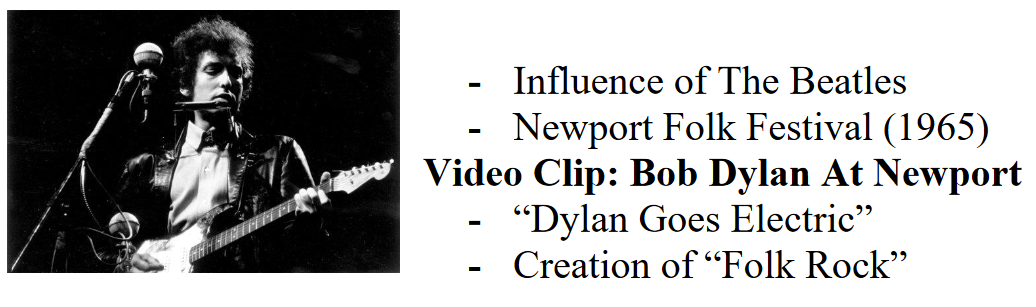
<h3 id="bob-dylan-and-folk-rock">Bob Dylan and Folk Rock</h3>

<p><img src="/images/music140/Pasted image 20230718203233.png" alt="" /></p>

<p>The Beatles called Bob Dylan the best songwriter of the time—they influenced each other. During the <em>Newport Folk Festival (1965)</em>, Dylan played Rock ‘n’ Roll with electric guitar. Audiences hated the electric guitar but more importantly the <em>Rock ‘n’ Roll that seemed inauthentic</em> to them. Pete Seeger covered his ears. This event became known as “Dylan Goes Electric.”</p>

<p><a href="https://www.youtube.com/watch?v=G8yU8wk67gY">Watch the performance</a></p>

<p>Dylan fused meaningful lyrics with Rock ‘n’ Roll sound, creating “<em>Folk Rock</em>.” He lost folk fans but gained broader popularity.</p>

<h4 id="example-bob-dylan-like-a-rolling-stone-from-highway-61-revisited-1965">Example: Bob Dylan: “Like a Rolling Stone” (from Highway 61 Revisited, 1965)</h4>
<p><a href="https://learn.uwaterloo.ca/d2l/le/content/917723/viewContent/4949410/View">Listen here</a></p>

<p>Fusing folk’s lyrical depth with 60s pop and rock sounds. Reached #2 Billboard Hot 100 / #1 Cashbox Top 100.</p>

<p>Bob Dylan’s Folk Rock influenced the broader Counter Culture movement.</p>

<hr />

<h2 id="the-counter-culture-searching-for-alternatives">The Counter Culture: Searching for Alternatives</h2>

<p>In the late 1960s, the Counter Culture encompassed many movements. Essentially, it represented large numbers of young baby boomers seeking different life structures from their parents—looking to live experimentally rather than simply accumulating material possessions.</p>

<h3 id="influence-of-the-beats">Influence of The Beats</h3>

<p><img src="/images/music140/Pasted image 20230718204759.png" alt="" /></p>

<p>A group skeptical of the U.S. government, including notable figures <em>Jack Kerouac</em> and <em>Allen Ginsberg</em>. Called “The Beats” because:</p>

<ol>
  <li>Jazz was popular (Jazz Beat)</li>
  <li>Getting arrested or watched (“Beaten down”)</li>
  <li>They believed everything lacks free choice, requiring conspiracy theory awareness. To achieve true free will, you need to reach a higher mental state called “<em>Beatitude</em>”</li>
</ol>

<p>In the early 1960s, young people grew skeptical of government, organized religion, and their parents’ ideologies. The coolest, most fashionable people were called “<em>Hippies</em>.”</p>

<p><img src="/images/music140/Pasted image 20230718205505.png" alt="" /></p>

<p>Two main hippie centers: <em>Greenwich Village (New York)</em> and <em>Haight-Ashbury (San Francisco)</em>. Hippies valued <em>experience over material goods</em> and <em>community over individual</em>.</p>

<h3 id="focus-on-sensory-stimulation-psychedelic-experience">Focus on Sensory Stimulation: Psychedelic Experience</h3>

<p><img src="/images/music140/Pasted image 20230718205828.png" alt="" /></p>

<p>Abstract posters and clothing created “Psychedelic experiences.” Drugs were used to “experiment with new states of consciousness.”</p>

<p><img src="/images/music140/Pasted image 20230718210214.png" alt="" /></p>

<p><strong>Music for Hippies</strong>:</p>
<ul>
  <li><em>Loud</em>: Music appeals to hearing, but played loud enough, you physically feel it—appealing to two senses instead of one</li>
  <li>Concerts utilized theater lights for <em>lighting shows</em> alongside music, appealing to visual senses</li>
  <li><em>Longer or unusual song forms</em>: AABA and 12-bar blues were good but predictable; customized, longer structures created more surprises</li>
  <li><em>Jamming</em> (collective improvisation): Even more surprises, all aimed at reaching unusual, psychedelic, higher mental states</li>
</ul>

<h4 id="example-the-grateful-dead-truckin-1970">Example: The Grateful Dead: “Truckin’” (1970)</h4>
<p><a href="https://learn.uwaterloo.ca/d2l/le/content/917723/viewContent/4949411/View">Listen here</a></p>

<p><img src="/images/music140/Pasted image 20230718211109.png" alt="" /></p>

<p>Influenced by Bob Dylan. While they recorded albums, their concerts were different:</p>
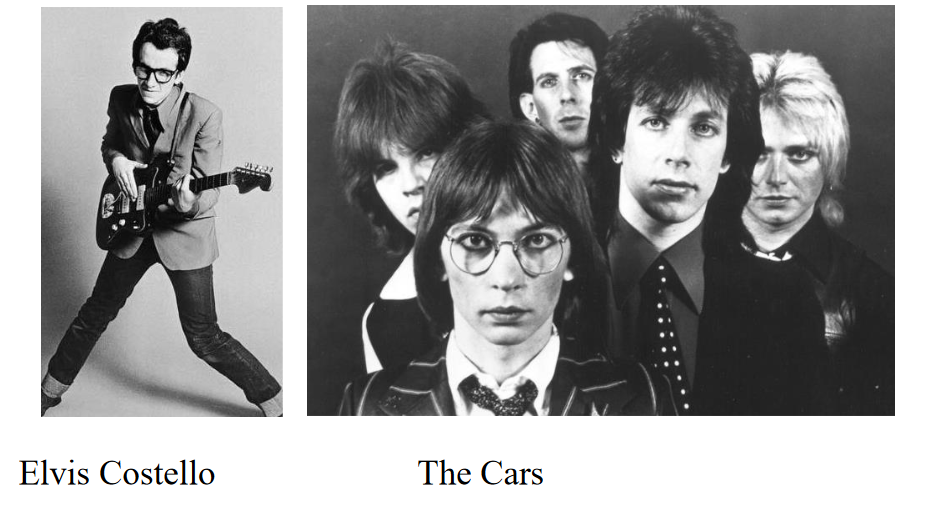
<ul>
  <li>No pre-planned setlists</li>
  <li>They’d play songs similar to album versions until the end, then continue <em>jamming</em> for extended periods to create psychedelic experiences</li>
  <li>Since every concert differed, fans called “<em>dead heads</em>” followed their tours, hearing the same songs played differently</li>
  <li>One 1972 concert extended 17 minutes after a song</li>
  <li>Loose arrangements typical of folk rock</li>
</ul>

<p>However, <em>Counter Culture wasn’t a music style</em>—counter culture people played all kinds of music. Apart from Folk Rock, others played Rock ‘n’ Roll influenced by The Beatles, calling their style:</p>

<h3 id="acid-rock--psychedelic-rock">Acid Rock / Psychedelic Rock</h3>

<p>“Acid” referred to the drug. The Beatles’ musical experimentation, particularly “Tomorrow Never Knows” (1966), influenced other artists.</p>

<h4 id="example-jefferson-airplane-white-rabbit-1967">Example: Jefferson Airplane: “White Rabbit” (1967)</h4>
<p><a href="https://learn.uwaterloo.ca/d2l/le/content/917723/viewContent/4949412/View">Listen here</a></p>

<p><img src="/images/music140/Pasted image 20230718212253.png" alt="" /></p>

<p>Counter Culture artists usually didn’t aim for big hits, preferring experience. However, this was a major hit. Though Counter Culture songs were usually long, this was relatively short.</p>

<p>The rhythm based on Spanish dance rhythm <em>Bolero</em>. Drug references filled the lyrics, which also related to <em>“Alice’s Adventures in Wonderland” (1865)</em> by Lewis Carroll. The Counter Culture believed reality was fake, requiring seeing the real world—similar to Alice entering wonderland through the rabbit hole. <em>The Matrix</em> also references Alice’s Adventures.</p>

<p><strong>Musical structure</strong>: Nothing conventional—structure followed volume increases. Started quiet, grew louder, ended at highest point. Like taking drugs, where effects start slow and gradually intensify.</p>

<p>The west coast counter culture peaked during the summer of 1967, remembered as the <a href="https://en.wikipedia.org/wiki/Summer_of_Love">Summer of Love</a>.</p>

<h3 id="political-awakening-from-inner-to-outer-focus">Political Awakening: From Inner to Outer Focus</h3>

<p>After 1967, Youth Culture became more outward-focused:</p>
<ul>
  <li>More politically active</li>
  <li>Focused on Civil Rights and Vietnam War Draft</li>
  <li>Increasingly skeptical of government</li>
</ul>

<p><img src="/images/music140/Pasted image 20230718214103.png" alt="" /></p>

<p>Youth International Party (Yippies) formed with leaders <em>Jerry Rubin</em> and <em>Abbie Hoffman</em>.</p>

<p><img src="/images/music140/Pasted image 20230725191316.png" alt="" /></p>

<p>Instead of Grateful Dead or Jefferson Airplane’s folk rock influence, music became more British blues influenced, called <em>Psychedelic Blues</em>. The definitive artist:</p>

<h3 id="jimi-hendrix-guitar-revolutionary">Jimi Hendrix: Guitar Revolutionary</h3>

<p>Technical virtuoso able to play smooth melodies with high distortion (full amplifier).</p>

<h4 id="example-jimi-hendrix-voodoo-child-slight-return-1967">Example: Jimi Hendrix: “Voodoo Child (Slight Return)” (1967)</h4>
<p><a href="https://learn.uwaterloo.ca/d2l/le/content/917723/viewContent/4949413/View">Listen here</a></p>

<ul>
  <li>Clear Blues influence—<em>not</em> 12-bar blues but a-a-b lyrics pattern</li>
  <li>Pioneered “<em>Wah-Wah</em> pedal”—ground device changing guitar tone as you pedal</li>
  <li><em>Whammy bar</em>—first rock player using it aggressively</li>
</ul>

<p><img src="/images/music140/Pasted image 20230725192842.png" alt="" /></p>

<p><a href="https://www.youtube.com/watch?v=zGM-pfvePu8&amp;list=PL-YqsfTWOq4lcjv8e9iV3TT76fR-weu4-&amp;index=13&amp;t=0s">Watch demonstration</a></p>

<p>Sliding it changes string tension, altering pitch.</p>

<hr />

<h2 id="woodstock-and-altamont-the-rise-and-fall-of-idealism">Woodstock and Altamont: The Rise and Fall of Idealism</h2>

<h3 id="woodstock-august-1969">Woodstock (August 1969)</h3>

<p><img src="/images/music140/Pasted image 20230725193202.png" alt="" /></p>

<p>A counter culture concert on a working farm. Overwhelming attendance could have been disastrous due to lack of organization and potential stampedes. However, it triumphed because <em>counter culture valued community over individual</em>—everyone helped each other stay calm and safe (except 1 death).</p>

<p>This massive success proved counter culture could work, making people believe it could change the world.</p>

<p><strong>Video Example</strong>: Country Joe performing Vietnam protest song, <a href="https://www.youtube.com/watch?v=eRl6-bHlz-4">“I Feel Like I’m Fixin’ To Die Rag”</a></p>

<h3 id="altamont-california-december-1969">Altamont, California (December 1969)</h3>

<p><img src="/images/music140/Pasted image 20230725194102.png" alt="" /></p>

<p>The Rolling Stones, having declined Woodstock, wanted their own version after its success. Two crucial differences from Woodstock:</p>

<ul>
  <li><strong>Space</strong>: Woodstock expanded across farm fields; Altamont was enclosed stadium with crowded, anxious conditions</li>
  <li><strong>Security</strong>: Rolling Stones, embracing their “bad boy” image, hired <em>Hell’s Angels</em> motorcycle gang, paying them with beer</li>
</ul>

<p>Hell’s Angels carried weapons, beat people, and killed someone. Since Rolling Stones wanted to record like Woodstock, they captured a Hell’s Angel murdering someone on camera.</p>

<p>This created horrible imagery for counter culture. Youth who believed counter culture could change the world were devastated.</p>

<hr />

<p><strong>April 1970</strong>: Paul McCartney leaves The Beatles—they break up.</p>

<h3 id="kent-state-ohio-may-1970">Kent State, Ohio: May 1970</h3>

<p><img src="/images/music140/Pasted image 20230725195219.png" alt="" />
<img src="/images/music140/Pasted image 20230725195227.png" alt="" /></p>

<p>Young people protested the Vietnam War, believing they shouldn’t fight. At Kent State University protest:</p>
<ul>
  <li>First day: peaceful protest</li>
  <li>Second day: vandalism started, National Guard arrived and opened fire on students—some injured, some died, including non-protesters</li>
</ul>

<p>Counter culture cooled down. Youth realized counter culture ideals couldn’t change the world.</p>
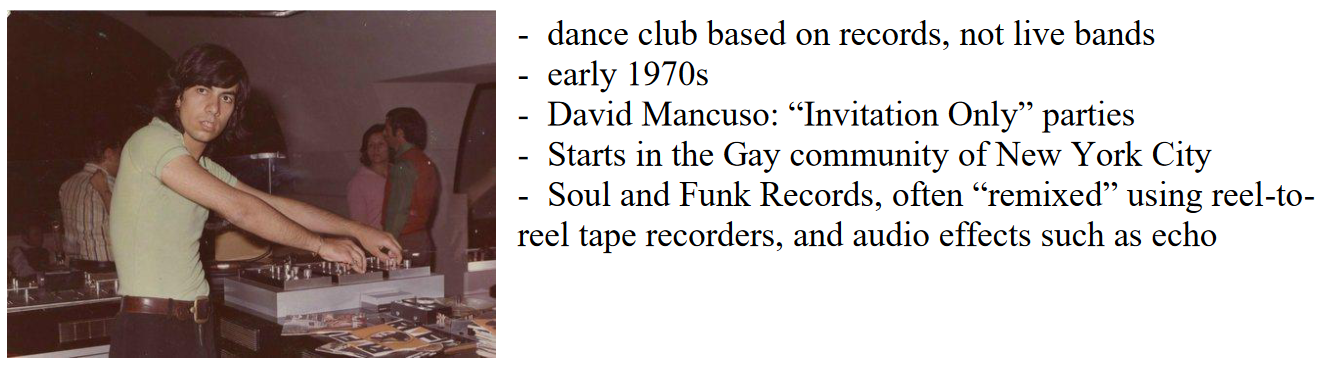
<p>Song about this: <a href="https://www.youtube.com/watch?v=JCS-g3HwXdc">Crosby, Stills, Nash, and Young: “Ohio” (1970)</a></p>

<p><strong>September 1970</strong>: Jimi Hendrix dies<br />
<strong>October 1970</strong>: Janis Joplin dies of drug overdose<br />
<strong>July 1971</strong>: Jim Morrison (The Doors) dies</p>

<hr />

<h2 id="the-1970s-cynicism-and-diversification">The 1970s: Cynicism and Diversification</h2>

<p>Counter-Culture’s failure initiated a shift toward more cynical (愤世嫉俗) worldview. Many young people no longer believed they could change the world or in counter-culture ideals (community over individual).</p>
<p>This cynicism was reinforced by:</p>

<h3 id="the-energy-crisis-1973-1974">The Energy Crisis (1973-1974)</h3>

<p><img src="/images/music140/Pasted image 20230725200107.png" alt="" /></p>

<p><em>Yom Kippur War (October 1973)</em>: Israel fought countries supplying U.S. oil; U.S. supported Israel, lost oil access. The Energy Crisis marked the first economic recession since WWII’s end.</p>

<h3 id="watergate">Watergate</h3>

<p><img src="/images/music140/Pasted image 20230725200441.png" alt="" /></p>

<p>Facing criminal charges and impeachment, President <em>Richard Nixon resigned (August 1974)</em>.</p>

<h3 id="vietnam-the-fall-of-saigon-april-30-1975">Vietnam: The Fall of Saigon (April 30, 1975)</h3>

<p><img src="/images/music140/Pasted image 20230725200950.png" alt="" /></p>

<p>The U.S. lost the Vietnam War. U.S. and non-communist Vietnamese troops trapped in Saigon had 24 hours to escape via helicopters.</p>

<h3 id="musical-evolution-in-the-1970s">Musical Evolution in the 1970s</h3>

<p><strong>For Soul Music</strong>:
<img src="/images/music140/Pasted image 20230725201202.png" alt="" /></p>

<p>Motown and Stax lost popularity. Soul developed the “Philadelphia” sound with bands like <em>The O’Jays</em>. <em>“Love Train” (Gamble/Huff) 1972</em> reached #1 R&amp;B, #1 Billboard Hot 100.</p>

<p><strong>For Funk Music</strong>:
<img src="/images/music140/Pasted image 20230725201402.png" alt="" /></p>

<p>The 70s marked funk’s peak. Funk became popular with more white audiences. Artists: <em>Sly and the Family Stone</em>, <em>George Clinton: Parliament Funkadelic</em>. <em>“Up For The Down Stroke” (1974)</em></p>

<p><strong>Pop developed singer/songwriter cycles</strong>:
<img src="/images/music140/Pasted image 20230725201914.png" alt="" /></p>

<p><em>“It’s Too Late” (King/Stern, 1971)</em> reached #1 Billboard Top 100, #1 Adult Contemporary. Boomers now in late 20s or 30s still listened to pop, meaning pop audiences included many “adults,” not only teenagers—evident in the new “Adult Contemporary” chart.</p>

<p><strong>Album sales reached new levels</strong>:
<img src="/images/music140/Pasted image 20230725202242.png" alt="" /></p>

<ul>
  <li><em>The Eagles’ “Hotel California” (1977)</em>: 44 million sold by 2021</li>
  <li><em>Fleetwood Mac’s “Rumours” (1977)</em>: 40 million sold by 2021</li>
</ul>

<hr />

<h2 id="hard-rock--heavy-metal-individualism-rising">Hard Rock / Heavy Metal: Individualism Rising</h2>

<p>We view Hard Rock and Heavy Metal as two ends of the same spectrum—some songs closer to Hard Rock, others to Heavy Metal.</p>

<h3 id="shift-to-the-hippie-aesthetic">Shift to the “Hippie Aesthetic”</h3>

<p>Started by The Beatles’ <em>Sgt. Pepper’s</em>, marking the shift from “Rock ‘n’ Roll” to “Rock”:</p>
<ul>
  <li>Singles to albums</li>
  <li>Dancing to listening</li>
  <li>Entertainers to “serious” musicians</li>
</ul>

<p>Sound developed from Psychedelic Blues/British Blues Revival. Largely a response to Counter-Culture’s failure. While counter-culture philosophy focused on collective advantages, Kent State shootings shifted focus toward the individual.</p>

<h3 id="distinctions-between-hard-rock-and-heavy-metal">Distinctions between Hard Rock and Heavy Metal</h3>

<p><strong>1) Distortion</strong>:</p>
<ul>
  <li><strong>Hard Rock</strong>: Less distortion, individual notes still clear and rich</li>
  <li><strong>Heavy Metal</strong>: More intense distortion, hard to distinguish individual notes</li>
  <li>Hard rock vocalists may have raspy voices (slight distortion)</li>
  <li>Heavy metal vocalists deliberately distort sound so much they’re jokingly called “cookie monster vocals.” <a href="https://www.youtube.com/watch?v=kYNmGHhIJ8k">Example</a></li>
</ul>

<p><strong>2) Tempo</strong>:</p>
<ul>
  <li><strong>Hard Rock</strong>: Generally mid-tempo, not too fast/slow</li>
  <li><strong>Heavy Metal</strong>: Extreme tempos more common (extremely fast or slow), also tempo changes</li>
</ul>

<p><strong>3) Blues-European Classical Influences</strong>:</p>
<ul>
  <li><strong>Hard Rock</strong>: Black and R&amp;B influence</li>
  <li><strong>Heavy Metal</strong>: European Classical music influence
    <ul>
      <li>Heavy metal artists often practice classical to master techniques for extreme speeds</li>
      <li><a href="https://www.youtube.com/watch?v=L9r-NxuYszg">Example</a> (3:50)</li>
    </ul>
  </li>
</ul>

<p><strong>4) Lyrics</strong>:</p>
<ul>
  <li><strong>Hard Rock</strong>: Chuck Berry style—girls, cars, no school</li>
  <li><strong>Heavy Metal</strong>: Fantasy elements, religion, war, psychological unstable states (helplessness, paranoia, insanity)</li>
</ul>

<h3 id="exemplars">Exemplars</h3>

<h4 id="acdc-hard-rock">AC/DC (Hard Rock)</h4>
<p><img src="/images/music140/Pasted image 20230725210122.png" alt="" /></p>

<p>Australian, formed 1973. Album <em>“Back in Black” (1980)</em> sold over 50 million copies—2nd highest album sales in history. Strong blues influence, riff-based, steady tempos, rock ‘n’ roll lyrics.</p>

<p><a href="https://www.youtube.com/watch?v=gEPmA3USJdI">Example</a></p>

<h4 id="metallica-heavy-metal">Metallica (Heavy Metal)</h4>
<p><img src="/images/music140/Pasted image 20230725210801.png" alt="" /></p>

<p>Los Angeles, formed 1981. Musically highly technical with frequent tempo changes, instrumental sections, classical influences, virtuosic soloing, heavy distortion, lyrics expressing alienation and loss of control.</p>

<p><a href="https://www.youtube.com/watch?v=2f1Ny74_ou0">Example</a></p>

<h3 id="founding-heavy-metal-bands">Founding Heavy Metal Bands</h3>

<p>1) Black Sabbath<br />
2) Deep Purple<br />
3) Led Zeppelin</p>

<h4 id="black-sabbath">Black Sabbath</h4>
<p><img src="/images/music140/Pasted image 20230725211551.png" alt="" /></p>

<p>British band. Lead singer Ozzy Osbourne explained: American counter culture didn’t happen in England. England’s economy was far worse than the U.S., and counter culture didn’t make sense to British youth. Instead of following U.S. counter culture trends, they created “<em>doomy music</em>” they felt more closely.</p>

<p>Focused on loss of control, madness, paranoia, and war elements.</p>

<p><strong>Example</strong>: <em>“War Pigs”</em> (<em>1970</em>—from album <em>Paranoid</em>)
<img src="/images/music140/Pasted image 20230725212117.png" alt="" /></p>

<p>Tempo changes, instrumental sections, lyrics focused on alienation and war futility. These elements lean heavy metal, but lower distortion in Ozzy’s voice with nasal sound leans toward hard rock.</p>

<h4 id="deep-purple">Deep Purple</h4>
<p><img src="/images/music140/Pasted image 20230725212834.png" alt="" /></p>

<p>Also British. <em>Jon Lord</em>, keyboard (electric organ) player, plugged electric organ into big guitar amplifiers for distortion—very few instruments sound good after amplification. Knowing piano meant proper music education, unlike guitars. Jon Lord brought classical music theory and history to hard rock and heavy metal.</p>

<p><strong>Example</strong>: <em>“Highway Star”</em> (<em>1972</em>—from album <em>Machine Head</em>)
<img src="/images/music140/Pasted image 20230725213041.png" alt="" /></p>

<p>No tempo changes and Chuck Berry-style lyrics make it closer to hard rock. Virtuosic vocal performance during introduction, electric organ use (Jon Lord), classical influences in musicianship and solo approaches (Jon Lord referenced classical pieces).</p>

<p>Jon Lord even composed pieces for both rock band and orchestra that were quite successful.
<img src="/images/music140/Pasted image 20230725214114.png" alt="" /></p>

<h4 id="led-zeppelin">Led Zeppelin</h4>
<p><img src="/images/music140/Pasted image 20230725214132.png" alt="" /></p>

<p>British, grew out of <em>The Yardbirds</em> (second to Rolling Stones in British Blues Revival). Lead guitarist Jimmy Page brought significant blues influence plus strong acoustic/Celtic influence. Virtuosic musicianship and recording studio mastery.</p>

<p>No interest in “editing” for singles—had a 6-minute hit; when radio stations asked for shorter version promising money, they refused. Eventually radio played it anyway.</p>

<p><strong>Example</strong>: <em>“Whole Lotta Love”</em> (<em>1969</em>—from album <em>Led Zeppelin II</em>)
<img src="/images/music140/Pasted image 20230725214519.png" alt="" /></p>

<p>Blues riff-based, closer to Hard Rock. Sued by <em>Willie Dixon</em> of Chess Records (“You Need Love” 1962—performed by Muddy Waters) for similarity—Dixon won and was listed as co-songwriter. Middle section was very “psychedelic,” Counter-culture influenced.</p>

<h3 id="cultural-shifts-from-collective-to-individual">Cultural Shifts: From Collective to Individual</h3>

<p>Hard Rock and Heavy Metal bands moved away from counter-culture’s “collective ideal” toward individual focus. Indicators:</p>

<p><strong>Band Names</strong>:</p>
<ul>
  <li>1960s: <em>The</em> Beatles, <em>The</em> Beach Boys—generally starting with “the,” mostly plural</li>
  <li>1970s: Deep Purple—”the” disappeared, names became singular</li>
</ul>

<p>Bands became closer to corporations.</p>

<p><strong>Logos</strong>:</p>
<ul>
  <li>1960s: Albums featured band names printed differently each time</li>
  <li>1970s: Albums featured fixed band name styles, like corporate logos</li>
</ul>

<p>Again, closer to corporations. The 1970s also featured many more solos where individual players showcased their skills.</p>

<h3 id="legacy-and-transformation">Legacy and Transformation</h3>

<p>The journey from Folk Revival through Counter Culture to Hard Rock/Heavy Metal represents more than musical evolution—it chronicles America’s social and political transformation. From the optimistic belief that music could change the world to the cynical realization that individual expression might be more powerful than collective action, these genres provided the soundtrack for a generation learning to navigate disillusionment while finding new forms of artistic and personal authenticity.</p>

<h3 id="punk-bringing-music-back-to-the-people">Punk: Bringing Music Back to the People</h3>

<p>By the mid-1960s, led by The Beatles’ experimental explorations, some people felt pop musicians were getting too distant from their audiences. Punk emerged as a new style from artists believing pop musicians should stay as close to their audience as possible.</p>

<p><strong>Origins</strong>: <em>New York City</em></p>

<p>First notable figures: <em>Lou Reed</em> and <em>John Cale</em>. In <em>1967</em>, they formed <em>Velvet Underground</em>.</p>

<p><img src="/images/music140/Pasted image 20230801193541.png" alt="" /></p>

<h4 id="example-the-velvet-underground-heroin-1967from-the-album-the-velvet-underground-and-nico">Example: The Velvet Underground: “Heroin” (1967—From the album “The Velvet Underground and Nico”)</h4>
<p><a href="https://learn.uwaterloo.ca/d2l/le/content/917723/viewContent/4949417/View">Listen here</a></p>

<ul>
  <li>Rejection of traditional approaches to instruments and songwriting</li>
  <li>Deliberately made musically simple and understandable to audiences</li>
  <li>Lyrics about real life (drug abuse) instead of abstract concepts</li>
</ul>

<p>Punk rejected the Hippie Aesthetic and later opposed Hard Rock/Heavy Metal for being abstract and distant from audiences.</p>

<p>By early 1970s, many other Punk artists emerged. New York City’s punk center was a club called <mark style="background: #D2B3FFA6;">CBGBs</mark> (Country, Blue Grass and Blues):</p>

<p><img src="/images/music140/Pasted image 20230801194223.png" alt="" /></p>

<p>Punk artists performing at CBGB included: <mark style="background: #ABF7F7A6;">The Talking Heads</mark>, <mark style="background: #ABF7F7A6;">Blondie</mark></p>

<p><img src="/images/music140/Pasted image 20230801194318.png" alt="" /></p>

<p>They all had different styles but used simpler approaches to music.</p>

<h4 id="the-ramones">The Ramones</h4>
<p><img src="/images/music140/Pasted image 20230801194426.png" alt="" /></p>

<p>Another CBGB band featuring:</p>

<ul>
  <li><strong>Do It Yourself (DIY) Culture</strong>: Made everything themselves, nothing complex</li>
  <li>Encouraged people that “everyone can make a band” due to simplicity</li>
  <li>Simple chord progressions</li>
  <li>No solos because that’s “showing off”</li>
  <li>Heavy early Rock ‘n’ Roll influence</li>
  <li>Great success in England</li>
</ul>

<p><em>“I Wanna Be Sedated” (The Ramones—1978)</em></p>

<h4 id="malcolm-mclaren-punk-entrepreneur">Malcolm McLaren: Punk Entrepreneur</h4>
<p><img src="/images/music140/Pasted image 20230801195143.png" alt="" /></p>

<p>Manager/entrepreneur who spent time in NYC, becoming familiar with American punk. He realized many teenagers liked DIY culture (example: DIY magazines cutting letters from other publications and pasting them together).</p>

<p>Having experience with American punk, he wanted to bring punk culture to England. When he met kids stealing band equipment who couldn’t sell it due to serial numbers, he asked them: “Why don’t you guys make a band? Everyone can make a band now with DIY.” This band became:</p>

<h4 id="the-sex-pistols">The Sex Pistols</h4>
<p><img src="/images/music140/Pasted image 20230801195813.png" alt="" /></p>

<p>Directed by McLaren to be purposefully controversial.</p>

<p><strong>Example</strong>: “God Save The Queen” (June 1977)
<a href="https://www.youtube.com/watch?v=MKbQHoT_Nmg">Watch here</a></p>

<p>Released June 1977, an important day for Queen Elizabeth, but the song mocked the Queen. So controversial that newspapers wouldn’t print the song’s name, even though it was #1:</p>

<p><img src="/images/music140/Pasted image 20230801200127.png" alt="" /></p>

<p>The Sex Pistols became stars but broke down shortly because stardom contradicted punk’s idea of staying close to audiences.</p>

<h3 id="punk-characteristics">Punk Characteristics</h3>

<ul>
  <li>Involved political commentary on social classes (from the poor)</li>
  <li>Because of economic recession, British punk focused far more on social and economic issues than American punk</li>
  <li>Opposed Hard Rock/Heavy Metal and Hippie Aesthetic:
    <ul>
      <li>Simplified songwriting—”stripped down”</li>
      <li>No solos</li>
      <li>No real division between audience and artist</li>
    </ul>
  </li>
</ul>

<h4 id="new-wave">New Wave</h4>
<p><img src="/images/music140/Pasted image 20230801200955.png" alt="" /></p>

<p>By late 1970s, new wave punk kept the musical style but was less controversial, balancing success with punk ideals. Some new wave punk artists: <em>Elvis Costello</em>, <em>The Cars</em>.</p>

<hr />

<h2 id="disco-everyones-a-star">Disco: Everyone’s a Star</h2>

<p><img src="/images/music140/Pasted image 20230801201107.png" alt="" /></p>

<p>Most clubs started having live bands instead of playing records by early 1970s. Since being gay was still largely illegal, gays needed “invitation only” parties to dance to records.</p>

<p><mark style="background: #FFB8EBA6;">David Mancuso</mark> was a famous DJ who started in gay parties in New York City:</p>
<ul>
  <li>Played Soul and Funk records</li>
  <li>Instead of just playing songs, he “remixed” with audio effects, chaining/editing designed song lists using reel tape recorders</li>
  <li>Faded music in and out, transitioning between songs while keeping constant beat</li>
</ul>

<p>Popularity grew through mid-1970s. By 1972, Disco became a musical genre. Record companies realized records were being played specially at discos, so they made music intended for DJ use. These recordings often had similar tempos and beats to help seamless transitions.</p>

<p><strong>Example</strong>: <em>The O’Jays: “Love Train” (1973)</em>
<img src="/images/music140/Pasted image 20230801201944.png" alt="" /></p>

<p>Though still considered 1970s soul music, it revealed Disco characteristics:</p>
<ul>
  <li>Complex arrangement like Soul, but very basic beat—good for DJ fading</li>
  <li>120 bpm because club songs were around that speed, so DJs could remix easily</li>
  <li>Clean production with no distortion</li>
</ul>

<h4 id="example-the-village-people-macho-man-1978">Example: The Village People: “Macho Man” (1978)</h4>
<p><a href="https://learn.uwaterloo.ca/d2l/le/content/917723/viewContent/4949420/View">Listen here</a></p>

<p><img src="/images/music140/Pasted image 20230801202333.png" alt="" /></p>

<p>Excellent example of disco recording at popularity’s peak:</p>
<ul>
  <li>130 bpm tempo—high-energy even by disco standards</li>
  <li>Complex arrangement but simple beat for DJs</li>
  <li>Clean production</li>
</ul>

<p><img src="/images/music140/Pasted image 20230801203302.png" alt="" /></p>

<p><strong>Disco as response to Stadium Rock and Hippie Aesthetic</strong>:</p>
<ul>
  <li>Attention to fashion—needed to dress up for discos</li>
  <li>Dance floor as stage where everyone was the star</li>
</ul>

<p>Stadium Rock (Hard Rock/Heavy Metal) symbolized heterosexuality. Women and gays felt excluded, so they created Disco.</p>

<p>Punk artists rejected Stadium Rock and completely rejected star concepts. Disco also disliked Stadium Rock but <em>completely embraced star ideas</em>—everyone could be the star.</p>

<h4 id="example-chic-le-freak-1978">Example: Chic: “Le Freak” (1978)</h4>
<p><img src="/images/music140/Pasted image 20230801203345.png" alt="" /></p>

<p>No solos but featured “dance breaks” where music became sparse, designed for collective dancing.</p>

<p><img src="/images/music140/Pasted image 20230801203735.png" alt="" /></p>

<p>Disco’s popularity grew through mid-1970s, peaking in <em>1977</em> with “Saturday Night Fever” film.</p>

<p><img src="/images/music140/Pasted image 20230801203844.png" alt="" /></p>

<h3 id="rock-backlash">Rock Backlash</h3>

<p>People started hating Disco by end of 1979, especially Rock fans.</p>

<p><strong>July 12th, 1979</strong>: Comiskey Park, Chicago—”Disco Demolition Night”. Between two baseball games, bringing a disco record to destroy earned cheap tickets.</p>

<p>Was it racism? No, Rock fans also listened to black music.
Was it homophobia? No, not many people knew disco originated from gays.
Maybe: Disco wanted to strip away big stars and focus on dance. However, rock fans following Hippie Aesthetic wanted focus on music—an opposition of values.</p>

<h3 id="did-disco-die">Did Disco Die?</h3>

<h4 id="frankie-knuckles">Frankie Knuckles</h4>
<p><img src="/images/music140/Pasted image 20230801204620.png" alt="" /></p>

<p>A Disco DJ moved to Chicago in 1977:</p>
<ul>
  <li>Played records at club called “The Warehouse”</li>
  <li>Remixed funk and disco songs as usual, but someone gave him a <mark style="background: #FFB8EBA6;">drum machine</mark>—hitting buttons produced drum sounds</li>
  <li>This new Disco with additional drum beats became popular</li>
  <li>People called it “music from The Warehouse” → “Warehouse music” → “<mark style="background: #FFB8EBA6;">House music</mark>”</li>
</ul>

<hr />

<h2 id="hip-hop-from-the-bronx-to-the-world">Hip Hop: From the Bronx to the World</h2>

<p>Started in <em>South Bronx, New York City</em> in the <em>1970s</em>. Once a decent neighborhood, it declined as civil rights riots became violent and middle-class people moved away. A highway built across Bronx in <em>1972</em> meant people no longer stopped to shop on streets. The neighborhood became very poor, but young people still wanted fun:</p>

<ul>
  <li><strong>Break Dancing</strong>: Dancing on cardboard doing difficult moves</li>
  <li><strong>Graffiti Art</strong>: Mostly on subways for maximum visibility</li>
  <li><strong>Rap</strong>: One person on turntables, another rapping</li>
</ul>

<p><img src="/images/music140/Pasted image 20230801210824.png" alt="" /></p>

<h3 id="precursors-of-rap">Precursors of Rap</h3>

<h4 id="signifying--the-dozens">Signifying / The Dozens</h4>
<p>Oral game of creatively insulting each other in turns (example: end of <em>8 Mile</em> with Eminem). African origin.</p>

<p><strong>Example</strong>: “Signifyin’ Monkey” (early 1960s)</p>

<h4 id="jamaican-toasting">Jamaican Toasting</h4>
<p><img src="/images/music140/Pasted image 20230801211139.png" alt="" /></p>

<p>Jamaica was too poor for most people to afford records. DJs were crucial for music access. These DJs were called “<mark style="background: #D2B3FFA6;">Sound system men</mark>,” playing records during “yard dances” (parties).</p>

<ul>
  <li>Sound system men competed; having exclusive records drew everyone to your yard dance</li>
  <li>They produced original songs since nobody else had their records</li>
  <li>Some records had A-side as regular song, B-side with only beat—they’d improvise about their skills, like playing The Dozens</li>
  <li>“Toasting” meant celebrating, so improvising about their abilities was called “toasting”</li>
</ul>

<h3 id="prehistory">Prehistory</h3>

<p>Once Jamaica declared independence, Jamaican immigrants came to the U.S. Being poor, they went to poor places like <mark style="background: #D2B3FFA6;">South Bronx</mark>.</p>

<h4 id="1973-kool-herc">1973: Kool Herc</h4>
<p><img src="/images/music140/Pasted image 20230801213004.png" alt="" /></p>

<p>First to bring Jamaican yard dance to Bronx:</p>
<ul>
  <li>Used two turntables</li>
  <li>Extended exciting song moments—while one record played a good part, he’d cue the other to the good part, playing it when the first finished. He called this <mark style="background: #D2B3FFA6;">Merry-Go-Round</mark></li>
  <li>Called his remix “cutting and mixing”</li>
  <li>Did Jamaican toasting</li>
</ul>

<h4 id="1976-grand-master-flash">1976: Grand Master Flash</h4>
<p><img src="/images/music140/Pasted image 20230801214200.png" alt="" /></p>

<p>Developed Kool Herc’s techniques:</p>
<ul>
  <li>“<mark style="background: #D2B3FFA6;">Back-spinning</mark>” records to repeat short sections</li>
  <li>Worked very fast, calling it “quick mix”</li>
  <li>Since he was heavily involved in DJ work, he couldn’t toast simultaneously and needed a separate toaster/rapper:</li>
</ul>

<h4 id="1976-grand-master-melle-mel">1976: Grand Master Melle Mel</h4>
<p><img src="/images/music140/Pasted image 20230801214642.png" alt="" /></p>

<p>Toaster/rapper for Grand Master Flash:</p>
<ul>
  <li>First to describe himself as “MC” (Master of Ceremonies)</li>
  <li>Did “full length” raps—practiced instead of improvising</li>
  <li>Wrote down raps, potentially the first hip-hop songwriter</li>
</ul>

<h4 id="1978-grand-wizard-theodore">1978: Grand Wizard Theodore</h4>
<p><img src="/images/music140/Pasted image 20230801214824.png" alt="" /></p>

<p>First person to do “scratching” on records. This <em>redefined turntables from consumer technology to production technology</em>.</p>

<h3 id="breaking-into-the-mainstream">Breaking into the Mainstream</h3>

<h4 id="example-rappers-delight-the-sugar-hill-gang-1979">Example: “Rapper’s Delight” (The Sugar Hill Gang, 1979)</h4>

<p>First recorded hip-hop hit song:</p>
<ul>
  <li>Released September 1979; #4 R&amp;B, #36 Pop</li>
  <li>Produced by <mark style="background: #FFB8EBA6;">Sylvia Robinson</mark>, minor soul star from 1960s and owner of local record label Sugar Hill Records, featuring 3 local rappers</li>
  <li>Based on beat from <em>“Good Times”</em> by Chic (<em>June 1979</em>, #1 Pop and R&amp;B)</li>
</ul>

<h4 id="august-1981-mtv-goes-on-air">August 1981: MTV Goes on Air</h4>
<p><img src="/images/music140/Pasted image 20230801215322.png" alt="" /></p>

<p>First 24-hour music-video station. Getting music video on MTV became mandatory for hit songs. MTV was run by white, middle-class Rock fans who didn’t really like hip-hop and black artists. Thus, <em>rap was excluded</em> from MTV until <em>1985-1986</em>:</p>

<h4 id="example-walk-this-way-run-dmcaerosmith-1986">Example: “Walk This Way” (Run DMC/Aerosmith, 1986)</h4>

<p>Aerosmith’s rock hit from 1977 with popular drum intro. Due to its catchy intro, it was one of the most popular song to rap on top. Run DMC collaborated with Aerosmith to “revive” the song, when Aerosmith was starting to lose popularity.</p>

<p>This collaboration was really the hit that broke the wall between rock and hip-hop; in fact, this is literally embodied in the music video. More importantly, this was the hit that opened MTV’s doors to hip-hop.
<a href="https://www.youtube.com/watch?v=4B_UYYPb-Gk">Watch here</a></p>

<hr />

<p>Despites being a 2-hour read, this document is still, at very best, a “radio-edit” of the modern history of pop music; many crucial genres, transformative artists, and personal favorites couldn’t find space here. To name a few, consider Michael Jackson’s revolutionary evolution with the MTV, the solo journeys of The Beatles after their breakup (I particularly love George), and the emerging scene of progressive rock (King Crimson, Pink Floyd, Yes) who were perhaps too ahead of their time. Remember too that this narrative concludes in the 1980s; this is a biography of technology that ends with the invention of the fax machine.</p>

<p>What emerges from this musical odyssey is a profound truth: popular music has never been merely entertainment, but rather an archive of human experience, social transformation, and cultural collision. From the African retentions that survived the horrors of slavery to become the rhythmic foundation of modern pop, from the assembly-line efficiency of Tin Pan Alley to the rebellious authenticity of punk, each movement we’ve explored represents one’s desire to create meaning through sound. The story of pop music is the story of us: the tension between tradition and innovation, between the hunger for unity and the celebration of difference. <strong>The beat goes on</strong>, and with it, the eternal human need to move, to feel, and to dream across all the boundaries that might otherwise divide us.</p>]]></content><author><name>Zijian Chen</name><email>s42chen@uwaterloo.ca</email></author><category term="music" /><category term="notes" /><summary type="html"><![CDATA[]]></summary></entry></feed>